
Catalogue Search | MBRL


Are you sure you want to remove the book from the shelf?

{{itemTitle}}
262
result(s) for
"GREGOIRE, Jacques"
Sort by:

The Profile of Emotional Competence (PEC): Development and Validation of a Self-Reported Measure that Fits Dimensions of Emotional Competence Theory
Emotional Competence (EC), which refers to individual differences in the identification, understanding, expression, regulation and use of one's own emotions and those of others, has been found to be an important predictor of individuals' adaptation to their environment. Higher EC is associated with greater happiness, better mental and physical health, more satisfying social and marital relationships and greater occupational success. While it is well-known that EC (as a whole) predicts a number of important outcomes, it is unclear so far which specific competency(ies) participate(s) in a given outcome. This is because no measure of EC distinctly measures each of the five core emotional competences, separately for one's own and others' emotions. This lack of information is problematic both theoretically (we do not understand the processes at stake) and practically (we cannot develop customized interventions). This paper aims to address this issue. We developed and validated in four steps a complete (albeit short: 50 items) self-reported measure of EC: the Profile of Emotional Competence. Analyses performed on a representative sample of 5676 subjects revealed promising psychometric properties. The internal consistency of scales and subscales alike was satisfying, factorial structure was as expected, and concurrent/discriminant validity was good.
Journal Article

Intellectual Differences Between Boys and Girls, 35 Years of Evolution in France from WISC-R to WISC-V
The French adaptation of the Wechsler Intelligence Scale of Children, 5th edition (WISC-V) was an opportunity to examine if some common representations of gender differences in intellectual abilities are supported by empirical evidence. The WISC-V standardization sample provided data on a wide range of cognitive tests in a large sample of 6- to 16-year-old children representative of the French population. This sample included 517 boys and 532 girls. The WISC-V data were compared to those of the French standardization samples of three previous versions of the WISC (WISC-R, WISC-III, and WISC-IV). These four standardization samples span a 35-year period. The data analysis of the WISC-V standardization sample and the three previous versions of this intelligence scale showed that the performance gaps on intellectual tests between girls and boys have gradually narrowed over time. Almost no gender differences were observed in the WISC-V standardization sample, not only in IQ but also in key facets of intelligence. Data do not support the stereotype that girls are better at verbal tasks and boys are better at visuospatial tasks. However, some statistically significant differences remain, but the magnitude was generally small with no practical implications. The only important difference is in favor of girls and concerns performance on processing speed tasks that require visual discrimination, attentional control, and writing.
Journal Article

Understanding Creativity in Mathematics for Improving Mathematical Education
Mathematical creativity is rooted in the intellectual abilities and personality traits of each individual, in which the direct influence of education is only moderate. However, education could have more influence on three important components of creativity: expertise, original thinking, and intrinsic motivation, which underlie individual creative potential. At school, the development of the students' creative potential should start from the teachers' mathematical education. Only expert and creative teachers can provide the appropriate environment for developing students' creativity. To develop their original thinking, students should have the opportunity to work with ill-posed and open-ended problems, to go wrong and make mistakes, and to find different solutions to the same problems. Through these experiences, associated with positive emotions, students should develop an intrinsic motivation for creativity in mathematics.
Journal Article

L'examen clinique de l'intelligence de l'enfant
Les échelles de Wechsler sont aujourd’hui les tests d’intelligence les plus largement utilisés par les psychologues français, en particulier dans leur version pour enfants et adolescents. L’auteur a été le premier à proposer en français un ouvrage de base consacré à cette version du test, rapidement devenu une référence utilisée par les formateurs et les praticiens. Après le WISC-R en 1992, le WISC-III en 2000, l’auteur a présenté en 2006 le WISC-IV et proposé une méthode scientifiquement solide d’interprétation des résultats à ce test.
Cette méthode est aujourd’hui enseignée dans de nombreuses universités françaises. Trois ans plus tard, une mise à jour s’imposait : cette deuxième édition revue et complétée des Fondements et pratiques du WISC-IV présente les informations nouvelles qui permettent de mieux tirer profit d’un instrument dont la richesse clinique se révèle au fil de son utilisation. Date de première édition : 2006.
eBook
The Processing of Symbolic and Nonsymbolic Ratios in School-Age Children
This study tested the processing of ratios of natural numbers in school-age children. Nine- and eleven-year-olds were presented collections made up of orange and grey dots (i.e., nonsymbolic format) and fractions (i.e., symbolic format). They were asked to estimate ratios between the number of orange dots and the total number of dots and fractions by producing an equivalent ratio of surface areas (filling up a virtual glass). First, we tested whether symbolic notation of ratios affects their processing by directly comparing performance on fractions with that on dot sets. Second, we investigated whether children's estimates of nonsymbolic ratios of natural numbers relied at least in part on ratios of surface areas by contrasting a condition in which the ratio of surface areas occupied by dots covaried with the ratio of natural numbers and a condition in which this ratio of surface areas was kept constant across ratios of natural numbers. The results showed that symbolic notation did not really have a negative impact on performance among 9-year-olds, while it led to more accurate estimates in 11-year-olds. Furthermore, in dot conditions, children's estimates increased consistently with ratios between the number of orange dots and the total number of dots even when the ratio of surface areas was kept constant but were less accurate in that condition than when the ratio of surface areas covaried with the ratio of natural numbers. In summary, these results indicate that mental magnitude representation is more accurate when it is activated from symbolic ratios in children as young as 11 years old and that school-age children rely at least in part on ratios of surface areas to process nonsymbolic ratios of natural numbers when given the opportunity to do so.
Journal Article

The innate schema of natural numbers does not explain historical, cultural, and developmental differences
Rips et al.'s proposition cannot account for the facts that (1) a historical look at the word number systems suggests that the concept of natural numbers has been progressively elaborated; (2) people from cultures without an elaborate counting system do not master the concept of natural numbers; (3) children take time to master natural numbers; and (4) the competing advantage of the postulated math schema in the natural selection process is not obvious.
Journal Article

Lead Me Not into Temptation: Using Cognitive Reappraisal to Reduce Goal Inconsistent Behavior
Temptations besiege us, and we must resist their appeal if we are to achieve our long-term goals. In two studies, we tested the hypothesis that cognitive reappraisal could be used to successfully maintain performance in a task embedded in temptation. In Study 1, 62 participants had to search for information on the Internet while resisting attractive task-irrelevant content on preselected sites. In Study 2, 58 participants had to count target words in a funny TV sequence. Compared to the no-reappraisal condition, participants who understood the situation as a test of willpower (the reappraisal condition) (1) performed better at the task (Studies 1 and 2), and (2) were less tempted by the attractive content of the TV sequence (Study 2). These findings suggest that, by making the temptation less attractive and the task more appealing, cognitive reappraisal can help us resist temptation.
Journal Article
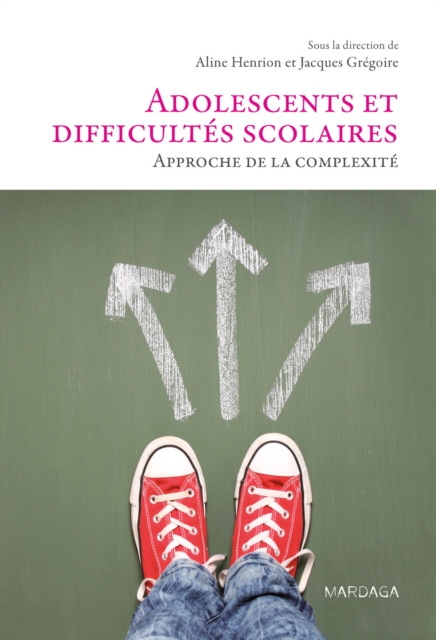
Adolescents et difficultés scolaires
Cet ouvrage a pour objectif d’ouvrir à la réflexion à propos des problématiques scolaires rencontrées à l’adolescence. Les auteurs ont souhaité mettre l’accent sur la complexité de la rencontre entre les adolescents et l’école – complexité, car une position unique ou une méthode à appliquer systématiquement n’est pas possible. Cet ouvrage propose une lecture multifocale qui permet d’aborder le sujet des difficultés scolaires à partir de différentes grilles de lecture qui se complètent et s’articulent et qui sont illustrées par des cas cliniques concrets. Le décrochage scolaire est considéré dans cet ouvrage comme un symptôme, une façon pour le jeune d’exprimer une ou des difficulté(s) qui se cristallise(nt) sur la question scolaire. Les auteurs s’intéressent en particulier aux jeunes qui ne présentent pas de troubles massifs des apprentissages, mais pour qui la scolarité devient, tout à coup ou progressivement, une pierre d’achoppement sur laquelle ils trébuchent. Les premiers chapitres développent une réflexion sur les effets de la rencontre entre les systèmes scolaire et familial, ainsi que sur les influences de l’évolution de notre société sur les problématiques scolaires. Les chapitres suivants proposent une approche centrée sur l’individu, le jeune. Ils font le point sur la question du diagnostic et des processus motivationnels, ainsi que sur les questions intrapsychiques rencontrées à l’adolescence. Vient ensuite une réflexion sur les médications et sur le sujet délicat de la consommation de cannabis. Les effets des troubles d’apprentissage et instrumentaux sur les difficultés scolaires sont également analysés. Dans le dernier chapitre, les auteurs s’intéressent à la place et à l’impact que peuvent avoir les enjeux familiaux sur les questions scolaires.
eBook