
Catalogue Search | MBRL


Are you sure you want to remove the book from the shelf?

{{itemTitle}}
34
result(s) for
"Galliera, Izabel"
Sort by:
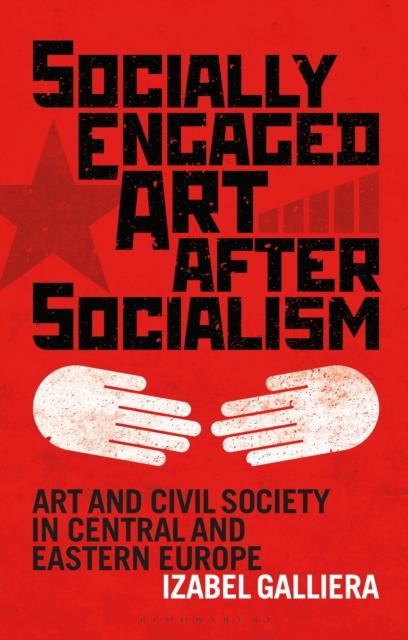
Socially Engaged Art after Socialism
Reclaiming public life from the ideologies of both communist regimes and neoliberalism, their projects have harnessed the politically subversive potential of social relations based on trust, reciprocity and solidarity. Drawing on archival material and exclusive interviews, in this book Izabel Galliera traces the development of socially engaged art from the early 1990s to the present in Bulgaria, Hungary and Romania. She demonstrates that, in the early 1990s, projects were primarily created for exhibitions organized and funded by the Soros Centers for Contemporary Art. In the early 2000s, prior to Bulgaria, Hungary and Romania entering into the European Union, EU institutions likewise funded socially-conscious public art in the region. Today, socially engaged art is characterised by the proliferation of independent and often self-funded artists' initiatives in cities such as Sofia, Bucharest and Budapest.Focusing on the relationships between art, social capital and civil society, Galliera employs sociological and political theories to reveal that, while social capital is generally considered a mechanism of exclusion in the West, in post-socialist contexts it has been leveraged by artists and curators as a vital means of communication and action.
eBook

Self-Institutionalizing as Political Agency: Contemporary Art Practice in Bucharest and Budapest
Reacting against politically monopolizing attempts at rewriting the socialist past in post-1989 Hungary and Romania, a diverse number of artists, curators, critics, activists and students have come together to form temporary organizations and institutions. Through a contextual reading and critical analysis of
(2009–2011) in Bucharest and DINAMO (2003–2006) and IMPEX (2006–2009) in Budapest, this article investigates what the author refers to as a “self-institutionalizing” and the ways in which this practice becomes a vehicle to rear politicized civil societies in post-cold war Central and Eastern Europe. The discussion of the two self-institutionalizing initiatives in Romania and Hungary seeks to contribute and complicate the official and institutionalized narrative of institutional critique rooted in a North American context.
Journal Article

Reclaiming public life, building public spheres: Contemporary art, exhibitions and institutions in post-1989 Europe
This Ph.D. dissertation traces the emergence and development of an important current of socially engaged art in Central and Eastern Europe after the fall of communism. It examines various participatory, collaborative and dialogic projects in public spaces by contemporary artists, working in Bulgaria, Hungary and Romania. These works often directly engaged marginalized communities, such as the homeless, members of immigrant groups and the Roma. In various ways, these artworks revived leftist traditions in a local context where, as political ideologies and economic orders, socialism had become equated with authoritarianism and democracy with neoliberalism. Occurring at specific moments in time throughout the post-communist period, most often with the presence of both financial and institutional support from the USA and EU nations, specific contemporary art practices sought to reclaim public life and build inclusive public spheres as democratic forms within emerging civil societies. Relying on sociological theories of social and political capital, and on theories of civil societies in political science, my goal has been to identify the potentially transformative roles that socially engaged art forms played in the post-communist transition. Concerned with current socio-political issues and foregrounding spaces of participation and collaboration, such art practices implicitly proposed new modes for art’s communication with the viewer, explored notions of public space as the locus of constantly negotiated public spheres, and provoked discussions of viable forms of democracy.
Dissertation
