
Catalogue Search | MBRL


Are you sure you want to remove the book from the shelf?

{{itemTitle}}
5
result(s) for
"Galston, William A. (William Arthur), 1946-"
Sort by:

Poverty and morality : religious and secular perspectives
\"This multi-authored book explores the ways that many influential ethical traditions - secular and religious, Western and non-Western - wrestle with the moral dimensions of poverty and the needs of the poor. These traditions include Buddhism, Christianity, Confucianism, Hinduism, Islam, and Judaism, among the religious perspectives; classical liberalism, feminism, liberal-egalitarianism, and Marxism, among the secular; and natural law, which might be claimed by both. The basic questions addressed by each of these traditions are linked to several overarching themes: what poverty is, the particular vulnerabilities of high-risk groups, responsibility for the occurrence of poverty, preferred remedies, how responsibility for its alleviation is distributed, and priorities in the delivery of assistance. This volume features an introduction to the types, scope, and causes of poverty in the modern world and concludes with Michael Walzer's broadly conceived commentary, which provides a direct comparison of the presented views and makes suggestions for further study and policy\"-- Provided by publisher.
Book

Anti-Pluralism
The Great Recession, institutional dysfunction, a growing divide between urban and rural prospects, and failed efforts to effectively address immigration have paved the way for a populist backlash that disrupts the postwar bargain between political elites and citizens. Whether today's populism represents a corrective to unfair and obsolete policies or a threat to liberal democracy itself remains up for debate. Yet this much is clear: these challenges indict the triumphalism that accompanied liberal democratic consolidation after the collapse of the Soviet Union. To respond to today's crisis, good leaders must strive for inclusive economic growth while addressing fraught social and cultural issues, including demographic anxiety, with frank attention. Although reforms may stem the populist tide, liberal democratic life will always leave some citizens unsatisfied. This is a permanent source of vulnerability, but liberal democracy will endure so long as citizens believe it is worth fighting for.
eBook

Anti-pluralism : the populist threat to liberal democracy
The Great Recession, institutional dysfunction, a growing divide between urban and rural prospects, and failed efforts to effectively address immigration have paved the way for a populist backlash that disrupts the postwar bargain between political elites and citizens. Whether today's populism represents a corrective to unfair and obsolete policies or a threat to liberal democracy itself remains up for debate. Yet this much is clear: these challenges indict the triumphalism that accompanied liberal democratic consolidation after the collapse of the Soviet Union. To respond to today's crisis, good leaders must strive for inclusive economic growth while addressing fraught social and cultural issues, including demographic anxiety, with frank attention. Although reforms may stem the populist tide, liberal democratic life will always leave some citizens unsatisfied. This is a permanent source of vulnerability, but liberal democracy will endure so long as citizens believe it is worth fighting for.
Book
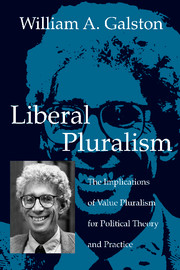
Liberal Pluralism
William Galston is a distinguished political philosopher whose work is informed by the experience of having also served from 1993–5 as President Clinton's Deputy Assistant for Domestic Policy. He is thus able to speak with an authority unique amongst political theorists about the implications of advancing certain moral and political values in practice. The foundational argument of this 2002 book is that liberalism is compatible with the value pluralism first espoused by Isaiah Berlin. William Galston defends a version of value pluralism - liberal pluralism - and argues, against the contentions of John Gray and others, that it undergirds a kind of liberal politics that gives weight to the ability of individuals and groups to live their lives in accordance with their deepest beliefs about what gives meaning and purpose to life.
eBook
