
Catalogue Search | MBRL


Are you sure you want to remove the book from the shelf?

{{itemTitle}}
160
result(s) for
"Gamble, Clive"
Sort by:

Settling the earth : the archaeology of deep human history
\"In this worldwide survey, Clive Gamble explores the evolution of the human imagination, without which we would not have become a global species. He sets out to determine the cognitive and social basis for our imaginative capacity and traces the evidence back into deep human history. He argues that it was the imaginative ability to \"go beyond\" and to create societies where people lived apart yet stayed in touch that made us such effective world settlers. To make his case Gamble brings together information from a wide range of disciplines: psychology, cognitive science, archaeology, palaeoanthropology, archaeogenetics, geography, quaternary science and anthropology. He presents a novel deep history that combines the archaeological evidence for fossil hominins with the selective forces of Pleistocene climate change, engages with the archaeogeneticists' models for population dispersal and displacement, and ends with the Europeans' rediscovery of the deep history settlement of the earth\"-- Provided by publisher.
Book

The house as a mind version 1; peer review: 2 approved
Palaeoanthropologists and evolutionary psychologists have successfully used the increasing size of the brain during human evolution to infer cognitive and social outcomes. Archaeologists have applied similar reasoning to the development of technology in deep history. This paper goes beyond these approaches by considering the house as a metaphor for the structure of hominin minds. It is argued that the study of the mind in deep history requires, (1) a recognition that mind is distributed between bodies, brains, and the world. The implications are examined through a magnetic resonance imaging (MRI) study (that unwraps the cerebellum and which suggests that folding rather than cortex size may be more important for understanding cognition.; (2) unmasking the ingrained container-
habitus that has been used to describe and investigate minds either in the present or deep past. This bias is explored by entering the eccentric house-mind of Sir John Soane (1753-1837) with its many compartments, paintings, and antiquities; and (3) an exploration of alternative embodied metaphors to enable archaeologists to study distributed mind in deep history. The metaphor ARCHITECTURE WITHOUT WALLS is discussed and briefly compared to the evidence for 'houses' in the Middle and Upper Pleistocene. The evidence indicates that hominins have always had complex, distributed minds but only recently in our deep history did we come to think predominantly through and with artificial containers such as houses. Late in human history these constructions became a common-sense
habitus that expressed and fashioned our cognitive experience of the world.
Journal Article


The ecology of social transitions in human evolution
We know that there are fundamental differences between humans and living apes, and also between living humans and their extinct relatives. It is also probably the case that the most significant and divergent of these differences relate to our social behaviour and its underlying cognition, as much as to fundamental differences in physiology, biochemistry or anatomy. In this paper, we first attempt to demarcate what are the principal differences between human and other societies in terms of social structure, organization and relationships, so that we can identify what derived features require explanation. We then consider the evidence of the archaeological and fossil record, to determine the most probable context in time and taxonomy, of these evolutionary trends. Finally, we attempt to link five major transitional points in hominin evolution to the selective context in which they occurred, and to use the principles of behavioural ecology to understand their ecological basis. Critical changes in human social organization relate to the development of a larger scale of fission and fusion; the development of a greater degree of nested substructures within the human community; and the development of intercommunity networks. The underlying model that we develop is that the evolution of 'human society' is underpinned by ecological factors, but these are influenced as much by technological and behavioural innovations as external environmental change.
Journal Article

Thinking big : how the evolution of social life shaped the human mind
When and how did the brains of our hominin ancestors become human minds? When and why did our capacity for language or art, music and dance evolve? It is the contention of this pathbreaking and provocative book that it was the need for early humans to live in ever-larger social groups, and to maintain social relations over ever-greater distances the ability to think big that drove the enlargement of the human brain and the development of the human mind.
Book
Climate change and evolving human diversity in Europe during the last glacial
A link between climate change and human evolution during the Pleistocene has often been assumed but rarely tested. At the macro-evolutionary level Foley showed for hominids that extinction, rather than speciation, correlates with environmental change as recorded in the deep sea record. Our aim is to examine this finding at a smaller scale and with high-resolution environmental and archaeological archives. Our interest is in changing patterns of human dispersal under shifting Pleistocene climates during the last glacial period in Europe. Selecting this time frame and region allows us to observe how two hominid taxa, Neanderthals and Crô-Magnons, adapted to climatic conditions during oxygen isotope stage 3. These taxa are representative of two hominid adaptive radiations, termed terrestrial and aquatic, which exhibited different habitat preferences but similar tolerances to climatic factors. Their response to changing ecological conditions was predicated upon their ability to extend their societies in space and time. We examine this difference further using a database of all available radiocarbon determinations from western Europe in the late glacial. These data act as proxies for population history, and in particular the expansion and contraction of regional populations as climate changed rapidly. Independent assessment of these processes is obtained from the genetic history of Europeans. The results indicate that climate affects population contraction rather than expansion. We discuss the consequences for genetic and cultural diversity which led to the legacy of the Ice Age: a single hominid species, globally distributed.
Journal Article

Thinking big : how the evolution of social life shaped the human mind
When and how did the brains of our hominin ancestors become human minds? When and why did our capacity for language or art, music and dance evolve? It is the contention of this pathbreaking and provocative book that it was the need for early humans to live in ever-larger social groups, and to maintain social relations over ever-greater distances the ability to think big that drove the enlargement of the human brain and the development of the human mind. This social brain hypothesis, put forward by evolutionary psychologists such as Robin Dunbar, one of the authors of this book, can be tested against archaeological and fossil evidence, as archaeologists Clive Gamble and John Gowlett show in the second part of Thinking Big. Along the way, the three authors touch on subjects as diverse and diverting as the switch from finger-tip grooming to vocal grooming or the crucial importance of making fire for the lengthening of the social day. Ultimately, the social worlds we inhabit today can be traced back to our Stone Age ancestors.
Book
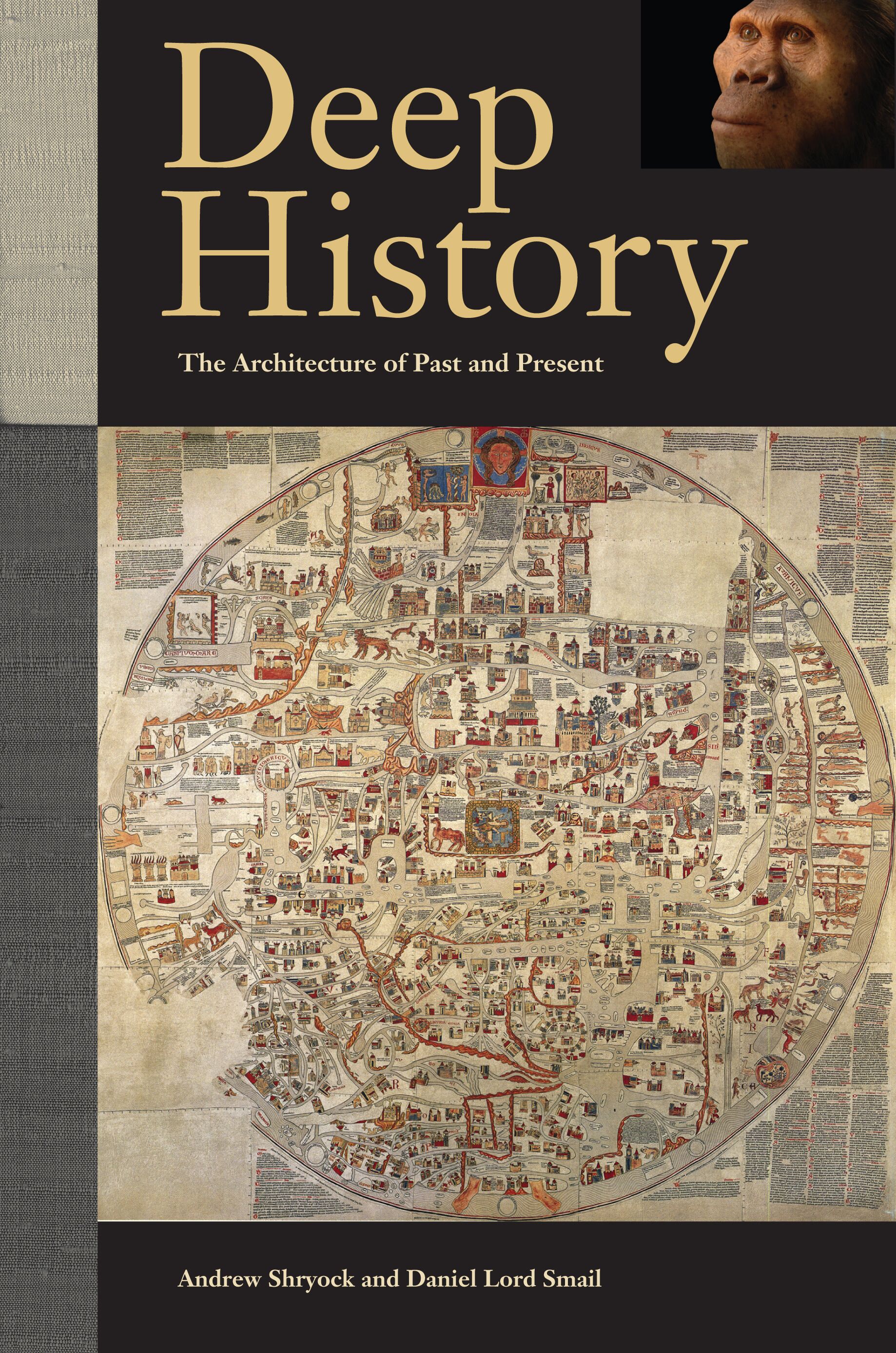
Deep history
Humans have always been interested in their origins, but historians have been reluctant to write about the long stretches of time before the invention of writing. In fact, the deep past was left out of most historical writing almost as soon as it was discovered. This breakthrough book, as important for readers interested in the present as in the past,brings science into history to offer a dazzling new vision of humanity across time. Team-written by leading experts in a variety of fields, it maps events, cultures, and eras across millions of years to present a new scale for understanding the human body, energy and ecosystems, language, food, kinship, migration, and more. Combining cutting-edge social and evolutionary theory with the latest discoveries about human genes, brains, and material culture, Deep History invites scholars and general readers alike to explore the dynamic of connectedness that spans all of human history. With Timothy Earle, Gillian Feeley-Harnik, Felipe Fernández-Armesto, Clive Gamble, April McMahon, John C. Mitani, Hendrik Poinar, Mary C. Stiner, and Thomas R. Trautmann
eBook
The Hominid Individual in Context
This book explores new approaches to the remarkably detailed information that archaeologists now have for the study of our early ancestors. Rather than explaining the archaeology of stones and bones as the product of group decisions, the contributors investigate how individual action created social life. This challenge to the accepted standpoint of the Palaeolithic brings new models and theories into the period; innovations that are matched by the resolution of data preserving individual action among the stones and bones. The volume brings together examples from recent excavations such as Boxgrove, Schöningen and Blombos Cave and the analyses of artefacts from Middle and Early Upper Pleistocene excavations in Europe, Africa and Asia.
eBook

The anthropology of deep history
The history of anthropology reveals a discipline driven by fission and fusion. In this article I use the framework of deep history as an example of what might be achieved if anthropology resolved to travel the road of fusion rather than continue with atomization. I will illustrate the pathway by examining the fusion of interdisciplinary endeavour that is encapsulated in the concept of a social brain. By placing social life at the heart of the historical process we find common ground for all the fields of anthropology, and beyond to other disciplines. Here anthropologists have the opportunity to set the agenda. The social brain works in deep as well as shallow history. It unites experimental and historical science. And it marks a return to those core principles which Lubbock and the founders of our Institute established. L'histoire de l'anthropologie dévoile une discipline dont les moteurs sont la fission autant que la fusion. Dans le présent article, j'utilise le cadre de l'histoire profonde comme exemple des résultats que l'on pourrait obtenir si l'anthropologie décidait de suivre la voie de la fusion au lieu de continuer à s'atomiser. J'illustre ce chemin en examinant la fusion interdisciplinaire qui a donné naissance au concept du cerveau social. En mettant la vie sociale au centre du processus historique, nous arrivons à un terrain partagé par tous les domaines de l'anthropologie et, au-delà, par d'autres disciplines. Sur ce terrain commun, les anthropologues ont la possibilité de fixer l'ordre du jour. Le cerveau social fonctionne dans l'histoire profonde aussi bien que dans l'histoire superficielle. Il fait le lien entre science expérimentale et science historique. Et il marque le retour aux principes fondamentaux établis par Lubbock et les fondateurs de notre Institut.
Journal Article