
Catalogue Search | MBRL


Are you sure you want to remove the book from the shelf?

{{itemTitle}}
4,356
result(s) for
"García, Mario T"
Sort by:

Blowout!
In March 1968, thousands of Chicano students walked out of their East Los Angeles high schools and middle schools to protest decades of inferior and discriminatory education in the so-called \"Mexican Schools.\" During these historic walkouts, or \"blowouts,\" the students were led by Sal Castro, a courageous and charismatic Mexican American teacher who encouraged the students to make their grievances public after school administrators and school board members failed to listen to them. The resulting blowouts sparked the beginning of the urban Chicano Movement of the late 1960s and early 1970s, the largest and most widespread civil rights protests by Mexican Americans in U.S. history.This fascinatingtestimonio, or oral history, transcribed and presented in Castro's voice by historian Mario T. Garcia, is a compelling, highly readable narrative of a young boy growing up in Los Angeles who made history by his leadership in the blowouts and in his career as a dedicated and committed teacher.Blowout!fills a major void in the history of the civil rights and Chicano movements of the 1960s, particularly the struggle for educational justice.
eBook

Rewriting the Chicano Movement
The Chicano Movement, el movimiento, is known as the largest and
most expansive civil rights and empowerment movement by Mexican
Americans up to that time. It made Chicanos into major American
political actors and laid the foundation for today's Latino
political power. Rewriting the Chicano Movement is a
collection of powerful new essays on the Chicano Movement that
expand and revise our understanding of the movement. These essays
capture the commitment, courage, and perseverance of movement
activists, both men and women, and their struggles to achieve the
promises of American democracy. The essays in this volume broaden
traditional views of the Chicano Movement that are too narrow and
monolithic. Instead, the contributors to this book highlight the
role of women in the movement, the regional and ideological
diversification of the movement, and the various cultural fronts in
which the movement was active. Rewriting the Chicano
Movement stresses that there was no single Chicano Movement
but instead a composite of movements committed to the same goal of
Chicano self-determination. Scholars, students, and community
activists interested in the history of the Chicano Movement can
best start by reading this book. Contributors: Holly
Barnet-Sanchez, Tim Drescher, Jesús Jesse Esparza, Patrick Fontes,
Mario T. García, Tiffany Jasmín González, Ellen McCracken, Juan
Pablo Mercado, Andrea Muñoz, Michael Anthony Turcios, Omar
Valerio-Jiménez
eBook
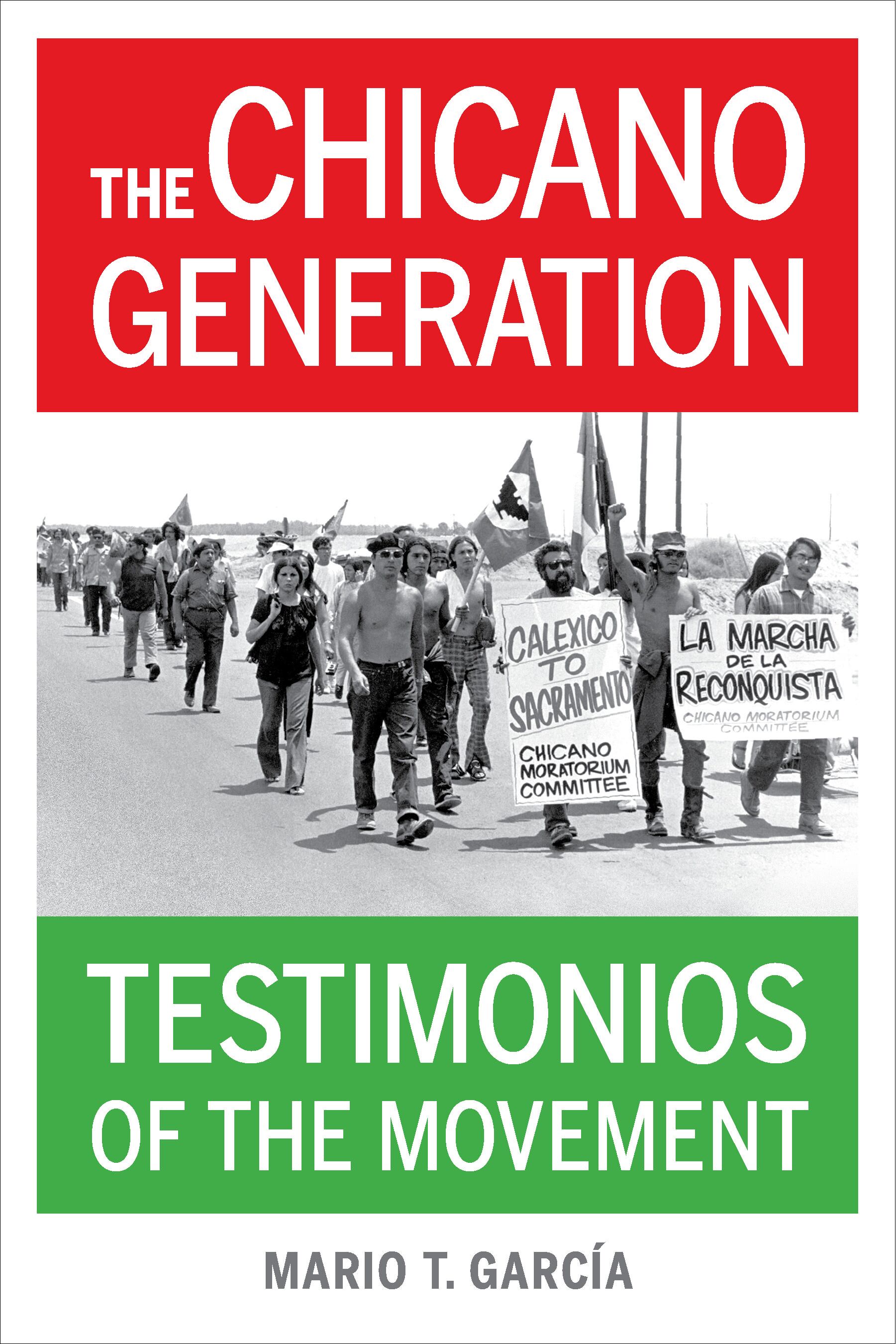
The Chicano generation
In The Chicano Generation, veteran Chicano civil rights scholar Mario T. García provides a rare look inside the struggles of the 1960s and 1970s as they unfolded in Los Angeles. Based on in-depth interviews conducted with three key activists, this book illuminates the lives of Raul Ruiz, Gloria Arellanes, and Rosalio Muñoz—their family histories and widely divergent backgrounds; the events surrounding their growing consciousness as Chicanos; the sexism encountered by Arellanes; and the aftermath of their political histories. In his substantial introduction, García situates the Chicano movement in Los Angeles and contextualizes activism within the largest civil rights and empowerment struggle by Mexican Americans in US history—a struggle that featured César Chávez and the farm workers, the student movement highlighted by the 1968 LA school blowouts, the Chicano antiwar movement, the organization of La Raza Unida Party, the Chicana feminist movement, the organizing of undocumented workers, and the Chicano Renaissance. Weaving this revolution against a backdrop of historic Mexican American activism from the 1930s to the 1960s and the contemporary black power and black civil rights movements, García gives readers the best representations of the Chicano generation in Los Angeles.
eBook


Migrant daughter : coming of age as a Mexican American woman
Taking us from the open spaces of rural New Mexico and the fields of California's Great Central Valley to the intellectual milieu of student life in Berkeley during the 1950s, this memoir, based on an oral history by Mario T. García, is the powerful and moving testimonio of a young Mexican American woman's struggle to rise out of poverty. Migrant Daughter is the coming-of-age story of Frances Esquibel Tywoniak, who was born in Spanish-speaking New Mexico, moved with her family to California during the Depression to attend school and work as a farm laborer, and subsequently won a university scholarship, becoming one of the few Mexican Americans to attend the University of California, Berkeley, at that time. Giving a personal perspective on the conflicts of living in and between cultures, this eloquent story provides a rare glimpse into the life of a young Mexican American woman who achieved her dreams of obtaining a university education. In addition to the many fascinating details of everyday life the narrative provides, Mario T. García's introduction contextualizes the place and importance of Tywoniak's life. Both introduction and narrative illustrate the process by which Tywoniak negotiated her relation to ethnic identity and cultural allegiances, the ways in which she came to find education as a channel for breaking with fieldwork patterns of life, and the effect of migration on family and culture. This deeply personal memoir portrays a courageous Mexican American woman moving between many cultural worlds, a life story that at times parallels, and at times diverges from, the real life experiences of thousands of other, unnamed women. Many titles in the Voices Revived program are also newly available as ebooks, offered at a discounted price to support wider access to scholarly work.
eBook

Luis Leal
Professor Luis Leal is one of the most outstanding scholars of Mexican, Latin American, and Chicano literatures and the dean of Mexican American intellectuals in the United States. He was one of the first senior scholars to recognize the viability and importance of Chicano literature, and, through his perceptive literary criticism, helped to legitimize it as a worthy field of study. His contributions to humanistic learning have brought him many honors, including Mexico's Aquila Azteca and the United States' National Humanities Medal. In this testimonio or oral history, Luis Leal reflects upon his early life in Mexico, his intellectual formation at Northwestern University and the University of Chicago, and his work and publications as a scholar at the Universities of Illinois and California, Santa Barbara. Through insightful questions, Mario García draws out the connections between literature and history that have been a primary focus of Leal's work. He also elicits Leal's assessment of many of the prominent writers he has known and studied, including Mariano Azuela, William Faulkner, Octavio Paz, Carlos Fuentes, Juan Rulfo, Gabriel García Márquez, Jorge Luis Borges, Tomás Rivera, Rolando Hinojosa, Rudolfo Anaya, Elena Poniatowska, Sandra Cisneros, Richard Rodríguez, and Ana Castillo.
eBook