
Catalogue Search | MBRL


Are you sure you want to remove the book from the shelf?

{{itemTitle}}
72
result(s) for
"Garsten, Bryan"
Sort by:


The Liberalism of Refuge
Frustrated by persisting inequality, oppression, and corruption in liberal societies, and disillusioned with liberalism's failures, many are stepping away. Yet liberal societies are still admirable because they offer refuge from the very people they empower . They require rulers to accept limitations on their power and provide escape hatches from the worst parts of political life. Offers of refuge may be found in opposition political parties, independent institutions, reasonably autonomous local communities, powerful civil society organizations, and the market economy. There is a nobility in offering refuge, in the safety and opportunity it presents for building something new.
Journal Article
A Reply To My Critics
Frustrated by persisting inequality, oppression, and corruption in liberal societies, and disillusioned with liberalism's failures, many are stepping away. Yet liberal societies are still admirable because they offer refuge from the very people they empower . They require rulers to accept limitations on their power and provide escape hatches from the worst parts of political life. Offers of refuge may be found in opposition political parties, independent institutions, reasonably autonomous local communities, powerful civil society organizations, and the market economy. There is a nobility in offering refuge, in the safety and opportunity it presents for building something new.
Journal Article


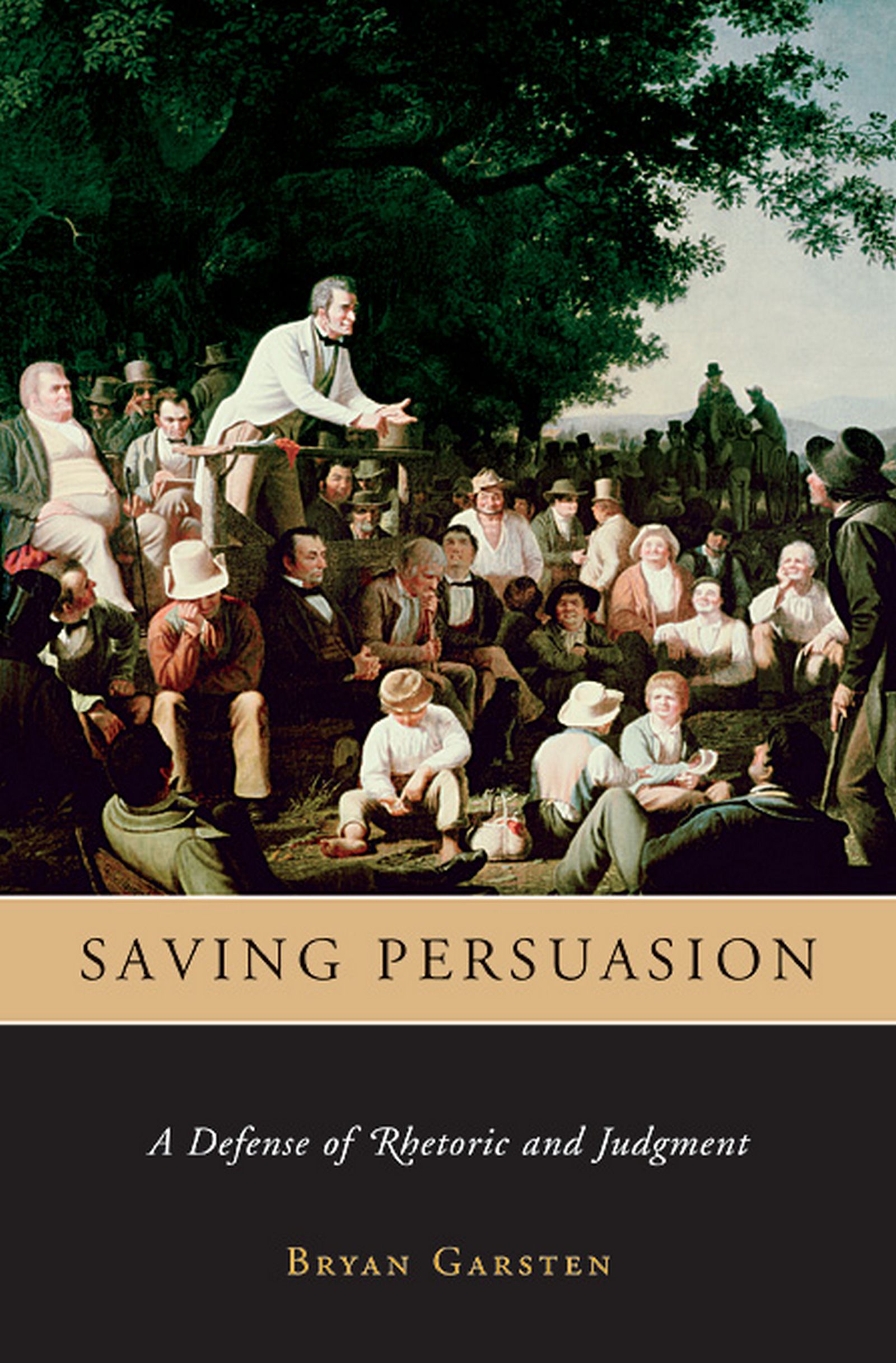
Saving persuasion : a defense of rhetoric and judgment
In today's increasingly polarized political landscape it seems that fewer and fewer citizens hold out hope of persuading one another. Even among those who have not given up on persuasion, few will admit to practicing the art of persuasion known as rhetoric. To describe political speech as \"rhetoric\" today is to accuse it of being superficial or manipulative. In Saving Persuasion, Bryan Garsten uncovers the early modern origins of this suspicious attitude toward rhetoric and seeks to loosen its grip on contemporary political theory. Revealing how deeply concerns about rhetorical speech shaped both ancient and modern political thought, he argues that the artful practice of persuasion ought to be viewed as a crucial part of democratic politics. He provocatively suggests that the aspects of rhetoric that seem most dangerous--the appeals to emotion, religious values, and the concrete commitments and identities of particular communities--are also those which can draw out citizens' capacity for good judgment. Against theorists who advocate a rationalized ideal of deliberation aimed at consensus, Garsten argues that a controversial politics of partiality and passion can produce a more engaged and more deliberative kind of democratic discourse.
eBook

Religion and the Case Against Ancient Liberty: Benjamin Constant's Other Lectures
Benjamin Constant's famous lecture comparing ancient and modern liberty can be better understood if it is read alongside a set of unpublished lectures on ancient religion that he delivered one year earlier. Those lectures suggest that Constant's commitment to modern liberty was based in part on his deep anxieties about religious freedom, and that he valued religious freedom because he thought the \"religious sentiment\" was an important manifestation of a natural human capacity for self-development. In putting religion and self-development at the heart of his vision, he tried to show that modern liberty could have a positive moral or spiritual purpose beyond merely assuring people freedom from interference in the pursuit of their interests.
Journal Article

Liberalism and the Rhetorical Vision of Politics
Visions of Politics, Quentin Skinner's impressive three-volume collection of essays, does not offer a systematic defense of any particular theory of politics. Skinner's vision is what I refer to as a \"rhetorical\" vision of politics. In this essay I do not want to criticize this fundamental vision of politics; instead I would like to spend time thinking about its political implications. I hope to suggest that we can acknowledge and even endorse the centrality of rhetorical contestation in political life without accepting the view that liberalism is an unhealthy Hobbesian or neo-Kantian project to \"halt the flux of politics.\" In fact an important strand of liberalism was motivated by a desire to save republicanism from those who would use its language against its essence—those who would use republican rhetoric to stifle the sort of contestation important to republican politics.
Journal Article