
Catalogue Search | MBRL


Are you sure you want to remove the book from the shelf?

{{itemTitle}}
24
result(s) for
"Gaycken, Oliver"
Sort by:


“The Swarming of Life”: Moving Images, Education, and Views through the Microscope
Discussions of the scientific uses of moving-image technologies have emphasized applications that culminated in static images, such as the chronophotographic decomposition of movement into discrete and measurable instants. The projection of movement, however, was also an important capability of moving-image technologies that scientists employed in a variety of ways. Views through the microscope provide a particularly sustained and prominent instance of the scientific uses of the moving image. The category of “education” subsumes theses various scientific uses, providing a means by which to bridge the cultures of scientific and popular scientific moving images.
Journal Article

\The Living Picture\: On the Circulation of Microscope-Slide Knowledge in 1903
Microscope slides allowed preparations to circulate among scientific and educational contexts. An extension of the circulation of microscope slides was how they became part of lantern exhibition culture. This article considers an early example of the adoption of microscope lantern show conventions by another medium, the cinema. F. Martin Duncan, who was employed by Charles Urban to produce a series of popular-science films beginning in 1903, brought his experience with microphotography to bear on the challenge of adapting cinema to the purpose of public instruction. Duncan's first series of films, entitled \"The Unseen World,\" demonstrated both profound links to the display tradition of the lantern lecture as well as the transformation of that tradition by the cinema's representational possibilities.
Journal Article
\The Swarming of Lifeaeuro: Moving Images, Education, and Views through the Microscope
Argument Discussions of the scientific uses of moving-image technologies have emphasized applications that culminated in static images, such as the chronophotographic decomposition of movement into discrete and measurable instants. The projection of movement, however, was also an important capability of moving-image technologies that scientists employed in a variety of ways. Views through the microscope provide a particularly sustained and prominent instance of the scientific uses of the moving image. The category of \"educationâ[euro] subsumes theses various scientific uses, providing a means by which to bridge the cultures of scientific and popular scientific moving images. [PUBLICATION ABSTRACT]
Journal Article

Animating, Entertaining, Educating: A Dialogue between Oliver Gaycken and Ariana Killoran
From a customer's saliva sample, the company takes over half a million genetic data points (a series of As, Ts, Cs, and Gs) and provides them with information about their personal ancestry. [...]recently, customers also received information about their individual health risks, drug responses, and physical traits. The FDA directive came just as I was returning from maternity leave and putting the finishing touches on some videos explaining genetic disease risk. Since new customers will not, for the time being, be receiving health information, these videos are not critical for new customers to understand the 23andMe product.
Journal Article


Documentary Plasticity
This chapter considers a selection of moving images from embryology, a field whose prominent engagement with imaging has been the focus of recent scholarship. Plasticity emerges as a concrete media form that travels between scientific and other fields as well as a model for an expansive approach to media history that incorporates excluded imaging traditions and reveals previously unacknowledged kinships among imaging practices. The chapter provides an account of Hans Elias's early films, which parallel and occasionally intersect with the rise of the traditional documentary film movement. An excavation of Elias's films both expands and enriches documentary studies by underlining the overlaps between scientific visualization traditions, modern educational practice, and documentary film history. The kinship has traced between embryological imaging and traditional animation may seem far removed from animation's celebrated plasticity as it relates to the graphic traditions of stretch‐and‐squash cartoon bodies.
Book Chapter

A Casual Glance Reveals a Perfect Mine of Treasures
George Kleine’s Catalogue of Educational Motion Pictures (1910) appeared at a pivotal moment in the history of nonfiction cinema in the United States, coming just after cinema’s consolidation as a cultural institution—its so-called second birth—but well before the establishment of a viable nontheatrical market in the 1920s.¹
This ambitious catalog, which ran to 336 pages and comprised over a thousand titles, contained a curious assortment of films compiled by Kleine on the basis of his experience as a distributor.² The opening pages included a series of texts that argued for the use of cinema as an educational medium.
Book Chapter
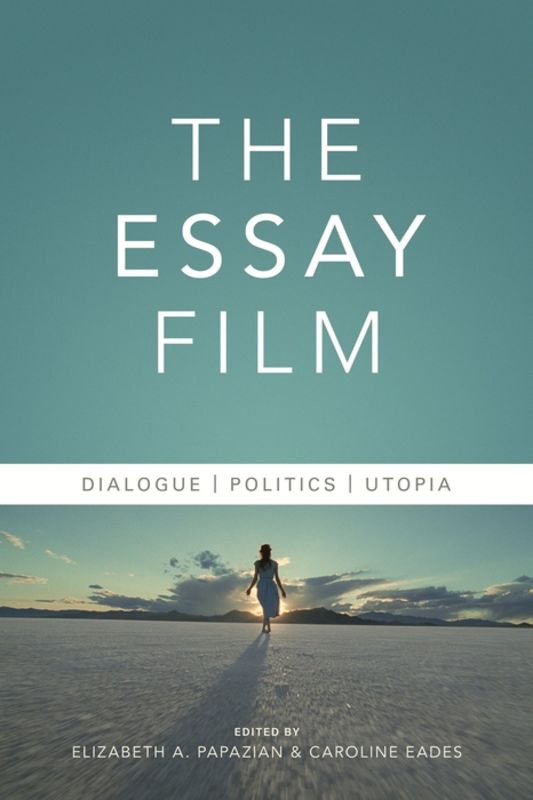
The essay film
With its increasing presence in a continuously evolving media environment, the essay film as a visual form raises new questions about the construction of the subject, its relationship to the world, and the aesthetic possibilities of cinema. In this volume, authors specializing in various national cinemas (Cuban, French, German, Israeli, Italian, Lebanese, Polish, Russian, American) and critical approaches (historical, aesthetic, postcolonial, feminist, philosophical) explore the essay film and its consequences for the theory of cinema while building on and challenging existing theories. Taking.
eBook