
Catalogue Search | MBRL


Are you sure you want to remove the book from the shelf?

{{itemTitle}}
65
result(s) for
"Geis, Anna"
Sort by:


Outlawing war is not enough to promote international peace: The ambivalence of liberal interventionism
Why has interstate war declined and why do states refrain from territorial conquests in the post-Second World War order? The 1928 Peace Pact cannot account for these remarkable developments. This article argues that outlawing war is not enough to promote international peace. International Relations debates on the influence of weapons of mass destruction, democratic regime types and political cultures on interstate behaviour provide further important insights into the delegitimation of certain types of war. Since the 1990s, a changing character of war and warfare has emerged that is especially promoted by democratic states. How democratic states have justified their military use of force and how they have conducted their military interventions has a strong and ambivalent impact on the liberal world order.
Journal Article

The Russian War Against Ukraine and Its Implications for the Future of Liberal Interventionism
The Russian war against Ukraine has already had crucial implications for the future of liberal interventionism. Drawing on current debates in IR about the transformation of the global world order, the article outlines how processes of global reordering affect (liberal) interventionism at different scales. The article argues that what has become known as the liberal international order is in retreat, at the expense of liberal peace-oriented international interventions. At the same time, current geopolitical realignments appear to be dividing the world into new spheres of influence, pitting democracies against autocracies at the global level and within regional conflicts. However, when it comes to security interventions and peacekeeping, the emerging realities on the ground, where a growing number of actors with different agendas interact, are more complex than simplistic world-order narratives suggest. Using the cases of international peacekeeping and security assistance as examples, the article shows that in some current international intervention sites, the emerging “multi-order world” is characterised by complicated constellations of parallel external assistance offers and rapid shifts in allegiances that do not necessarily follow clear divisions between “authoritarian” and “liberal” forms of assistance. The article therefore does not confirm expectations of the emergence of a “new Cold War” and a new round of ideological competition between international systems.
Journal Article
From liberal interventionism to stabilisation: A new consensus on norm-downsizing in interventions in Africa
This article traces recent changes of the practices and justifications of the use of force in intervention, in the context of African security governance, highlighting how these changes interact with norm transformations at the scale of the global order. In doing so, it conveys how a long-standing pattern of norm contestation between international and African actors over external intervention vs sovereignty, has started to give way to a mutually accepted division of labour. After 9/11, the paradigm of liberal interventionism has been incrementally replaced by the framework of stabilisation, with a re-prioritisation of sovereigntist agendas. This has increased collaboration between international and African actors, specifically prompting the United Nations and the African Union to divide tasks of mandating and enforcement, thereby increasing inter-institutional ‘order’. This consensus, however, far from signifying wider compliance with ‘liberal ordering’ principles, rather indicates the need to revisit central assumptions of the International Relations norm diffusion literature. While the latter emphasises the diffusion of ‘good’ international norms, especially pertaining to human rights and democratisation, the growing consensus on ‘intervention as stabilisation’ instead exposes how post-9/11 justifications of practices that carry the potential to downsize the scope of such norms, are starting to resonate across international, regional and national sites of policy and practice.
Journal Article

The existence and use of ‘evil’ in international politics
There is an extensive literature on acts, events and people in international politics that may be described as ‘evil’, but much less work specifically focusing on how this idea operates and is used in an international context. This has begun to change recently, however, as a result of leading international figures – most notably George W. Bush – using the term prominently. This special issue seeks to further advance scholarship on these issues by moving beyond purely philosophical accounts on the nature of evil, and considering: how it has been used to frame the identities of actors in international relations (IR); whether it works to enable or preclude specific kinds of behaviour; and what role it plays as part of our moral and political vocabulary. This introduction provides a brief survey of the literature on evil in IR, and gives an overview of the contributions to the special issue.
Journal Article

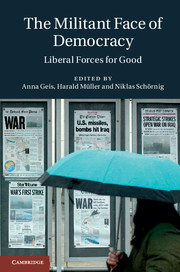
The Militant Face of Democracy
Democratic peace theory - the argument that democracies very rarely go to war with each other - has come under attack recently for being too naïve and for neglecting the vast amount of wars fought by democracies, especially since the end of the Cold War. This volume offers a fresh perspective by arguing that the same norms that are responsible for the democratic peace can be argued to be responsible for democratic war-proneness. The authors show that democratic norms, which are usually understood to cause peaceful behaviour, are heavily contested when dealing with a non-democratic other. The book thus integrates democratic peace and democratic war into one consistent theoretical perspective, emphasising the impact of national identity. The book concludes by arguing that all democracies have a 'weak spot' where they would be willing to engage militarily.
eBook
The ‘Concert of Democracies’: Why some states are more equal than others
This article engages with a discourse emerging from international political theory, international law and political science on awarding privileges to democracies in crucial issues of global governance. Proposals that a ‘Concert of Democracies’ should be legally entitled to take decisions in case the United Nations Security Council is unable or unwilling to act are amongst the most prominent expression of this vision of the stratification of the international society into first-class and second-class regimes. The article reconstructs central tenets of this discourse on the inclusion and exclusion of regime types and shows that this kind of differentiation of states has been very much inspired by readings and appropriations of ‘democratic peace’ scholarship in International Relations. The article critiques the underlying problematic theoretical assumptions and the practical implications of democratic peace theory and policy proposals inferred from it.
Journal Article

Engaging with Public Opinion at the Micro-Level: Citizen Dialogue and Participation in German Foreign Policy
Abstract
This article analyzes how and why foreign policy (FP)-makers use dialogue and participation processes (DPPs) with (groups of) individual citizens as a source of public opinion. Taking Germany as a case study and drawing on DPP initiatives by the Federal Foreign Office (Auswärtiges Amt, AA) since 2014, we analyze the officials’ motivation for establishing such processes and find four different sets of motivation: (1) image campaigning, (2) educating citizens, (3) listening to citizens, and (4) changing the citizens’ role in FP. Our article makes three contributions. First, we provide a novel typology of the sources of public opinion upon which FP-makers can draw. Second, our study points to the importance of, and provides a framework for, analyzing how officials engage with public opinion at the micro-level, which has so far been understudied in FP analysis. Finally, our empirical analysis suggests that both carefully assessing and influencing public opinion feature prominently in motivation, whereas PR purposes are of minor importance. Recasting the citizens’ role in FP gains in importance over time and may mirror the increased need to legitimize FP in Western democracies vis-à-vis their publics.
Journal Article

How far is it from Königsberg to Kandahar? Democratic peace and democratic violence in International Relations
Over the last two decades, there has been a ‘democratic turn’ in peace and conflict research, that is, the peculiar impact of democratic politics on a wide range of security issues has attracted more and more attention. Many of these studies are inspired by Immanuel Kant's famous essay on ‘Perpetual Peace’. In this article, we present a critical discussion of the ‘democratic distinctiveness programme’ that emerged from the Democratic Peace debate and soon spread to cover a wider range of foreign policy issues. The bulk of this research has to date been based on an overly optimistic reading of a ‘Kantian peace’. In particular, the manifold forms of violence that democracies have exerted, have been treated either as a challenge to the Democratic Peace proposition or as an undemocratic contaminant and pre-democratic relict. In contrast, we argue that forms of ‘democratic violence’ should no longer be kept at arm's length from the democratic distinctiveness programme but instead should be elevated to a main field of study. While we acknowledge the benefits of this expanding research programme, we also address a number of normative pitfalls implied in this scholarship such as lending legitimacy to highly questionable foreign policy practices by Western democracies. We conclude with suggestions for a more self-reflexive and ‘critical’ research agenda of a ‘democratically turned’ peace and conflict studies, inspired by the Frankfurt school tradition.
Journal Article