
Catalogue Search | MBRL


Are you sure you want to remove the book from the shelf?

{{itemTitle}}
11
result(s) for
"Gharipour, Mohammad, editor"
Sort by:

Gardens of Renaissance Europe and the Islamic empires : encounters and confluences
\"A collection of essays exploring similarities between gardens and designed landscapes in Europe and the Islamic world after the fifteenth century. Essays identify possible direct or indirect influences and examine transcontinental mutual influences in garden design\"--Provided by publisher.
Book

Gardens of Renaissance Europe and the Islamic empires : encounters and confluences
The cross-cultural exchange of ideas that flourished in the Mediterranean during the sixteenth and seventeenth centuries profoundly affected European and Islamic society. Gardens of Renaissance Europe and the Islamic Empires considers the role and place of gardens and landscapes in the broader context of the information sharing that took place among Europeans and Islamic empires in Turkey, Persia, and India. In illustrating commonalities in the design, development, and people's perceptions of gardens and nature in both regions, this volume substantiates important parallels in the revolutionary advancements in landscape architecture that took place during the era. The contributors explain how the exchange of gardeners as well as horticultural and irrigation techniques influenced design traditions in the two cultures; examine concurrent shifts in garden and urban landscape design, such as the move toward more public functionality; and explore the mutually influential effects of politics, economics, and culture on composed outdoor space. In doing so, they shed light on the complexity of cultures and politics during the Renaissance. A thoughtfully composed look at the effects of cross-cultural exchange on garden design during a pivotal time in world history, this thought-provoking book points to new areas in inquiry about the influences, confluences, and connections between European and Islamic garden traditions. In addition to the editor, the contributors include Cristina Castel-Branco, Paula Henderson, Simone M. Kaiser, Ebba Koch, Christopher Pastore, Laurent Paya, D. Fairchild Ruggles, Jill Sinclair, and Anatole Tchikine.
eBook


Synagogues in the Islamic World
This beautifully illustrated volume looks at the spaces created by and for Jews in areas under the political or religious control of Muslims in regions such as Central Asia, the Middle East, North Africa and Spain.
eBook

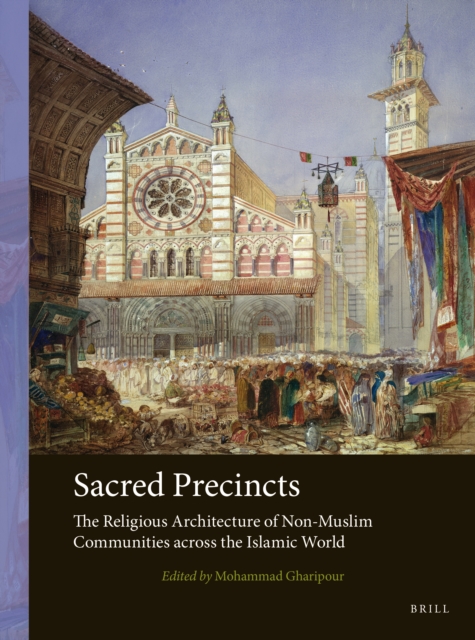
Sacred Precincts
Sacred Precincts examines non-Muslim religious sites in the Islamic world, revealing how architecture responds to contextual issues and traditions. It explores urban contexts; issues of identity; design; construction; transformation and the history of sacred sites in the Middle East and Africa from the advent of Islam to the 20th century. The book includes case studies on churches, synagogues and sacred sites in Iran; Turkey; Cyprus; Egypt; Iraq; Tunisia; Morocco; Malta; Nigeria; Mali, and the Gambia.
eBook

Calligraphy and architecture in the Muslim world
\"This book explores the myriad interactions between calligraphy and architecture throughout the history of the Muslim world. From Spain to China, Islamic architecture and calligraphy are inexorably intertwined. Mosques, dervish lodges, mausolea, libraries, even baths and marketplaces bear masterpieces of calligraphy that rival the most refined books and scrolls. This major reference work focuses on architectural inscriptions throughout the Muslim world, some going back to the Middle Ages, others dating from our own lifetime. What were the purposes of these inscriptions? How do they infuse buildings with culturally specific meanings, sacred or profane? What do they add to architectural design? What sorts of materials were used, and how do they interact with light and space? Who were their patrons, and what do we know about the artists who produced them? You can find out with this exciting new collection written by a stellar cast of international contributors. It features 28 case studies explain different aspects and contexts of calligraphy in Islamic architecture. It is geographically wide-ranging - covers North Africa, the Middle East, South Asia, China and Spain. It takes an interdisciplinary approach to analysing calligraphy as part of its larger spatial-architectural context. It is lavishly illustrated with 400 colour images.\"
Book

Islamic Architecture Today and Tomorrow
Through Islamic Architecture Today and Tomorrow, established experts, designers, and newer scholars from the world of 'Islamic architecture', broadly conceived, consider the field's changing nature and continued relevance in our rapidly globalizing context. Reflective essays address the meaning of 'Islamic' in built environments, as well as the geographical, chronological, and disciplinary diversity of a dynamic field of study that encompasses far more than mosques and tombs. Essays address the use and interpretation of historic structures and spaces, in addition to contemporary design, conservation, and touristic experience, as well as research, publication, and pedagogical practices. It introduces scholars and practitioners to the state of Islamic architecture as a field of inquiry and provides a snapshot of the issues and challenges facing the field today. Looking forward, it invites readers to consider built environments in Islamic contexts as integral to global systems from an interdisciplinary and inclusive perspective. While this volume offers nuanced perspectives on a host of pressing questions, it ultimately aims to advance a necessarily on-going conversation. The book will have wide appeal among architectural historians, art historians, and other scholars working on material in the traditional Islamic regions of the world (North Africa, the Middle East, and South Asia) and beyond, as well as scholars of religion and society. Practicing architects, landscape architects, planners, preservationists, and heritage managers in the regions addressed may also be interested in the volume. Essays have been written with non-specialist and student readers in mind. Undergraduate, graduate, and design students may use selected essays, or the entire collection, in university or graduate school coursework in architecture and Middle Eastern or Islamic studies.
eBook

Epidemic Urbanism
The recent pandemic has put into perspective the impact of epidemic illness on urban life and exposed the vulnerabilities of societies. Interdisciplinary case studies from across the globe explore what insights from the outbreak, experience and response to previous epidemics might inform our understanding of the current world. 150 b/w illus.
eBook

Social housing in the Middle East : architecture, urban development, and transnational modernity
As oil-rich countries in the Middle East are increasingly associated with soaring skyscrapers and modern architecture, attention is being diverted away from the pervasive struggles of social housing in those same urban settings. Social Housing in the Middle East traces the history of social housing—both gleaming postmodern projects and bare-bones urban housing structures—in an effort to provide a wider understanding of marginalized spaces and their impact on identities, communities, and class. While architects may have envisioned utopian or futuristic experiments, these buildings were often constructed with the knowledge and skill sets of local workers, and the housing was in turn adapted to suit the modern needs of residents. This tension between local needs and national aspirations are linked to issues of global importance, including security, migration, and refugee resettlement. The essays collected here consider how culture, faith, and politics influenced the solutions offered by social housing; they provide an insightful look at how social housing has evolved since the 19th century and how it will need to adapt to suit the 21st.
eBook