
Catalogue Search | MBRL


Are you sure you want to remove the book from the shelf?

{{itemTitle}}
223,814
result(s) for
"Gilbert, A."
Sort by:

Arguing with people
Arguing with People brings developments from the field of Argumentation Theory to bear on critical thinking in a clear and accessible way. This book expands the critical thinking toolkit, and shows how those tools can be applied in the hurly-burly of everyday arguing. Gilbert emphasizes the importance of understanding real arguments, understanding just who you are arguing with, and knowing how to use that information for successful argumentation. Interesting examples and partner exercises are provided to demonstrate tangible ways in which the book's lessons can be applied.--Amazon.com.
Book

The hidden structure of human enamel
Enamel is the hardest and most resilient tissue in the human body. Enamel includes morphologically aligned, parallel, ∼50 nm wide, microns-long nanocrystals, bundled either into 5-μm-wide rods or their space-filling interrod. The orientation of enamel crystals, however, is poorly understood. Here we show that the crystalline
c
-axes are homogenously oriented in interrod crystals across most of the enamel layer thickness. Within each rod crystals are not co-oriented with one another or with the long axis of the rod, as previously assumed: the
c
-axes of adjacent nanocrystals are most frequently mis-oriented by 1°–30°, and this orientation within each rod gradually changes, with an overall angle spread that is never zero, but varies between 30°–90° within one rod. Molecular dynamics simulations demonstrate that the observed mis-orientations of adjacent crystals induce crack deflection. This toughening mechanism contributes to the unique resilience of enamel, which lasts a lifetime under extreme physical and chemical challenges.
Enamel is the hardest tissue in the body and has been widely studied, yet aspects of its structure remain unclear. Here, the authors report on a study of the orientation and alignment of enamel crystals and challenge previous assumptions.
Journal Article

Sci-Book : STEPS to STEM student science notebook
\"A \"Sci-Book\" or \"Science Notebook\" serves as an essential companion to the science curriculum supplement, STEPS to STEM. As students learn key concepts in the seven \"big ideas\" in this program (Electricity & Magnetism; Air & Flight; Water & Weather; Plants & Animals; Earth & Space; Matter & Motion; Light & Sound), they record their ideas, plans, and evidence. There is ample space for students to keep track of their observations and findings, as well as a section to reflect upon the use of \"Science and Engineering Practices\" as set forth in the Next Generation Science Standards (NGSS). Using a science notebook is reflective of the behavior of scientists. One of the pillars of the Nature of Science is that scientists must document their work to publish their research results; it is a necessary part of the scientific enterprise. This is important because STEPS to STEM is a program for young scientists who learn within a community of scientists. Helping students to think and act like scientists is a critical feature of this program. Students learn that they need to keep a written record if they are to successfully share their discoveries and curiosities with their classmates and with the teacher. Teachers should also model writing in science to help instill a sense of purpose and pride in using and maintaining a Sci-Book. Lastly, students' documentation can serve as a valuable form of authentic assessment; teachers can utilize Sci-Books to monitor the learning process and the development of science skills.\" -- Publisher's description.
Book

The Earth Microbiome project: successes and aspirations
The Earth Microbiome Project (EMP) was launched in August 2010, with the ambitious aim of constructing a global catalogue of the uncultured microbial diversity of this planet. The primary vision of the Earth Microbiome Project, to process the microbial diversity and functional potential from approximately 200,000 environmental samples, marks it as an undertaking so massive that it was at first considered to be pure folly (as late as 2012, Jonathan Eisen was quoted in Nature as saying Knight and Gilbert literally talk about sampling the entire planet. It is ludicrous and not feasible - yet they are doing it [1]).
Journal Article
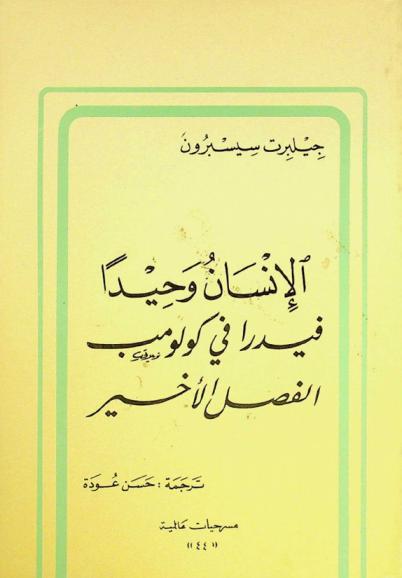
الإنسان وحيدا ؛ فيدرا في كولومب ؛ الفصل الأخير
في أصل هذا العمل قصة إخبارية تاريخية : إدانة موسوليني لصهره تشيانو، والد أحفاده. لو حدثت هذه القضية في العصور القديمة، لكان من شأن يوربيديس أو سوفوكليس أو شكسبير أو راسين أن يصنعوا منها مأساة. ولماذا لا تفعل ذلك بحجة أنها حلقة معاصرة ؟ لماذا لا نستخلص من هذا الوضع تحليلا للعزلة الرهيبة التي يعيشها القادة، وللقدر الذي يفرضونه قبل أن يتعرضوا له ؟ الكبرياء، والعنف، وما يسميه الرجال الشرف، وما تسميه النساء السعادة هي الشخصيات غير المرئية، ولكنها قوية للغاية في هذا العمل، والتي لم يجرؤ أي مسرح حتى الآن على تمثيلها في فرنسا على الأقل. ومع ذلك، فإننا نجد هناك هذا الحاضر الذي يطاردنا هذا التحالف من العاطفة والرحمة، والصرامة والحنان الذي ميز بالفعل أول عمل درامي للمؤلف : إنه منتصف الليل يا دكتور شفایتزر.
Book

Crystallization by particle attachment in synthetic, biogenic, and geologic environments
Crystals grow in a number a ways, including pathways involving the assembly of other particles and multi-ion complexes. De Yoreo et al. review the mounting evidence for these nonclassical pathways from new observational and computational techniques, and the thermodynamic basis for these growth mechanisms. Developing predictive models for these crystal growth and nucleation pathways will improve materials synthesis strategies. These approaches will also improve fundamental understanding of natural processes such as biomineralization and trace element cycling in aquatic ecosystems. Science , this issue 10.1126/science.aaa6760 Materials nucleate and grow by the assembly of small particles and multi-ion complexes. Field and laboratory observations show that crystals commonly form by the addition and attachment of particles that range from multi-ion complexes to fully formed nanoparticles. The particles involved in these nonclassical pathways to crystallization are diverse, in contrast to classical models that consider only the addition of monomeric chemical species. We review progress toward understanding crystal growth by particle-attachment processes and show that multiple pathways result from the interplay of free-energy landscapes and reaction dynamics. Much remains unknown about the fundamental aspects, particularly the relationships between solution structure, interfacial forces, and particle motion. Developing a predictive description that connects molecular details to ensemble behavior will require revisiting long-standing interpretations of crystal formation in synthetic systems, biominerals, and patterns of mineralization in natural environments.
Journal Article

Bernard Shaw and Gilbert Murray
\"This collection of 171 letters, most never before published, finally makes the fascinating Shaw/Murray correspondence available. With explanatory headnotes and footnotes by Charles A. Carpenter, Bernard Shaw and Gilbert Murray offers insight into an unusual literary and political friendship.\"-- Publisher description.
BOOK
A noninteracting low-mass black hole–giant star binary system
Black hole binary systems with companion stars are typically found via their x-ray emission, generated by interaction and accretion. Noninteracting binaries are expected to be plentiful in the Galaxy but must be observed using other methods. We combine radial velocity and photometric variability data to show that the bright, rapidly rotating giant star 2MASS J05215658+4359220 is in a binary system with a massive unseen companion. The system has an orbital period of ~83 days and near-zero eccentricity. The photometric variability period of the giant is consistent with the orbital period, indicating star spots and tidal synchronization. Constraints on the giant’s mass and radius imply that the unseen companion is
3.3
−
0.7
+
2.8
solar masses, indicating that it is a noninteracting low-mass black hole or an unexpectedly massive neutron star.
Journal Article
Exploring genetic interaction manifolds constructed from rich single-cell phenotypes
How cellular and organismal complexity emerges from combinatorial expression of genes is a central question in biology. High-content phenotyping approaches such as Perturb-seq (single-cell RNA-sequencing pooled CRISPR screens) present an opportunity for exploring such genetic interactions (GIs) at scale. Here, we present an analytical framework for interpreting high-dimensional landscapes of cell states (manifolds) constructed from transcriptional phenotypes. We applied this approach to Perturb-seq profiling of strong GIs mined from a growth-based, gain-of-function GI map. Exploration of this manifold enabled ordering of regulatory pathways, principled classification of GIs (e.g., identifying suppressors), and mechanistic elucidation of synergistic interactions, including an unexpected synergy between CBL and CNN1 driving erythroid differentiation. Finally, we applied recommender system machine learning to predict interactions, facilitating exploration of vastly larger GI manifolds.
Journal Article