
Catalogue Search | MBRL


Are you sure you want to remove the book from the shelf?

{{itemTitle}}
50
result(s) for
"Gilbert, Paula Ruth"
Sort by:


Violence and the Female Imagination
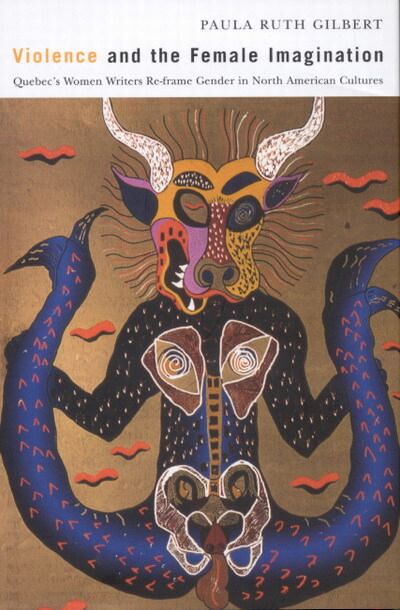
Violence and the Female Imagination explores whether these imagined women are striking out at an external other or harming themselves through acts of self-destruction and depression. Gilbert examines the degree to which women are imitating men in the outward direction of their anger and hostility and suggests that such \"tough\" women may be mocking men in their \"macho\" exploits of sexuality and violence. She illustrates the ways in which Quebec female authors are \"feminizing\" violence or re-envisioning gender in North American culture.
eBook
Violence and the Female Imagination
In the past twenty years Quebec women writers, including Aline Chamberland, Claire Dé, Suzanne Jacob, and Hélène Rioux, have created female characters who are fascinated with bold sexual actions and language, cruelty, and violence, at times culminating in infanticide and serial killing. Paula Ruth Gilbert argues that these Quebec feminist writers are \"re-framing\" gender. Violence and the Female Imagination explores whether these imagined women are striking out at an external other or harming themselves through acts of self-destruction and depression. Gilbert examines the degree to which women are imitating men in the outward direction of their anger and hostility and suggests that such \"tough\" women may be mocking men in their \"macho\" exploits of sexuality and violence. She illustrates the ways in which Quebec female authors are \"feminizing\" violence or re-envisioning gender in North American culture. Gilbert bridges methodological gaps and integrates history, sociology, literary theory, feminist theory, and other disciplinary approaches to provide a framework for the discussion of important ethical and aesthetic questions.
eBook

Transatlantic Passages
Despite a burgeoning interest in transatlantic and regional studies, the long-standing cultural connections between francophone communities on both sides of the Atlantic have received little critical attention. Transatlantic Passages presents essays, interviews, and images that address the often-neglected cultural commerce integral to understanding historical and contemporary identities in Quebec and francophone Europe.
eBook
Confronting Global Gender Justice
Confronting Global Gender Justice contains a unique, interdisciplinary collection of essays that address some of the most complex and demanding challenges facing theorists, activists, analysts, and educators engaged in the tasks of defining and researching women’s rights as human rights and fighting to make these rights realities in women’s lives.
With thematic sections on Complicating Discourses of Victimhood, Interrogating Practices of Representation, Mobilizing Strategies of Engagement, and Crossing Legal Landscapes, this volume offers both specific case studies and more general theoretical interventions. Contributors examine and assess current understandings of gender justice, and offer new paradigms and strategies for dealing with the complexities of gender and human rights as they arise across local and international contexts. In addition, it offers a particularly timely assessment of the effectiveness and limits of international rights instruments, governmental and nongovernmental organization activities, grassroots and customary practices, and narrative and photographic representations.
This book is a valuable resource for both undergraduate and graduate students in fields such as Gender or Women’s Studies, Human Rights, Cultural Studies, Anthropology, and Sociology, as well as researchers and professionals working in related areas.
Introduction: Women's Lives, Human Rights by Debra Bergoffen, Paula Ruth Gilbert, and Tamara Harvey Part I: Complicating the Discourses of Victimhood 1. Women and the Genocidal Rape of Women: The Gender Dynamics of Gendered War Crimes by Laura Sjoberg 2. Human Trafficking: Why is it Such and Important Women's Issue? by Louise Shelley 3. Transforming the Representable: Asian Women in Anti-Trafficking Discourse by Donna Kay Maeda 4. Sin, Salvation, or Starvation? The Problematic Role of Religious Morality in U.S. Anti-Sex Trafficking Policy by Lucinda Peach Part II: Interrogating Practices of Representation 5. How Not to Give Rape Political Significance by Louise Du Toit 6. Human Trafficking: A Photographic Essay by Kay Chrenush 7. Marjorie Agosín's Poetics of Memory: Human Rights, Feminism, and Literary Forms by Ricardo F. Vivancos P érez 8. Digital Storytelling for Gender Justice: Exploring the Challenges of Participation and the Limits of Polyvocality by Amy Hill Part III: Strategies of Engagement 9. 'Sweet Electrical Greetings': Women, HIV, and the Evolution of an Intervention Project in Papua New Guinea by Holly Wardlow, with Mary Tamia 10. Economic Empowerment of Women as a Global Project: Economic Rights in the Neo-Liberal Era by Nitza Berkovitch and Adriana Kemp 11. Algerian Women in Movement: Three Waves of Feminist Activism by Valentine M. Moghadam 12. Using Law and Education to Make Human Rights Real in Women's Real Lives by Nancy Chi Cantalupo Part IV: Crossing Legal Landscapes 13. Seduced by Information, Contaminated by Power: Women's Rights as a Global Panopticon by Saida Hod ži ć 14. Human Rights of Women and Girls with Disabilities in Developing Countries by Amy T. Wilson 15. Gender and Customary Mechanisms of Justice in Uganda by Joanna R. Quinn 16. Policing Bodies and Borders: Women, Prostitution, and the Differential Regulation of U.S. Immigration Policy by Deirdre Moloney 17. The Institutionalization of Domestic Violence Against Women in the United States by Julie Walters Part V: Confronting Global Gender Justice 18. Configuring Feminisms, Transforming Paradigms: Reflections from Kum-Kum Bhavnani, from an Interview with Kum-Kum Bhavnani by Connie L. McNeely
Debra Bergoffen is Emeritus Professor of Philosophy at George Mason University. Her book The Philosophy of Simone de Beauvoir: Gendered Phenomenologies, Erotic Generosities (1997), and her most recent articles, including \"Exploiting the Dignity of the Vulnerable Body,\" evidence her ongoing concern with feminist theory, women’s rights and human rights.
Paula Ruth Gilbert is Professor of French, Canadian, and Women and Gender Studies at George Mason University. Her research covers: nineteenth-century French Studies; Quebec Studies; violence and gender and violent women; narrative, gender, and human rights. Her most recent book is Violence and the Female Imagination (2006).
Tamara Harvey is Associate Professor of English at George Mason University. She is author of Figuring Modesty in Feminist Discourse Across the Americas, 1633-1700 (2008), and co-editor with Greg O’Brien of George Washington’s South (2003). Her research focuses on women and early America, with an emphasis on hemispheric studies.
Connie L. McNeely received the Ph.D. in Sociology from Stanford University and is currently on the faculty of the School of Public Policy at George Mason University. Her books have included Constructing the Nation-State (1995) and the edited volume Public Rights, Public Rules (1998). Her current research and most recent publications address various aspects of culture, politics, social theory, and inequality.
eBook


Introduction
Place and time are essential elements of who we are. Our identity is shaped by the architectures of our experiences, be they spatial, temporal, intellectual, material, or spiritual. In the citations above from Benjamin, a German-born theorist, and Scott, a contemporary Anglo-Québécois feminist writer, it is clear that Paris is a powerful locus of desire and of being. Just as Benjamin found in Paris the fuel for his reflections on modernity, so Scott, a contemporaryflâneuse, finds in Benjamin’sArcades Projecta structuring principle for her own postmodern text, a first-person narrative where the subject is never that of a
Book Chapter

Public and Private Violence
Although it is common to refer to the killing of any child – newborn or older – by either parent as infanticide (as I shall do in this study), current legal definitions of infanticide and filicide are precisely defined and are quite country-specific. According toBlack’s Law Dictionaryas used in the United States legal system, infanticide is: “I. The act of killing a newborn child, esp. by the parents or with their consent. In archaic usage, the word referred also to the killing of an unborn child. – also termedchild destruction; neonaticide. 2. The practice of killing newborn children. 3. One
Book Chapter
Who’s the Subject Now?
“Re-vision,” says Adrienne Rich in a 1971 essay,¹ has revolutionary potential. Re-vision can be revolutionary when understood as “the act of looking back, of seeing with fresh eyes, of entering an old text from a new critical direction … an act of survival.” Enriching the term even more, Rich calls it a “drive to self-knowledge … more than a search for identity … part of our refusal of the self-destructiveness of male-dominated society … how we can begin to see and name – and therefore live – afresh” (“When We Dead Awaken: Writing as Re-Vision” 35). Linda Williams, borrowing a decade later
Book Chapter