
Catalogue Search | MBRL


Are you sure you want to remove the book from the shelf?

{{itemTitle}}
186
result(s) for
"Gillespie, Michael Patrick"
Sort by:

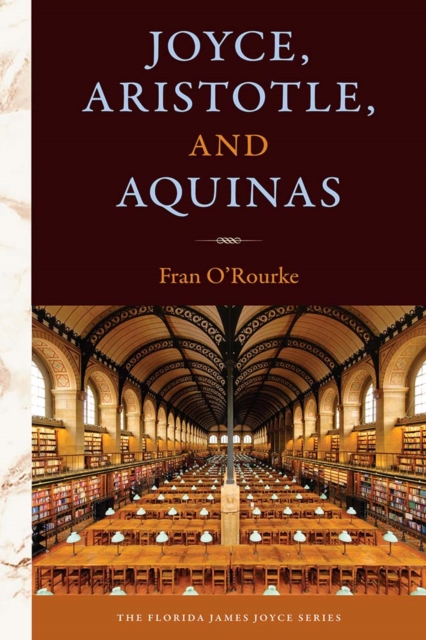
Joyce, Aristotle, and Aquinas
A rich examination of the influence of Aristotle and
Thomas Aquinas on James Joyce
In this book, Fran O'Rourke examines the influence of Aristotle
and Thomas Aquinas on James Joyce, arguing that both thinkers
fundamentally shaped the philosophical outlook which pervades the
author's oeuvre. O'Rourke demonstrates that Joyce was a
philosophical writer who engaged creatively with questions of
diversity and unity, identity, permanence and change, and the
reliability of knowledge.
Beginning with an introduction to each thinker, the book traces
Joyce's discovery of their works and his concrete engagement with
their thought. Aristotle and Aquinas equipped Joyce with
fundamental principles regarding reality, knowledge, and the soul,
which allowed him to shape his literary characters. Joyce
appropriated Thomistic concepts to elaborate an original and
personal aesthetic theory.
O'Rourke provides an annotated commentary on quotations from
Aristotle that Joyce entered into his famous Early Commonplace Book
and outlines their crucial significance for his writings. He also
provides an authoritative evaluation of Joyce's application of
Aquinas's aesthetic principles.
The first book to comprehensively illuminate the profound impact
of both the ancient and medieval thinker on the modernist writer,
Joyce, Aristotle, and Aquinas offers readers a rich
understanding of the intellectual background and philosophical
underpinnings of Joyce's work.
A volume in the Florida James Joyce Series, edited by Sebastian
D. G. Knowles
eBook


The Branding of Oscar Wilde
Bien qu’au cours de sa vie, Oscar Wilde ait été entouré par un certain nombre de personnages flamboyants, il se démarqua de ceux-ci en raison du grand talent dont il fit preuve quand il s’est agi de se forger une image de marque. Cette démarche va bien au-delà de la simple mise en scène de soi, et elle a de bien plus larges implications en termes de rapports à la société. C’est grâce à la création de cette image de marque que Wilde se distingua d’une génération d’excentriques, grâce à l’habileté dont il fit preuve dans l’élaboration d’une image publique singulière, image qui parvint à frapper les esprits tout en échappant aux foudres de la censure. Cette image était celle d’un artiste apparemment sans inhibition mais qui, en réalité, savait parfaitement susciter le frisson sans pour autant provoquer de la révulsion. Entre ses années d’étudiant à Oxford et les procès de 1895, la « marque Wilde » protégea sa vanité et accrut sa réputation, à travers sa capacité à changer de registre et à s’adapter à des environnements différents. Comprendre le fonctionnement de cette image de marque et l’engagement de Wilde envers cette dernière au gré des situations, permet d’offrir un aperçu de l’évolution de sa carrière d’écrivain et de saisir au mieux les perspectives changeantes dont les lecteurs doivent avoir conscience afin de comprendre son œuvre. Although over the course of his life Oscar Wilde was surrounded by a number of flamboyant individuals, he set himself apart by his particularly adept talent for brand creation, a trait that went well beyond self-dramatization and that had much broader societal implications. Wilde’s branding distinguished him from a generation of eccentrics through a calculated ability to create a unique and arresting public persona that provoked response but stopped short of generating censure. Wilde’s brand was the seemingly uninhibited artist who knew exactly how to balance conflicting impressions, creating frisson but stopping short of revulsion. Between his time as a student at Oxford and the period he spent in the dock at his 1895 trials, Wilde’s “branding” protected his vanity and enhanced his reputation through an ability to shift emphasis and respond to surroundings. Understanding his brand and Wilde’s commitment to it according to the situation gives insights into how he developed as an artist and into the alternative perspectives of which readers need to be aware in order best to understand his work.
Journal Article
The Branding of Oscar Wilde
Although over the course of his life Oscar Wilde was surrounded by a number of flamboyant individuals, he set himself apart by his particularly adept talent for brand creation, a trait that went well beyond self-dramatization and that had much broader societal implications. Wilde’s branding distinguished him from a generation of eccentrics through a calculated ability to create a unique and arresting public persona that provoked response but stopped short of generating censure. Wilde’s brand was the seemingly uninhibited artist who knew exactly how to balance conflicting impressions, creating frisson but stopping short of revulsion. Between his time as a student at Oxford and the period he spent in the dock at his 1895 trials, Wilde’s “branding” protected his vanity and enhanced his reputation through an ability to shift emphasis and respond to surroundings. Understanding his brand and Wilde’s commitment to it according to the situation gives insights into how he developed as an artist and into the alternative perspectives of which readers need to be aware in order best to understand his work.
Journal Article
The Branding of Oscar Wilde
Bien qu’au cours de sa vie, Oscar Wilde ait été entouré par un certain nombre de personnages flamboyants, il se démarqua de ceux-ci en raison du grand talent dont il fit preuve quand il s’est agi de se forger une image de marque. Cette démarche va bien au-delà de la simple mise en scène de soi, et elle a de bien plus larges implications en termes de rapports à la société. C’est grâce à la création de cette image de marque que Wilde se distingua d’une génération d’excentriques, grâce à l’habileté dont il fit preuve dans l’élaboration d’une image publique singulière, image qui parvint à frapper les esprits tout en échappant aux foudres de la censure. Cette image était celle d’un artiste apparemment sans inhibition mais qui, en réalité, savait parfaitement susciter le frisson sans pour autant provoquer de la révulsion. Entre ses années d’étudiant à Oxford et les procès de 1895, la « marque Wilde » protégea sa vanité et accrut sa réputation, à travers sa capacité à changer de registre et à s’adapter à des environnements différents. Comprendre le fonctionnement de cette image de marque et l’engagement de Wilde envers cette dernière au gré des situations, permet d’offrir un aperçu de l’évolution de sa carrière d’écrivain et de saisir au mieux les perspectives changeantes dont les lecteurs doivent avoir conscience afin de comprendre son œuvre.
Journal Article

Reading on the Edge of Chaos: \Finnegans Wake\ and the Burden of Linearity
\"20 The problem facing readers of the Wake-although articulated in various forms-has always been the same: how does one acknowledge its complexity yet at the same time approach it with a system of interpretation simple enough to encompass its magnitude? Because it privileges logical consistency through clearly defined linear relationships, Cartesian reasoning, which serves as the default response to Finnegans Wake, produces the opposite effect. [...]the very success of such critics as Stephen Greenblatt in their advocacy of \"new historicism\"-which is merely the old historicism read on a microcosmic level-rests upon a willingness to apply reductionist manifestations of history to literature.32 One needs instead an expansionist view of possibilities. Because slight variations in temperature, air pressure, humidity or other features can lead to a geometric impact upon the weather-the by now well-known Butterfly effect-forecasting with accuracy is nearly impossible. Applying this attitude to a reading of the museyroom episode means extrapolating responses from impressions within the episode without necessarily linking these impressions in the syllogistic form followed by conventional interpretations. Since this mode of interpretation eschews readings set in a self-contained narrative form, one can assign to the punning, the allusions to battles, the sexual tension, or any other element within the passage a pivotal role in one's own response without having to suppress all of the other referential reverberations within the work.
Journal Article

Reading Joyce’s Poetry against the Rest of the Canon
I take the epigraph for this essay from the wire that Stephen Dedalus sent to Buck Mulligan at The Ship pub in Lower Abbey Street. Mulligan had been waiting there with Haines, his English visitor, for Stephen to appear, flush with his salary for teaching at Mr. Deasy’s school, to buy them drinks. Reading the telegram aloud to the Dublin cognoscenti, assembled in an office off the Reading Room of the National Library to listen to Stephen recount his Shakespeare theory, Mulligan’s first reaction seems effusive in its appreciation of Stephen’s wit: “O, you peerless mummer! O you priestified Kinchite!”
Book Chapter

Foreword
Reading Fran O’Rourke’s Joyce, Aristotle, and Aquinas is akin to listening to Debussy’s “The Girl with the Flaxen Hair,” a beautifully constructed work, seemingly straightforward while full of complexities that convey the exuberance of the creation with grace and pleasure. Professor O’Rourke has written a marvelous scholarly study that offers, in lucid prose, profound insights into an important portion of the intellectual, imaginative, and creative contexts that inform the writings of James Joyce. O’Rourke disclaims direct interpretive intentions and instead makes the modest, though in my view quite important, assertion that his work is “concerned exclusively with philosophical themes which
Book Chapter