
Catalogue Search | MBRL


Are you sure you want to remove the book from the shelf?

{{itemTitle}}
3
result(s) for
"Gilson, Julie, author"
Sort by:

EU-Japan relations and the crisis of multilateralism
\"Presenting the history of relations between the European Union and Japan, this book explains the origins and significance of the momentous 2018 Economic Partnership Agreement and its parallel Strategic Partnership Agreement. Set within the historical context of the 1991 Hague Declaration and Action Plan of 2001, this book analyses the impact of recent background changes to the liberal trading order, the proliferation of free trade agreements, and uncertainty about the US' role in the world, on relations between Japan and the EU. Adopting a path dependent approach, it illustrates how these agreements were reached as a result of growing patterns of cooperative behaviour between the EU and Japan, and the imprint of shared past experiences in areas from trade to security. In so doing, this book also raises important questions about the future of multilateral cooperation, exploring the potential for bilateral agreements to undermine the possibility of finding international solutions to increasingly international problems. EU-Japan Relations and the Crisis of Multilateralism will appeal to students and scholars of European and Japanese politics and international relations, as well as policy makers internationally with an interest in these significant agreements.\"-- Provided by publisher.
Book
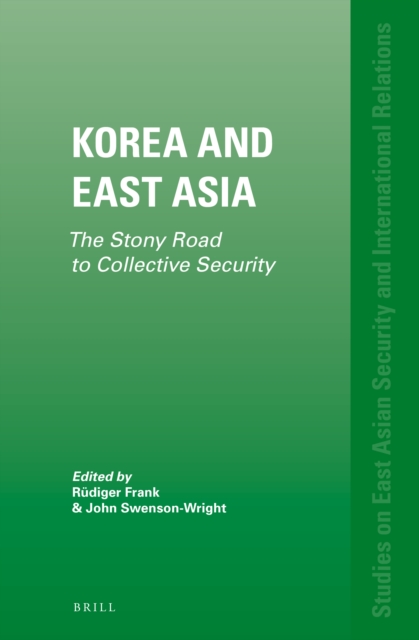
Korea and East Asia
This book critically addresses the potential of the liberal concept of collective security to provide a solution to conflict in East Asia, with a focus on the Korean peninsula.
eBook

Civil Society and International Governance
A PDF version of this book is available for free in open access via www.tandfebooks.com as well as the OAPEN Library platform, www.oapen.org. It has been made available under a Creative Commons Attribution-Non Commercial-No Derivatives 3.0 license and is part of the OAPEN-UK research project. Structures and processes occurring within and between states are no longer the only – or even the most important - determinants of those political, economic and social developments and dynamics that shape the modern world. Many issues, including the environment, health, crime, drugs, migration and terrorism, can no longer be contained within national boundaries. As a result, it is not always possible to identify the loci for authority and legitimacy, and the role of governments has been called into question. Civil Society anf International Governance critically analyses the increasing impact of nongovernmental organisations and civil society on global and regional governance. Written from the standpoint of advocates of civil society and addressing the role of civil society in relation to the UN, the IMF, the G8 and the WTO, this volume assess the role of various non-state actors from three perspectives: theoretical aspects, civil society interaction with the European Union and civil society and regional governance outside Europe, specifically Africa, East Asia and the Middle East. It demonstrates that civil society’s role has been more complex than one defined in terms, essentially, of resistance and includes actual participation in governance as well as multi-facetted contributions to legitimising and democratising global and regional governance. This book will be of interest to students and scholars of political science, international relations, civil society, sociology, European politics and global governance.
eBook