
Catalogue Search | MBRL


Are you sure you want to remove the book from the shelf?

{{itemTitle}}
8
result(s) for
"Gleick, James Chaos : making a new science"
Sort by:
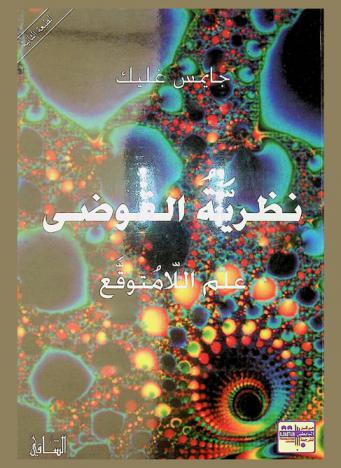
نظرية الفوضى : علم اللامتوقع
تبدأ نظرية الفوضى من الحدود التي يتوقف عندها العالم التقليدي ويعجز فمنذ شرع العلم في حل ألغاز الكون عانى دوما من الجهل بشأن ظاهرة الاضطراب مثل تقلبات المناخ وحركة أمواج البحر والتقلبات في الأنواع الحية وأعدادها والتذبذب في عمل القلب والدماغ إن الجانب غير المنظم من الطبيعة غير المنسجم وغير المتناسق والمفاجئ والانقلابي أعجز العلم دوما وشرعت تلك الصورة في التغير تدريجيا في سبعينات القرن العشرين عندما همت كوكبة من العلماء الأميركيين والأوروبيين للاجتماع بأمر الاضطراب وفوضاه وتألفت تلك الكوكبة من علماء : الفيزياء والرياضيات والبيولوجيا والكيمياء سعوا للإمساك بالخيوط التي تجمع ظواهر الفوضى كلها.
BOOK

O RINGS AND THE OSCILLATORY WA-WA
That voice - if you heard [Richard P. Feynman] giving one of his world-famous physics lectures, or interrogating NASA witnesses after the space shuttle disaster, or telling stories from an armchair on public television, you might have been seduced by the unregenerate New York City accent, the gruff Art Carney delivery, the tones of charmed comic delight. Feynman's speaking voice echoes raw and direct through the printed pages of his surprisingly successful 1985 book of reminiscences, '' 'Surely You're Joking, Mr. Feynman!,' '' and the same is true of its successor volume, with the equally gangly title '' 'What Do You Care What Other People Think?' '' Even more than '' 'Surely You're Joking,' '' '' 'What Do You Care?' '' is a hodgepodge, assembled from various fragments - some letters from friends, a BBC interview, some leftover tape recordings, a 1955 lecture - by [Ralph Leighton], a friend and drumming partner of Feynman's. The assortment lacks the natural, easy flow of its predecessor. Yet in many ways, the new book gives a far more somber and realistic picture of Feynman: not just a bongo-playing, skirt-chasing, joke-telling prankster, but a man, always earnest and sometimes troubled, who thought more deeply than most about the power and the limitations of science. ''Well, that was nice,'' he says here, ''and I love her, too, but -you know how you absentmindedly drop pencils around: you're showing Professor [ Eugene ] Wigner a formula, or something, and leave the pencil on his desk.'' So Feynman sliced off the writing. Soon he got a letter with her firm moral injunction: ''WHAT DO YOU CARE WHAT OTHER PEOPLE THINK?''
Book Review
The Census: Why We Can't Count
Yet once again thousands of people chose the wrong century of birth and the final tally of centenarians proved much too large, about double what the bureau and most demographers believe to be the actual number -based on other surveys and on actual records of births and deaths. Why? The computers took care of the 130- and 140-year-olds. ''But we had no requirement that children in a household shouldn't be over 100,'' says Gregory Spencer, chief of the Population Projections branch. ''You'd look and find two 112-year-old parents with their 109-year-old child.'' Sex-Change Procedures. The bureau's understanding of what constitutes a plausible household makes some arbitrary assumptions. In this year's census, whenever both members of a gay couple fill in the ''husband/wife'' dot and the ''married'' dot and the ''male'' dot, the census computers will automatically choose one of the men at random and ''correct'' his sex. (The same for two women.) In general, sex is the category best reported by those who respond to the census; even so, in 1980, more than 3 million people had their sex chosen by computer, Dr. Spencer says. The 1900 Problem. Too many people think they were born in exactly 1900. Based on past experience, the current census is certain to show a remarkable number of people just turning 90. Teen-Age Widows. Mispunching errors can create entire categories of nonexistent people. The teen-age widows are one group famous in census lore. ''If you have a one-in-a-thousand mispunching, it can create quite a sizable fictitious population,'' says Dr. [Leslie Kish] of the University of Michigan. Confusion about Relationships. Filling in the dots under ''If a RELATIVE of Person 1,'' many householders glance at their elderly parents and mark ''son/daughter'' when they should mark ''father/mother.'' Or they look at their husband or wife, who happens to be the father or mother of their children, and mark ''father/mother'' when they should mark ''husband/wife.'' Capture-recapture has its problems. One is the sampling error that arises from sheer chance. Ten identical boats taking samples under identical circumstances will still produce 10 varying counts. Statisticians know how to calculate the expected range of deviation; the larger the sample, the less it will be. The method also produces systematic errors, errors caused by the nature of the selection itself. Some animals are ''trap-happy,'' others ''trap-shy.'' The capture and the recapture have to be far enough apart that the tagged fish can mix randomly through the population, but close enough together that the population has not changed significantly in the meantime. ''This is the hairy part,'' says Henry Horn, a Princeton ecologist, ''making the assumption that all individuals get a chance to mix completely, that the marking process itself has no effect, and that there's no tendency for the marked individuals to be recaptured since they were the easiest to capture in the first place. All those assumptions have to be made, and none of them are true.'' For serious counts, the method must be combined with modeling techniques designed to face the selection biases head on, acknowledging them and trying to measure them. To count the 10 billion stars of the Milky Way, astronomers actually count only 100,000 or so. ''You have to get basic data, make a model, and understand how your counting depends on the parameters of the model,'' says Dr. [John Bahcall] of the Institute for Advanced Study. The model is a guide to the galaxy's structure: the ages and compositions of stars, the nature of their clustering, the proportions of hard-to-count blue stars to easy-to-count red stars. Just as the model depends on the raw data produced by telescopes and computers, the accuracy of the count depends in turn on the model. ''You try the model on new data, and use the new data to refine the model,'' Dr. Bahcall says. Though the process is circular, it is effective.
Newspaper Article
AFTER THE BOMB, A MUSHROOM CLOUD OF METAPHORS
Describe the quality of the light, the famous light brighter than a thousand suns. Was it ''almost colorless and shapeless''? ''A stupendous burst of fierce light''? Would you call it ''a light not of this world''? Was it more like ''a ghastly pulsating radiance''? Was it, by any chance, the kind of thing where ''the night turned into day''? Was it green, pink, red, scarlet, purple, ethereal purple, violet, gold, yellow, yellow-white, white, multicolored or all of the above? A story told many times becomes a myth, of course, and Trinity is our myth, the one that explains the age's anxiety about the human future or our reckless, short-term approach to life. In the instant of that blast, humans became fantastically powerful and fantastically vulnerable. For a time, the scientists were treated like gods - and as Jay Cantor has a fictionalized [J. Robert Oppenheimer] write in his 1988 novel, ''Krazy Kat,'' ''Gods are a luxury we can't afford in the atomic age.'' Oppenheimer himself, in a speech soon after Trinity, chose Prometheus, the fire-bringer, as the proper symbol. As befits any mythic hero, Mr. Cantor's Oppenheimer is both larger and darker than life. ''Krazy,'' he writes, ''I think you can imagine the blackness that has grown inside me since the day you first saw me at Alamogordo. That sadness fills my limbs with dark heavy blood, keeps me from acting in the world to make right what I did.'' Readers of the myth, in all its versions, are like children hearing the same bedtime story for the hundredth time, refusing to allow the omission of familiar details: the porkpie hat, the tower against the sky. Don't forget that they called it ''the gadget.'' Don't forget that they worried about setting the whole atmosphere afire. (''Anna side bet Oppie,'' says Mr. Cantor's stand-in for Enrico Fermi, ''onna whether ahr leetle gadgeet wella egnite the earth's etmosphere.'') Don't forget that they fused the desert floor to a green glass.
Newspaper Article
SURVIVAL OF THE LUCKIEST
Marrella, a delicate animal nicknamed lace crab, the most prevalent of the Burgess creatures, looked to [Charles Doolittle Walcott], for want of anything better, like a trilobite. It isn't - it's something new. Opabinia, a much rarer animal, looked to Walcott like a fairly ordinary two-eyed sort of worm, at any rate some primitive member of the arthropod phylum. Mr. [Harry Whittington] realized that it did not belong with the arthropods or with any other modern classification. It had not two but five eyes, four of them on a pair of stalks. It had a protruding frontal nozzle that may have functioned like a vacuum cleaner. And so on - to even eerier creatures, like the whimsically named Hallucigenia and Sanctacaris (Santa Claws), some found by Mr. [Simon Conway Morris] when he embarked on a new program of ''fieldwork'' in the drawers and cabinets of the Smithsonian in Washington. ''Wonderful Life'' is richly illustrated with drawings of these and many other animals. ''The history of life is a story of massive removal followed by differentiation within a few surviving stocks,'' Mr. Gould concludes, ''not the conventional tale of steadily increasing excellence, complexity, and diversity.'' Furthermore, he argues that the vanished body plans seem, functionally speaking, every bit as ''fit'' as the survivors. Chance must have played a central role in choosing the victims of this decimation. ''Darwinian history of life held that there was progress in evolution,'' he said in a telephone interview from Beaumont, Tex. ''What the re-examination of the Burgess Shale tells us is that there isn't any progress at all and that human evolution is highly improbable. If you could, like Marty McFly in the movie 'Back to the Future,' go back in time and visit the Burgess Shale in the Cambrian period, and then replay history, odds are that we humans wouldn't exist at all. We are just one of an infinite number of possibilities.'' Mr. Gould, who teaches biology, geology and the history of science at Harvard University, is at work on a book on the structure of evolutionary theory. ''That work,'' he said, unlike ''Wonderful Life,'' ''is technical and for specialists.'' MAX BERLEY NOBODY WOULD LISTEN
Book Review
WHY CAN'T A ROBOT BE MORE LIKE A MAN?
Autonomy is another crucial problem. Some robot demonstrations that give the best superficial impressions - like the ''robot'' submarine that explored the Titanic in 1985 -have no autonomy at all. They are remote-controlled, which makes them, by a purist's definition, not robots at all. Scientists want to give robots general goals and motives (rather than specific repeated tasks) - goals like ''keep this area clean'' or ''roam around until you see something unusual.'' That is hard. Just trying to make a robot sense what is nearby, or understand something about the passing of time, is hard. Roboticists gain a new appreciation for the soft and bloody machinery of real life. Similarly, researchers specializing in robot hands, marvels of engineering with delicately opposed fingers, have started to think about letting go in technique as well as in spirit. It's one thing to grasp an object, the way you grasp a hammer or paintbrush. People, though, have ''other modes,'' as Kenneth Salisbury Jr. of M.I.T., a leading hand designer, puts it. He holds a pen upright, places its point on the table top and loosely slides his fingers downward. ''This is a controlled slip,'' he says. ''It requires more confidence.'' It also requires a flexibility and a real-time feedback of information that robots are only beginning to achieve. ''There's something slightly anti-human about it,'' says A. K. Dewdney, a computer scientist at the University of Western Ontario, who writes the ''Computer Recreations'' column for Scientific American. He sees a dark trend in the psychology of the most extreme robotics visionaries. ''They're so eager to see the first robot take its tiny steps,'' he says, ''that I have the feeling they're into a kind of metallic fatherhood.''
Newspaper Article
IN THE TRENCHES OF SCIENCE
As news of the yttrium-ytterbium affair spread through the scientific world, the journal's editors denied vehemently that they had divulged the secret. They privately expressed anger at Chu, suspecting an intentional deception on his part to mislead competing researchers. (Chu's friends share the suspicion. They have been retelling the joke about the king who leaves to his favorite knight the key to his queen's chastity belt, only to hear the knight gallop up behind him, shouting angrily, ''It's the wrong key.'') Chu, in turn, earnestly denies any deception. He explains the mistake as a typist's error, and anyway, he says, he corrected it two weeks before publication. ''I don't understand why those people made such a big deal,'' he says. ''Whether it's a typo or not - it is a typo, I have to say -why should they get so excited?'' Chu was born in 1941, in China's Hunan Province, grew up in Taiwan and graduated from Cheng Kung University there in 1962. He came to New York to get a master's degree at Fordham University and then he moved to the University of California at San Diego, where he came under the magnetic influence of Bernd Matthias, the grand old man of superconductivity. For years, the German-born Matthias was directly or indirectly responsible for almost every improvement in the temperature at which materials become superconductors. If Chu later routinely scoured the world's scientific journals for hints of new materials, it was because Matthias had taught him to. Whenever Matthias learned of a promising substance, he made sure to get a sample and cool it down to the realm of absolute zero; so did Chu. Matthias once told his protege that many of the best ideas come from dreams. In 1982, Chu woke from a dream about sodium sulphide and, for the next two weeks, his team concocted every conceivable version of sodium sulphide. (Every one turned out to be useless.) Chu also shared with his teacher an intuitive feeling for his esoteric substances. ''Paul has beliefs which he can't walk up to a blackboard and prove to you, but, if you talk to him, you realize they come from deep experience,'' says Marvin Cohen, a theoretical physicist at the University of California at Berkeley. ''He has an intimate relationship to his materials. It's different from the cold, analytical, machinelike style of some people in our field.'' A theorist in this quantum age thinks of substances abstractly and mathematically. ''I don't know what color they are, I don't know whether they're heavy or light,'' Cohen says. ''Paul knows the sizes of their atoms, how they act chemically, what kind of crystal structures they go into. He's accumulated these things.'' Paul Chu will remember four tense and glorious weeks in February. ''It's strange,'' he says, ''yttrium and ytterbium, they both start with 'Y.' People kept on calling me and saying, 'Ytterbium's not working.' I just said, 'Oh? It's not working?' ''
Newspaper Article
UH-OH, HERE COMES THE MAILMAN
A Californian, from ''practically on the San Andreas fault line,'' has calculated that, where earthquakes are concerned, we are midway through a 14-year period of ''divine intervention.'' He has come up with ''a chemical-biblical equation thru some 52 pages which very detailedly'' - I can well believe this - ''outlines or explains the difference between a very-well-designed universe & the universe as it exists today.'' The 52 pages will be mine upon request. Uh-oh. You have to admire the ''willingly wallowing,'' but this is starting to make me nervous. Sure enough, here is a lengthy single-spaced essay (painstakingly tied up with what looks like tooth floss) titled ''Chaos and Rays.'' Apparently, one of these rays ''impregnates the chaos'' and ''fructifies the forces.'' And there's more, much more. Armageddon . . . conflagrations . . . the Agni Yoga . . . karma . . . the Fiery World and the Heart. Some of you, I know, are already taking pen in hand. You are going to clear up my befuddlement about dianetics or Velikovskianism. Or you are going to alert me that: ''the GRAND TRUTH is also staring at everyone right in the face but it just isn't recognized.'' Or you are going to insist that if only I believe in the ''Phi Parameter'' then ''you will have gained a wonderful key to the physics of the universe.'' Please don't bother. Someone else has beat you to it.
Newspaper Article