
Catalogue Search | MBRL


Are you sure you want to remove the book from the shelf?

{{itemTitle}}
75
result(s) for
"Gmelch, Walter H"
Sort by:

Building academic leadership capacity
\"A clear, systematic road map to effective campus leadership developmentBuilding Academic Leadership Capacity gives institutions the knowledge they need to invest in the next generation of academic leaders. With a clear, generalizable, systematic approach, this book provides insight into the elements of successful academic leadership and the training that makes it effective. Readers will explore original research that facilitates systematic, continuous program development, augmented by the authors' own insight drawn from experience establishing such programs. Numerous examples of current campus programs illustrate the concepts in action, and reflection questions lead readers to assess how they can apply these concepts to their own programs.The academic leader is the least studied and most misunderstood management position in America. Demands for accountability and the complexities of higher education leadership are increasing, and institutions need ways to shape leaders at the department chair, dean, and executive levels of all functions and responsibilities. This book provides a road map to an effective development program, whether the goal is to revamp an existing program or build one from the ground up. Readers will learn to: Develop campus leadership programs in a more systematic manner Examine approaches that have been proven effective at other institutions Consider how these approaches could be applied to your institution Give leaders the skills they need to overcome any challenge The field of higher education offers limited opportunity to develop leaders, so institutions must invest in and grow campus leaders themselves. All development programs are not created equal, so it's important to have the most effective methods in place from day one. For the institution seeking a better way to invest in the next generation of campus leaders, Building Academic Leadership Capacity is a valuable resource\"-- Provided by publisher.
Book

The Department Chair as Transformative Diversity Leader
With the imminent demographic shifts in our society and the need to prepare students for citizenship in a global, knowledge-based society, the role of the academic department chair in creating diverse and inclusive learning environments is arguably the most pivotal position in higher education today. In the United States, increasing minority student enrollment coupled with the emergence of a minority majority American nation by 2042 demands that academic institutions be responsive to these changing demographics. The isolation of the ivory tower is no longer an option. This is the first book to address the role of the department chair in diversity and addresses an unmet need by providing a research-based, systematic approach to diversity leadership in the academic department based upon survey findings and in-person interviews. The department chair represents the nexus between the faculty and the administration and is positioned uniquely to impact diversity progress. Research indicates that more than 80 percent of academic decisions regarding appointment, curriculum, tenure and promotion, classroom pedagogy, and student outcomes are made by the department chair in consultation with the faculty. This book examines the multidimensional contributions that chairs make in advancing diversity within their departments and institutions in the representation of diverse faculty and staff; in tenure and promotion; curricular change; student learning outcomes; and departmental climate. The scope and content of the book is not limited to institutions in the United States but is applicable to academic institutions globally in their efforts to address the access and success of increasingly diverse student populations. It addresses institutional power structures and the role of the dean in relation to the appointment of chairs and their impact on the success of chairs from non-dominant groups, including female, minority, and lesbian/gay/transgendered individuals who serve in predo
eBook

Understanding University Committees
Committees are indispensable to the governance of higher education, yet there is seldom guidance to faculty and administrators on how committees should be conducted or how to maximize committee obligations.
This is the first handbook on how both to manage committees and how to engage effectively as members to achieve departmental or broad institutional goals, and how participation valuably contributes to individual learning and advancement.
Based on empirical research, organizational theory, and interviews with faculty and administrators, Dr. David Farris provides an informative and vivid examination of the dynamics of committee work, addresses the planning, conduct, roles, composition, and dispositions of members as well as the institutional context and structures in which they operate that are vital to organizational success.
Committees are not just laboratories for implementing the vision of university leadership, developing solutions to institutional challenges, and refining organizational procedures; they are the proving ground for future leaders in higher education. How members perform in committees reflects our professionalism, aptitude, integrity, and character - all-important considerations given that we serve as ambassadors for our department, college, office, and colleagues.
In addition to reviewing the mechanism of committees, Dr. Farris provides practical information regarding the functional application of committees (tactical, operational, or strategic), committee leadership and management, group dynamics that influence committee performance, and the importance of diversity and inclusive committee cultures to institutional performance.
eBook

Building Academic Leadership Capacity
A clear, systematic road map to effective campus leadership development Building Academic Leadership Capacity gives institutions the knowledge they need to invest in the next generation of academic leaders. With a clear, generalizable, systematic approach, this book provides insight into the elements of successful academic leadership and the training that makes it effective. Readers will explore original research that facilitates systematic, continuous program development, augmented by the authors' own insight drawn from experience establishing such programs. Numerous examples of current campus programs illustrate the concepts in action, and reflection questions lead readers to assess how they can apply these concepts to their own programs. The academic leader is the least studied and most misunderstood management position in America. Demands for accountability and the complexities of higher education leadership are increasing, and institutions need ways to shape leaders at the department chair, dean, and executive levels of all functions and responsibilities. This book provides a road map to an effective development program, whether the goal is to revamp an existing program or build one from the ground up. Readers will learn to: -Develop campus leadership programs in a more systematic manner -Examine approaches that have been proven effective at other institutions -Consider how these approaches could be applied to your institution -Give leaders the skills they need to overcome any challenge The field of higher education offers limited opportunity to develop leaders, so institutions must invest in and grow campus leaders themselves. All development programs are not created equal, so it's important to have the most effective methods in place from day one. For the institution seeking a better way to invest in the next generation of campus leaders, Building Academic Leadership Capacity is a valuable resource.
eBook

Seasons of a Dean's Life
What are the demands of being a dean? What leadership development do deans need as they progress through their academic careers? How are their responsibilities changing? What are institutions looking for in applicants?This book identifies the range of leadership skills required, and illuminates the process of building leadership capacity, by drawing on interviews with over 50 sitting deans, both women and men; on the insights derived from conducting professional development seminars for several hundred deans; and on the authors' 48 years of collective experience in eight different deanships.The abundant examples and accounts of individual deans' leadership successes and failures, and the competences they developed along their career paths, give the reader a taste of what the deanship is really like-and how the role changesover time. In the process of gathering their data, and tracing their own and others', administrative journeys, the authors found similarities in how deans progress as leaders, in the common rites of passage they encounter, and in the evolution of their role. They describe the stages or \"seasons\" of the deanship, ranging from getting started - the first three years of deanship (springtime), to hitting your stride - years four to seven of deanship (summer), and keeping the fire alive - eight years and beyond of deanship (fall), through to planning to step down and leaving the role (winter). What also emerged from the authors' research is that most deans come to their positions without leadership training, without prior executive experience, without a clear understanding of the ambiguity of their new role, or its responsibilities. This book fills a void by offering guidance on applying for a deanship, preparing for the role, and purposefully building the needed skills and knowledge. For anyone considering taking on a deanship, this book offers a unique window into the role. For sitting deans, it offers a compass for shaping the trajectory of their
eBook

Coping with faculty stress
This useful book outlines the chief forms and major causes of academic stress. Practical advice shows how to distinguish negative from positive stress and how to deal with negative stressors in life and at work. The book includes exercises to help the academic understand how stress affects him or her, as well as forms to help design programmes for coping with stress.
eBook
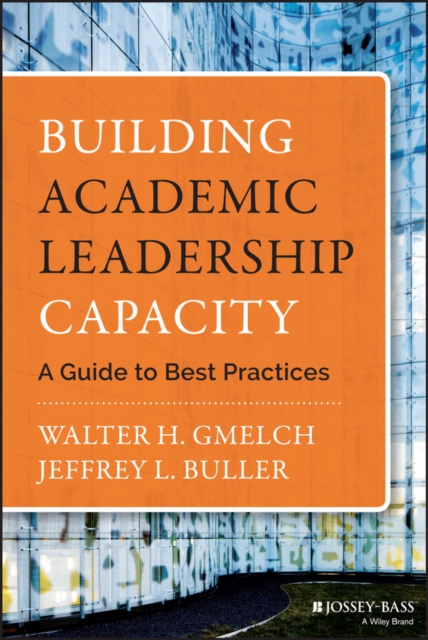
Building academic leadership capacity
A clear, systematic road map to effective campus leadership development Building Academic Leadership Capacity gives institutions the knowledge they need to invest in the next generation of academic leaders. With a clear, generalizable, systematic approach, this book provides insight into the elements of successful academic leadership and the training that makes it effective. Readers will explore original research that facilitates systematic, continuous program development, augmented by the authors' own insight drawn from experience establishing such programs. Numerous examples of current campus programs illustrate the concepts in action, and reflection questions lead readers to assess how they can apply these concepts to their own programs. The academic leader is the least studied and most misunderstood management position in America. Demands for accountability and the complexities of higher education leadership are increasing, and institutions need ways to shape leaders at the department chair, dean, and executive levels of all functions and responsibilities. This book provides a road map to an effective development program, whether the goal is to revamp an existing program or build one from the ground up. Readers will learn to: Develop campus leadership programs in a more systematic manner Examine approaches that have been proven effective at other institutions Consider how these approaches could be applied to your institution Give leaders the skills they need to overcome any challenge The field of higher education offers limited opportunity to develop leaders, so institutions must invest in and grow campus leaders themselves. All development programs are not created equal, so it's important to have the most effective methods in place from day one. For the institution seeking a better way to invest in the next generation of campus leaders, Building Academic Leadership Capacity is a valuable resource.
eBook

The impact of personal, professional and organizational characteristics on administrator burnout
The purpose of the study was threefold: to identify the most salient personal, professional, and organizational characteristics contributing to administrator burnout; to determine those correlational relationships that are most salient; and to assess the role of social support's impact on job satisfaction, burnout, and performance. A total of 1,000 principals and superintendents from Washington State were administered the Administrator Work Inventory. The authors identify different strategies to be taken to mitigate the various dimensions of burnout.
Journal Article

The Roles and Challenges of Deans
This paper examines the relationships between academic deans' roles, conflict, and ambiguity, and postulates that the same roles in which they engage today are regarded as challenges in the future which will not abate unless conflict and ambiguity are lessened. The authors discuss the implications of these issues and recommend strategies recommended for easing the burden of the deanship from personal, administrative, and positional perspectives.
Journal Article
Sources of Stress for Academic Department Chairpersons
Seeks to answer the following research questions: What job dimensions
are perceived as stressful by department chairs? To what degree do
chairs exhibit stress from their dual faculty and administrator roles?
What influence does academic discipline have on chair stress? and What
influence do personal attributes have on chair stress? Over 800
department chairs, stratified by discipline, were selected from research
and doctorate granting institutions and completed the Department Chair
Stress Index along with demographic questions. A response rate of 70.2
per cent was achieved. The results of the study indicate that, overall,
stress among department chairs appears to be monolithic in its effect.
Also chairs expressed high stress both in faculty and in administrative
areas of concern.
Journal Article