
Catalogue Search | MBRL


Are you sure you want to remove the book from the shelf?

{{itemTitle}}
6
result(s) for
"Goodrich, Peter, 1954- author"
Sort by:

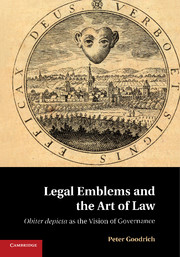
Legal Emblems and the Art of Law
The emblem book was invented by the humanist lawyer Andrea Alciato in 1531. The preponderance of juridical and normative themes, of images of rule and infraction, of obedience and error in the emblem books is critical to their purpose and interest. This book outlines the history of the emblem tradition as a juridical genre, along with the concept of, and training in, obiter depicta, in things seen along the way to judgment. It argues that these books depict norms and abuses in classically derived forms that become the visual standards of governance. Despite the plethora of vivid figures and virtual symbols that define and transmit law, contemporary lawyers are not trained in the critical apprehension of the visible. This book is the first to reconstruct the history of the emblem tradition, evidencing the extent to which a gallery of images of law already exists and structuring how the public realm is displayed, made present and viewed.
eBook

Law in the Courts of Love
Law in the Courts of Love traces the literary history and diversity of past legal systems. These 'minor jurisprudences' range from the spiritual laws of the courts of conscience to the code and judgements of love handed down by women's courts in medieval France. Professor Goodrich presents the 15th Century Courts of Love in Paris as one instance of an alternative jurisdiction drawn from the diversities of the legal and literary past. Their textual records are correspondingly mixed in genre, being in the form of poems, narratives, plays, treaties and judicial decisions. More broadly, these studies trace certain boundaries of modern law and make up one of many forms of legal knowledge which escape today's vision of a unitary law. The author believes that the unquesionable faith in a unity law and its distance from person and emotion is precisely what makes impossible the attention to the individual that justice ultimately requires. Law in the Courts of Love shows how the historical diversity of forms and procedures of law can competently form the basis for critical revisions of contemporary legal doctrine and professional practice. This book will be of interest to undergraduate and postgraduate students of law and literature, critical legal studies and legal history, or anyone wishing to specialise in feminist legal theory.
eBook

The Scene of the Mass Crime
The Scene of the Mass Crime takes up the unwritten history of the peculiar yet highly visible form of war crimes trials. These trials are the first and continuing site of the interface of law, history and film. From Nuremberg to the contemporary trials in Cambodia, film, in particular, has been crucial both as evidence of atrocity and as the means of publicizing the proceedings. But what does film bring to justice? Can law successfully address war crimes, atrocities, genocide? What do the trials actually show? What form of justice is done, and how does it relate to ordinary courts and proceedings? What lessons can be drawn from this history for the very topical political issue of filming civil and criminal trials? This book takes up the diversity and complexity of these idiosyncratic and, in strict terms, generally extra-legal medial situations. Drawing on a fascinating diversity of public trials and filmic responses, from the Trial of the Gang of Four to the Gacaca local courts of Rwanda to the filmic symbolism of 9-11, from Soviet era show trials to Nazi People's Courts leading international scholars address the theatrical, political, filmic and symbolic importance of show trials in making history, legitimating regimes and, most surprising of all, in attempting to heal trauma through law and through film. These essays will be of considerable interest to those working on international criminal law, transitional justice, genocide studies, and the relationship between law and film.
eBook
Politics, postmodernity and critical legal studies
This timely and assured book provides a unique guide to critical legal studies which is one of the most exciting developments within contemporary jurisprudence. It is the first book to systematically apply a critical philosophy to the substance of common law. The book develops a coruscating and interdisciplinary overview of the politics and cultural significance of the institutions of the law.
eBook