
Catalogue Search | MBRL


Are you sure you want to remove the book from the shelf?

{{itemTitle}}
1,103
result(s) for
"Gordon, Peter E"
Sort by:
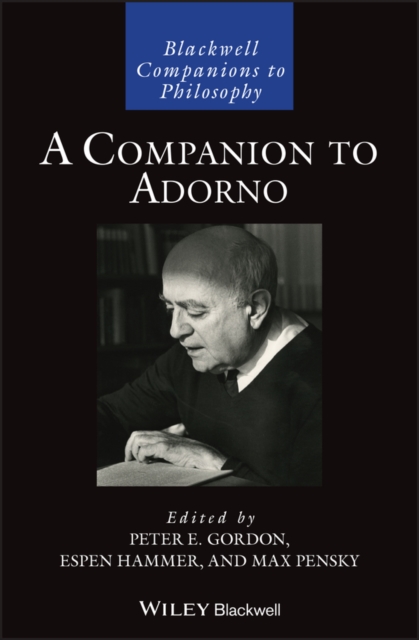
A Companion to Adorno
A definitive contribution to scholarship on Adorno, bringing together the foremost experts in the field
As one of the leading continental philosophers of the last century, and one of the pioneering members of the Frankfurt School, Theodor W. Adorno is the author of numerous influential—and at times quite radical—works on diverse topics in aesthetics, social theory, moral philosophy, and the history of modern philosophy, all of which concern the contradictions of modern society and its relation to human suffering and the human condition. Having authored substantial contributions to critical theory which contain searching critiques of the 'culture industry' and the 'identity thinking' of modern Western society, Adorno helped establish an interdisciplinary but philosophically rigorous study of culture and provided some of the most startling and revolutionary critiques of Western society to date.
The Blackwell Companion to Adorno is the largest collection of essays by Adorno specialists ever gathered in a single volume. Part of the acclaimed Blackwell Companions to Philosophy series, this important contribution to the field explores Adorno's lasting impact on many sub-fields of philosophy. Seven sections, encompassing a diverse range of topics and perspectives, explore Adorno's intellectual foundations, his critiques of culture, his views on ethics and politics, and his analyses of history and domination.
* Provides new research and fresh perspectives on Adorno's views and writings
* Offers an authoritative, single-volume resource for Adorno scholarship
* Addresses renewed interest in Adorno's significance to contemporary questions in philosophy
* Presents over 40 essays written by international-recognized experts in the field
A singular advancement in Adorno scholarship, the Companion to Adorno is an indispensable resource for Adorno specialists and anyone working in modern European philosophy, contemporary cultural criticism, social theory, German history, and aesthetics.
eBook

Weimar Thought
During its short lifespan, the Weimar Republic (1918-33) witnessed an unprecedented flowering of achievements in many areas, including psychology, political theory, physics, philosophy, literary and cultural criticism, and the arts. Leading intellectuals, scholars, and critics--such as Hannah Arendt, Walter Benjamin, Ernst Bloch, Bertolt Brecht, and Martin Heidegger--emerged during this time to become the foremost thinkers of the twentieth century. Even today, the Weimar era remains a vital resource for new intellectual movements. In this incomparable collection,Weimar Thoughtpresents both the specialist and the general reader a comprehensive guide and unified portrait of the most important innovators, themes, and trends of this fascinating period.
The book is divided into four thematic sections: law, politics, and society; philosophy, theology, and science; aesthetics, literature, and film; and general cultural and social themes of the Weimar period. The volume brings together established and emerging scholars from a remarkable array of fields, and each individual essay serves as an overview for a particular discipline while offering distinctive critical engagement with relevant problems and debates.
Whether used as an introductory companion or advanced scholarly resource,Weimar Thoughtprovides insight into the rich developments behind the intellectual foundations of modernity.
eBook

Secularization, Genealogy, and the Legitimacy of the Modern Age
This essay reconstructs the secularization debate between Blumenberg and Löwith. It explores what a genealogy of secular modernity can and cannot accomplish, asking how to build on Blumenberg's legacy without repeating his errors. Blumenberg absorbed the skepticism of a genealogy of secularism and responded with an unrealistic image of disconnected modernity, while also understanding that modernity might contain normative resources of its own not requiring the redemptive efforts of secularizing translation. The legitimacy of the modern age involves not only the secularizing redemption of religious norms but also a search for sources of profane hope beyond the confines of tradition.
Journal Article
Introduction: Reflections on the Fiftieth Anniversary of Hans Blumenberg's The Legitimacy of the Modern Age
This collection celebrates the semicentennial of the publication of Hans Blumenberg's The Legitimacy of the Modern Age. The question that inspired Blumenberg may continue to provoke readers today, when challenges to secularism have emerged both in academic discourse and in political life: Can modernity ground its own normativity without appealing to the religious past? Or must we abandon the attempt to seek a rational grounding for modern norms? Is secularism still valid as a political framework and as a cognitive and moral ideal, or is it mistaken to believe in the independence or \"self-assertion\" of secular modernity?
Journal Article

The Trace of God: Derrida and Religion
Derrida's writings on the question of religion have played a crucial role in the transformation of scholarly debate across the globe. The Trace of God provides a compact introduction to this debate. It considers Derrida's fraught relationship to Judaism and his Jewish identity, broaches the question of Derrida's relation to the Western Christian tradition, and examines both the points of contact and the silences in Derrida's treatment of Islam.
eBook
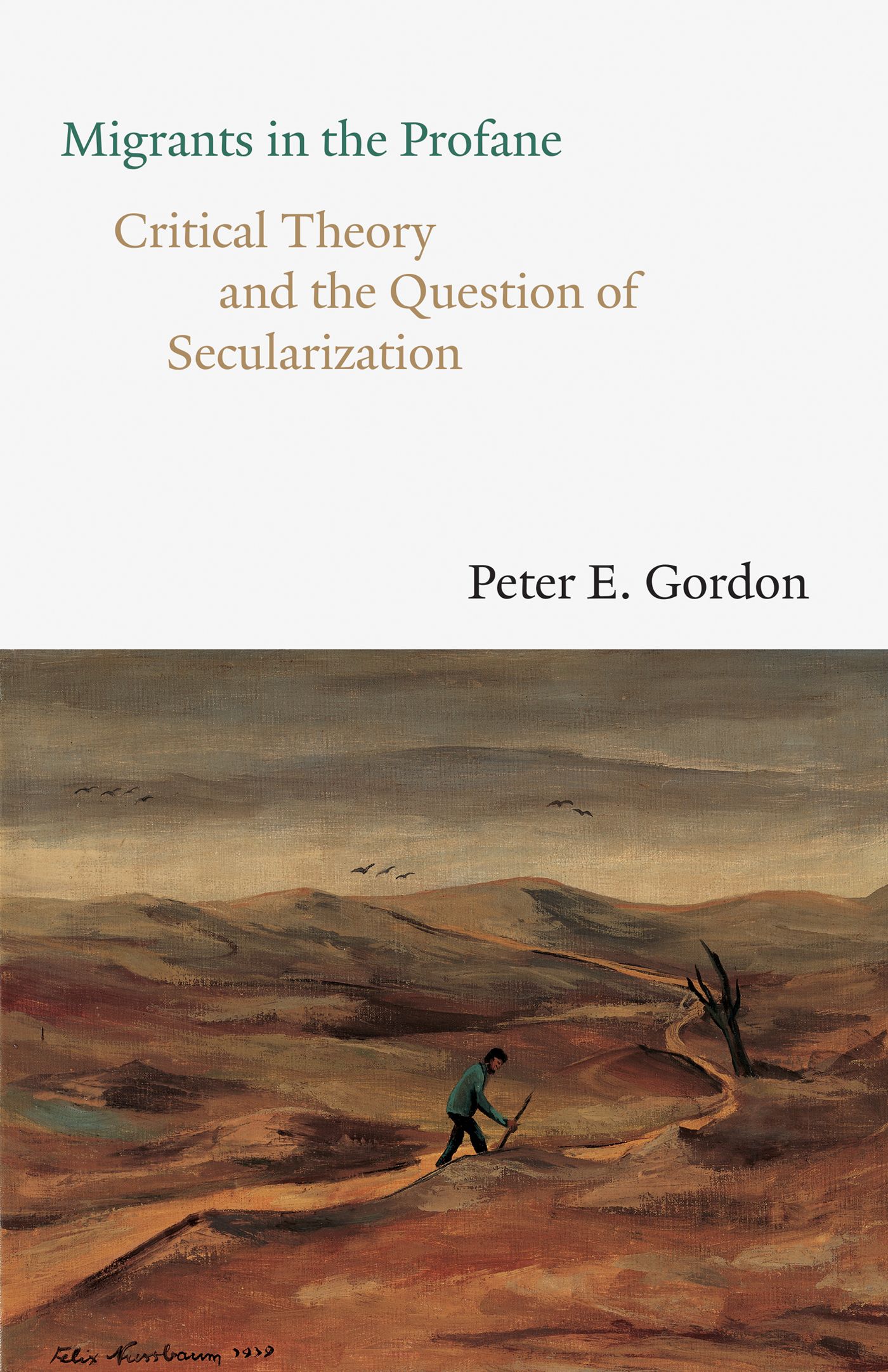
Migrants in the Profane
A beautifully written exploration of religion's role in a secular, modern politics, by an accomplished scholar of critical theoryMigrants in the Profane takes its title from an intriguing remark by Theodor W. Adorno, in which he summarized the meaning of Walter Benjamin's image of a celebrated mechanical chess-playing Turk and its hidden religious animus: \"Nothing of theological content will persist without being transformed; every content will have to put itself to the test of migrating in the realm of the secular, the profane.\" In this masterful book, Peter Gordon reflects on Adorno's statement and asks an urgent question: Can religion offer any normative resources for modern political life, or does the appeal to religious concepts stand in conflict with the idea of modern politics as a domain free from religion's influence? In answering this question, he explores the work of three of the Frankfurt School's most esteemed thinkers: Walter Benjamin, Max Horkheimer, and Theodor W. Adorno. His illuminating analysis offers a highly original account of the intertwined histories of religion and secular modernity.
eBook

Between Christian Democracy and Critical Theory: Habermas, Böckenförde, and the Dialectics of Secularization in Postwar Germany
Over the last twenty years, the classical theory of secularization has suffered a series of near fatal humiliations. It was Max Weber who deserves greatest credit for the orthodox thesis, according to which modernization brought an inevitable differentiation of value spheres, a thoroughgoing rationalization of procedure, and the consequent disenchantment of the world. The classical theory presupposed that the comprehensive metaphysical and normative authority of religion could not long survive once it stood exposed to the disarticulating processes of rationalization: charisma would yield to bureaucratic routine and, without the requisite authorization for normative consensus, the social whole would shatter into a mosaic of incommensurable parts. It is crucial to recall that German Christian Democracy gained institutional and ideological legitimacy in the early years of political trauma when a clean break from the Third Reich seemed a prerequisite for democratic participation. German conservatives who might otherwise have suffered from the stigmas of the past developed a legitimizing political-theological narrative that saw Nazism as the denouement of secularization. Adapted from the source document.
Journal Article

The Modernist Imagination
Some of the most exciting and innovative work in the humanities currently takes place at the intersection of intellectual history and critical theory. Just as critical theorists are becoming more aware of the historicity of theory, contemporary practitioners of modern intellectual history are recognizing their potential contributions to theoretical discourse. No one has done more than Martin Jay to realize the possibilities for mutual enrichment between intellectual history and critical theory. This carefully selected collection of essays addresses central questions and current practices of intellectual history and asks how the legacy of critical theory has influenced scholarship across a wide range of scholarly disciplines. In honor of Martin Jay's unparalleled achievements, this volume includes work from some of the most prominent contemporary scholars in the humanities and social sciences.
eBook
