
Catalogue Search | MBRL


Are you sure you want to remove the book from the shelf?

{{itemTitle}}
2
result(s) for
"Gouges, Olympe de, 1748-1793 author"
Sort by:
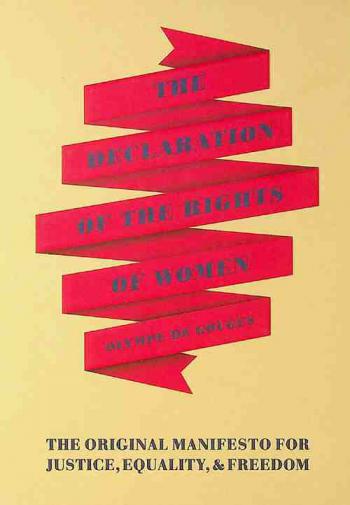
The declaration of the rights of women : the original manifesto for justice, equality, & freedom
Olympe de Gouges was the most important fighter for women's rights you've never heard of. An activist and writer in revolutionary Paris, she published 'The Declaration of the Rights of Women' in 1791, and was beheaded two years later, her articulate demands for equality proving too much for their time. Over one hundred and fifty years later, the key statements of her declaration were internationally endorsed by the United Nations in its Declaration on the Elimination of Discrimination against Women, which in turn went on to be legally recognized by nearly every country in the world. This volume presents both of these key texts along with enlightening and inspiring commentary from a host of powerful women, from Virginia Woolf to Hillary Clinton.
BOOK

Between the Queen and the Cabby
In Between the Queen and the Cabby, John Cole provides the first full translation of de Gouges's Rights of Woman and the first systematic commentary on its declaration, its attempt to envision a non-marital partnership agreement, and its support for persons of colour. Cole compares and contrasts de Gouges's two texts, explaining how the original text was both her model and her foil. By adding a proposed marriage contract to her pamphlet, she sought to turn the ideas of the French Revolution into a concrete way of life for women. Further examination of her work as a playwright suggests that she supported equality not only for women but for slaves as well. Cole highlights the historical context of de Gouges's writing, going beyond the inherent sexism and misogyny of the time in exploring why her work did not receive the reaction or achieve the influential status she had hoped for. Read in isolation in the gender-conscious twenty-first century, de Gouges's Rights of Woman may seem ordinary. However, none of her contemporaries, neither the Marquis de Condorcet nor Mary Wollstonecraft, published more widely on current affairs, so boldly attempted to extend democratic principles to women, or so clearly related the public and private spheres. Read in light of her eventual condemnation by the Revolutionary Tribunal, her words become tragically foresighted: \"Woman has the right to mount the Scaffold; she must also have that of mounting the Rostrum.\"
eBook