
Catalogue Search | MBRL


Are you sure you want to remove the book from the shelf?

{{itemTitle}}
34
result(s) for
"Grabe, Maria Elizabeth"
Sort by:

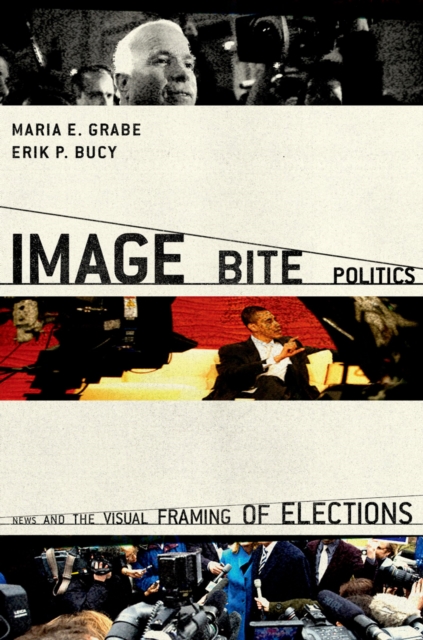
Image bite politics : news and the visual framing of elections
Image Bite Politics is the first book to systematically assess the visual presentation of presidential candidates in network news coverage of elections and to connect these visual images with shifts in public opinion. Presenting the results of a comprehensive visual analysis of general election news from 1992-2004, encompassing four presidential campaigns, the authors highlight the remarkably potent influence of television images when it comes to evaluating leaders. The book draws from a variety of disciplines, including political science, behavioral biology, cognitive neuroscience, and media studies in order to investigate the visual framing of elections in an interdisciplinary fashion. Moreover, the book presents findings that are counterintuitive and which challenge widely held assumptions; yet are supported by systematic data. For example, Republicans receive consistently more favorable visual treatment than Democrats, countering the conventional wisdom of a “liberal media bias”; and image bites are more prevalent, and in some elections more potent, in shaping voter opinions of candidates than sound bites. Finally, the authors provide a foundation for promoting visual literacy among news audiences and bring the importance of visual analysis to the forefront of research.
eBook

Demographic variation in how the social brain processes news messages
A high capacity for visual perception distinguishes Homo sapiens from other primates. This human ability to detect social cues and retain visual records of social networks has been tested mostly with static facial images in laboratory settings. However, media consumption has become closely entangled with the way social life is navigated. Therefore, the study reported here tested demographic differences (gender and education) in visual information processing of social and nonsocial objects featured in audiovisual news content. Women recognized (accuracy) and recalled (salience) social images better than men. On the other hand, men were more skilled at recognizing, but not recalling, nonsocial images. Participants with lower educational levels recognized and recalled fewer images than individuals with higher educational levels. Interactions between demographic variables and time suggest that memory records for social images are more stable than those for nonsocial images. Memory may have survival-relevant importance, serving navigational functions that vary across environmental demands, resulting in differences across demographic groups.
Journal Article
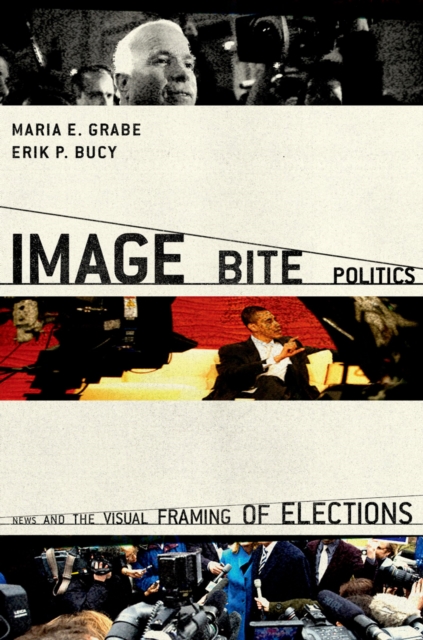
Image Bite Politics: News and the Visual Framing of Elections: News and the Visual Framing of Elections
Image Bite Politics is the first book to systematically assess the visual presentation of presidential candidates in network news coverage of elections and to connect these visual images with shifts in public opinion. Presenting the results of a comprehensive visual analysis of general election news from 1992-2004, encompassing four presidential campaigns, the authors highlight the remarkably potent influence of television images when it comes to evaluating leaders. The book draws from a variety of disciplines, including political science, behavioral biology, cognitive neuroscience, and media studies, to investigate the visual framing of elections in an incisive, fresh, and interdisciplinary fashion. Moreover, the book presents findings that are counterintuitive and challenge widely held assumptions--yet are supported by systematic data. For example, Republicans receive consistently more favorable visual treatment than Democrats, countering the conventional wisdom of a liberal media bias; and image bites are more prevalent, and in some elections more potent, in shaping voter opinions of candidates than sound bites. Finally, the authors provide a foundation for promoting visual literacy among news audiences and bring the importance of visual analysis to the forefront of research.
eBook
“Happy warriors” revisited Hedonic and agonic display repertoires of presidential candidates on the evening news
Absent from most analyses of political news are detailed assessments of the candidates' nonverbal behavior, which has been shown experimentally to have considerable persuasive influence. Unlike attractiveness and other relatively stable aspects of appearance, facial displays are highly variable and reveal important moment-to-moment information about the emitter's internal state. In this paper we argue that facial displays are influential elements within political news and examine the character of televised candidate displays over four presidential election cycles. The analysis considers coverage of major party nominees shown during the general elections of 1992, 1996, 2000, and 2004 on the major broadcast networks (ABC, CBS, and NBC). To motivate our hypotheses, we draw on the biopolitics literature that has identified three classes of displays relevant to the study of nonverbal political behavior: happiness/reassurance, anger/threat, and fear/evasion. The analysis focuses on the relationship between the display types shown in election coverage, the context in which the displays are shown, and candidate standings in the polls.
Journal Article

\Happy warriors\ revisited
Absent from most analyses of political news are detailed assessments of the candidates' nonverbal behavior, which has been shown experimentally to have considerable persuasive influence. Unlike attractiveness and other relatively stable aspects of appearance, facial displays are highly variable and reveal important moment-to-moment information about the emitter's internal state. In this paper we argue that facial displays are influential elements within political news and examine the character of televised candidate displays over four presidential election cycles. The analysis considers coverage of major party nominees shown during the general elections of 1992, 1996, 2000, and 2004 on the major broadcast networks (ABC, CBS, and NBC). To motivate our hypotheses, we draw on the biopolitics literature that has identified three classes of displays relevant to the study of nonverbal political behavior: happiness/reassurance, anger/threat, and fear/evasion. The analysis focuses on the relationship between the display types shown in election coverage, the context in which the displays are shown, and candidate standings in the polls. [PUBLICATION ABSTRACT]
Journal Article
\Happy warriors\ revisited - hedonic and agonic display repertoires of presidential candidates on the evening news
Absent from most analyses of political news are detailed assessments of the candidates' nonverbal behavior, which has been shown experimentally to have considerable persuasive influence. Unlike attractiveness and other relatively stable aspects of appearance, facial displays are highly variable and reveal important moment-to-moment information about the emitter's internal state. In this paper we argue that facial displays are influential elements within political news and examine the character of televised candidate displays over four presidential election cycles. The analysis considers coverage of major party nominees shown during the general elections of 1992, 1996, 2000, and 2004 on the major broadcast networks (ABC, CBS, and NBC). To motivate our hypotheses, we draw on the biopolitics literature that has identified three classes of displays relevant to the study of nonverbal political behavior: happiness/reassurance, anger/threat, and fear/evasion. The analysis focuses on the relationship between the display types shown in election coverage, the context in which the displays are shown, and candidate standings in the polls.
Journal Article

Turning Sexual Science Into News: Sex Research and the Media
In this article we report on the findings of a two-part project investigating contemporary issues in sexuality researchers' interaction with journalists. The goal of the project was to explore best practices and suggest curricular and training initiatives for sexuality researchers and journalists that would enhance the accurate dissemination of sexuality research results in the media. We present the results of a survey of a convenience sample of 94 sexuality researchers about their experiences and concerns regarding media coverage and a summary of the main themes that emerged from an invitational conference of sexuality researchers and journalists. In addition, we present some preliminary recommendations for training and best practices. Topics assessed include reporting accuracy; sex researchers' comfort with various topics, media, and journalists; researchers' perceptions of the purpose and content of articles; concern about the impact of media coverage; and training for sexuality researchers.
Journal Article

Sourcing and Reporting in News Magazine Programs: 60 Minutes versus Hard Copy
A number of studies consistently point at the disproportionate focus on elite news sources such as men in government and business while women, minorities, and working-class people are shown to be underrepresented as sources in the news. At the same time research reveals that soundbites from sources are shrinking while reporters are taking up increasingly more news airtime. In a society that rests on democratic ideals about the mass media's facilitation of a pluralistic public debate, these findings provoke concern. Virtually all studies on sourcing focus on newspapers and nightly television newscasts. This content analysis of 291 news stories focuses on tabloid and traditional news magazine programs. The findings of this study provide some support for the concerns about whose voices are heard in the news. Moreover, striking differences between tabloid and traditional news magazine sourcing patterns are revealed.
Journal Article