
Catalogue Search | MBRL


Are you sure you want to remove the book from the shelf?

{{itemTitle}}
64
result(s) for
"Graff, Nelson"
Sort by:


Advancing Assessment for Student Success
This book is about student success and how to support and improve it. It takes as its point of departure that we--as faculty, assessment directors, student affairs professionals, and staff--reflect together in a purposeful and informed way about how our teaching, curricula, the co-curriculum, and assessment work in concert to support and improve student learning and success. It also requires that we do so in collaboration with our colleagues and our students for the rich insights that we gain from them.Conversational in style, this book offers a wide variety of illustrations of how your peers are putting assessment into practice in ways that are meaningful to them and their institutions, and that lead to improved student learning. The authors provide rich guidance for activities ranging from everyday classroom teaching and assessment to using assessment to improve programs and entire institutions.The authors envisage individual faculty at four-year institutions and community colleges as their main audience, whether those faculty are focused on their own classes or support their colleagues through leadership roles in assessment. If you plan to remain focused on your own courses and students, you will find that those sections of this book will help you better understand why and how assessment leaders do what they do, which in turn will make your participation in assessment more engaging and increase your expertise in facilitating student learning. Because the authors also aim to strengthen connections between the curriculum and co-curriculum and include examples of co-curricular assessment, student affairs professionals and staff interested in doing the same will also find ideas in this book relevant to their work.Opening with a chapter on equity in assessment practice, so critical to learning from and benefitting our diverse students, the authors guide you through the development and use of learning outcomes, the design of assignments with attention to clear promp
eBook
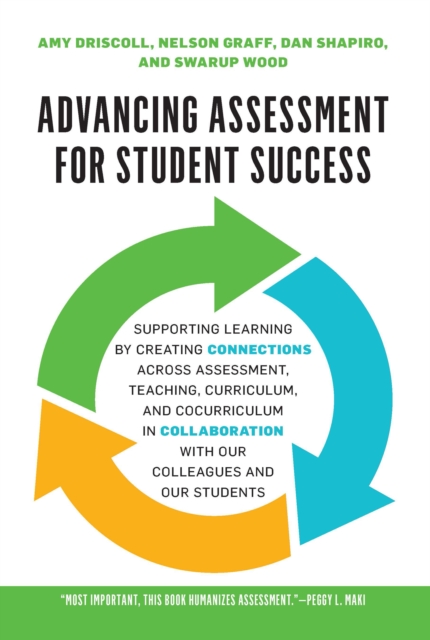
Advancing Assessment for Student Success: Supporting Learning by Connecting Assessment With Teaching, Curriculum, and Cocurriculum and Cultivating Collaborations With Our Colleagues and Our Students
This book is about student success and how to support and improve it. It takes as its point of departure that we--as faculty, assessment directors, student affairs professionals, and staff--reflect together in a purposeful and informed way about how our teaching, curricula, the co-curriculum, and assessment work in concert to support and improve student learning and success. It also requires that we do so in collaboration with our colleagues and our students for the rich insights that we gain from them.Conversational in style, this book offers a wide variety of illustrations of how your peers are putting assessment into practice in ways that are meaningful to them and their institutions, and that lead to improved student learning. The authors provide rich guidance for activities ranging from everyday classroom teaching and assessment to using assessment to improve programs and entire institutions.The authors envisage individual faculty at four-year institutions and community colleges as their main audience, whether those faculty are focused on their own classes or support their colleagues through leadership roles in assessment. If you plan to remain focused on your own courses and students, you will find that those sections of this book will help you better understand why and how assessment leaders do what they do, which in turn will make your participation in assessment more engaging and increase your expertise in facilitating student learning. Because the authors also aim to strengthen connections between the curriculum and co-curriculum and include examples of co-curricular assessment, student affairs professionals and staff interested in doing the same will also find ideas in this book relevant to their work.Opening with a chapter on equity in assessment practice, so critical to learning from and benefitting our diverse students, the authors guide you through the development and use of learning outcomes, the design of assignments with attention to clear prompts and rubrics, and the achievement of alignment and coherence in pedagogy, curriculum, and assessment to better support student engagement, achievement and success. The chapter on using student evidence for improvement offers support, resources, and recommendations for doing so, and demonstrates exciting uses of student wisdom.The book concludes by emphasizing the importance of reflection in assessment practices--offering powerful examples and strategies for professional development--and by describing appropriate, creative, and effective approaches for communicating assessment information with attention to purpose and audience.
eBook

Teaching Rhetorical Analysis to Promote Transfer of Learning
This article describes an assignment piloted in spring of 2008 called the Rhetorical Analysis Project, which required students to analyze three different texts addressing a common issue, compose an argument about the representation of that issue as illustrated by those texts, and revise that argument to match a rhetorical model they chose from some popular magazine. Such tasks have the potential to help students develop the rhetorical awareness and meta‐knowledge about writing that research suggests may help them transfer their learning about writing to new contexts and tasks. My investigation with students a semester after the class suggests that they believe they have experienced lasting changes in their reading and writing processes as a result of it, and therefore that such assignments may provide powerful alternatives to the formulaic writing that is taking increasing root in schools in response to high‐stakes testing. تصف هذه المقالة مهمة منفذة في ربيع 2008 سميت بمشروع التحليل الخطابي الذي طلب من الطلاب أن يحللوا ثلاثة نصوص مختلفة تناولوا من خلالها قضية مشتركة وشكلوا حجة حول تمثيل تلك القضية كما عرضت في تلك النصوص ونقحوا تلك الحجة لتناسب نظاماً خطابياً اختاروه من مجلة شعبية ما. ولدى المهام كهذه الاحتمالية لمساعدة الطلاب في تطوير الوعي الخطابي وما فوق المعرفة بشأن الكتابة التي تقترح الأبحاث أنها قد تساعدهم في نقل تعلمهم الكتابي إلى سياقات ومهام جديدة. ويقترح تحقيقي مع الطلاب بعد نهاية المادة بفصل دراسي أنهم يعتقدون أنهم أدركوا تغيرات مستديمة في عمليتيهم القرائية والكتابية بسببها وبالتالي قد توفر المهام كهذه بدائل قوية للكتابة النموذجية التي تتراسخ في المدراس مستجيبة للامتحانات ذات الأهمية الكبرى. 本文描述一项在2008年春天进行的「修辞分析研究计划」,其旨在初步测试一种学生习作。该习作要求学生分析三个不同的文本,但其内容都是有关同一个议题;撰文论述该三个文本对该议题的表征;并根据学生自己从一些流行杂志所选取的修辞模式,对其论述作出相应的修订。这些学习任务具有帮助学生发展修辞意识及有关写作的元知识的潜力。根据研究结果显示,其发展有助于学生把他们在写作方面的习得转移到新的语境中及新的学习任务上。作者在该课堂后的第二个学期里对学生进行调查,其结果显示,学生相信该课堂的经验令他们在学习阅读和写作过程方面,习得一些持久的改变。作者因此认为,这样的习作可提供强效能的另类教学方法,以别于为应对高风险测试而日益在学校里扎根的公式写作方法。 Cet article présente un projet réalisé au printemps 2008, appelé Projet d'analyse rhétorique, qui demandait aux élèves d'analyser trois textes différents concernant une même question, de composer un argumentaire se rapportant à cette question telle que présentée par ces textes, et de revoir l'argumentaire pour l'apparier à un modèle rhétorique qu'ils choisissaient dans un magazine populaire. Ces tâches sont en mesure d'aider les élèves à développer une conscience rhétorique et une métaconnaissance relative à l'écriture qui, selon les recherches, peut les aider à transférer ce qu'ils ont appris en matière d'écriture à de nouveaux contextes et à de nouvelles tâches. Mon investigation auprès des élèves, un semestre plus tard, permet de penser qu'ils pensent avoir bénéficié des changements durables dans leurs processus de lecture et d'écriture à la suite de cette expérience, et par conséquent que les devoirs de ce type peuvent constituer une puissante alternative à l'écriture conventionnelle qui est en train de prendre de plus en plus de place dans les écoles à la suite des tests. В рамках проекта по риторическому анализу, начатому весной 2008, учащиеся анализировали определенный аспект трех различных текстов. Они должны были составить аргументированное эссе с примерами того, как представлен этот аспект в предложенных текстах, а затем отредактировать свое эссе так, чтобы оно соответствовало риторической модели, которую школьники должны были сами выбрать из какого‐нибудь популярного журнала. Такого рода задачи развивают у учащихся способность к осознанию риторических аспектов письма и мета‐знание о создании письменного текста, что впоследствии – согласно данному исследованию – помогает им использовать эти знания для решения новых задач письма в новых контекстах. Опрос школьников, проведенный спустя семестр после описанных занятий, показывает, что эти занятия стали причиной глубоких, долгосрочных изменений в подходах учащихся к чтению и письму. Таким образом, подобные задания являют собой серьезную альтернативу тем трафаретным подходам к обучению письму, которые все чаще применяются в школах – особенно при подготовке к стандартному тестированию. Este artículo describe una tarea probada en la primavera de 2008 titulado el Proyecto de Análisis Retórico. Este proyecto exigía que los estudiantes analizaran tres diferentes textos sobre un tema común, crearan un argumento sobre la presentación de dicho tema como ilustrado en el texto, y revisaran el argumento para conformarlo a un modelo que ellos mismos debían escoger de una revista popular. Tales tareas pueden ayudar a los estudiantes a desarrollar la conciencia retórica y el meta‐conocimiento sobre la escritura que la investigación sugiere podría ayudarles a transferir lo que aprenden sobre la escritura a nuevos contextos y tareas. Mi investigación con los estudiantes un semestre después de la clase sugiere que ellos creen que han experimentado cambios permanentes en sus procesos de leer y escribir como resultado del proyecto, y que, por lo tanto, tales tareas pueden darles poderosas alternativas a la escritura basada en fórmulas que se está implantando en las escuelas debido a los exámenes de gran consecuencia.
Journal Article
From High School Curriculum to Literacy Network
This department focuses on literacy leaders, including school and instructional leaders, teachers, and external partners, who are working to improve outcomes for adolescent and adult learners in a wide range of education settings. Columns investigate the challenges and complexities inherent in such work and share lessons learned, impactful strategies and approaches, and promising pathways forward.
Journal Article

\An Effective and Agonizing Way to Learn\: Backwards Design and New Teachers' Preparation for Planning Curriculum
[...] they reflect the value for teacher educators of talking to our former students and hearing from them what worked and did not work about our classes. [...] these results suggest an opportunity for teacher educators focused on improving our preparation of teachers.
Journal Article

Reading across the Disciplines
Reading Across the Disciplines offers a collection of
twelve essays detailing a range of approaches to dealing with
students' reading needs at the college level. Transforming reading
in higher education requires more than individual faculty members
working on SoTL projects in their particular fields. Teachers need
to consider reading across the disciplines.
In this collection, authors from Australia and North America,
teaching in a variety of disciplines, explore reading in
undergraduate courses, doctoral seminars, and faculty development
activities. By paying attention to the particular classroom and
placing those observations in conversation with scholarly
literature, they create new knowledge about reading in higher
education from disciplinary and cross-disciplinary
perspectives.
Reading Across the Disciplines demonstrates how
existing research about reading can be applied to specific
classroom contexts, offering models for faculty members whose own
research interests may lie elsewhere but who believe in the
importance of reading.
eBook

Approaching Authentic Peer Review
The author describes using think-aloud protocol strategies across literacy instruction to improve peer review and help students develop critical skills that inform revision of their own texts. Specific classroom practices are described in detail
Journal Article

Literacy, Economy, and Power
Following on the groundbreaking contributions of Deborah Brandt’s Literacy in American Lives —a literacy ethnography exploring how ordinary Americans have been affected by changes in literacy, public education, and structures of power— Literacy, Economy, and Power expands Brandt’s vision, exploring the relevance of her theoretical framework as it relates to literacy practices in a variety of current and historical contexts, as well as in literacy’s expanding and global future. Bringing together scholars from rhetoric, composition, and literacy studies, the book offers thirteen engrossing essays that extend and challenge Brandt’s commentary on the dynamics between literacy and power.
The essays cover many topics, including the editor of the first Native American newspaper, the role of a native Hawaiian in bringing literacy to his home islands, the influence of convents and academies on nineteenth-century literacy, and the future of globalized digital literacies. Contributors include Julie Nelson Christoph, Ellen Cushman, Kim Donehower, Anne Ruggles Gere, Eli Goldblatt, Harvey J. Graff, Gail E. Hawisher, Bruce Horner, David A. Jolliffe, Rhea Estelle Lathan, Min-Zhan Lu, Robyn Lyons-Robinson, Carol Mattingly, Beverly J. Moss, Paul Prior, Cynthia L. Selfe, Michael W. Smith, and Morris Young. Literacy, Economy, and Power also features an introduction exploring the scholarly impact of Brandt’s work, written by editors John Duffy, Julie Nelson Christoph, Eli Goldblatt, Nelson Graff, Rebecca Nowacek, and Bryan Trabold. An invaluable tool for literacy studies at the graduate or professional level, Literacy, Economy, and Power provides readers with a wide-ranging view of the work being done in literacy studies today and points to ways researchers might approach the study of literacy in the future.
eBook