
Catalogue Search | MBRL


Are you sure you want to remove the book from the shelf?

{{itemTitle}}
1,708
result(s) for
"Green, Judith"
Sort by:


What Are the Health Benefits of Active Travel? A Systematic Review of Trials and Cohort Studies
Increasing active travel (primarily walking and cycling) has been widely advocated for reducing obesity levels and achieving other population health benefits. However, the strength of evidence underpinning this strategy is unclear. This study aimed to assess the evidence that active travel has significant health benefits.
The study design was a systematic review of (i) non-randomised and randomised controlled trials, and (ii) prospective observational studies examining either (a) the effects of interventions to promote active travel or (b) the association between active travel and health outcomes. Reports of studies were identified by searching 11 electronic databases, websites, reference lists and papers identified by experts in the field. Prospective observational and intervention studies measuring any health outcome of active travel in the general population were included. Studies of patient groups were excluded.
Twenty-four studies from 12 countries were included, of which six were studies conducted with children. Five studies evaluated active travel interventions. Nineteen were prospective cohort studies which did not evaluate the impact of a specific intervention. No studies were identified with obesity as an outcome in adults; one of five prospective cohort studies in children found an association between obesity and active travel. Small positive effects on other health outcomes were found in five intervention studies, but these were all at risk of selection bias. Modest benefits for other health outcomes were identified in five prospective studies. There is suggestive evidence that active travel may have a positive effect on diabetes prevention, which may be an important area for future research.
Active travel may have positive effects on health outcomes, but there is little robust evidence to date of the effectiveness of active transport interventions for reducing obesity. Future evaluations of such interventions should include an assessment of their impacts on obesity and other health outcomes.
Journal Article


The use of Qualitative Comparative Analysis (QCA) to address causality in complex systems: a systematic review of research on public health interventions
Background
Qualitative Comparative Analysis (QCA) is a method for identifying the configurations of conditions that lead to specific outcomes. Given its potential for providing evidence of causality in complex systems, QCA is increasingly used in evaluative research to examine the uptake or impacts of public health interventions. We map this emerging field, assessing the strengths and weaknesses of QCA approaches identified in published studies, and identify implications for future research and reporting.
Methods
PubMed, Scopus and Web of Science were systematically searched for peer-reviewed studies published in English up to December 2019 that had used QCA methods to identify the conditions associated with the uptake and/or effectiveness of interventions for public health. Data relating to the interventions studied (settings/level of intervention/populations), methods (type of QCA, case level, source of data, other methods used) and reported strengths and weaknesses of QCA were extracted and synthesised narratively.
Results
The search identified 1384 papers, of which 27 (describing 26 studies) met the inclusion criteria. Interventions evaluated ranged across: nutrition/obesity (
n
= 8); physical activity (
n
= 4); health inequalities (
n
= 3); mental health (
n
= 2); community engagement (
n
= 3); chronic condition management (
n
= 3); vaccine adoption or implementation (
n
= 2); programme implementation (
n
= 3); breastfeeding (
n
= 2), and general population health (
n
= 1). The majority of studies (
n
= 24) were of interventions solely or predominantly in high income countries. Key strengths reported were that QCA provides a method for addressing causal complexity; and that it provides a systematic approach for understanding the mechanisms at work in implementation across contexts. Weaknesses reported related to data availability limitations, especially on ineffective interventions. The majority of papers demonstrated good knowledge of cases, and justification of case selection, but other criteria of methodological quality were less comprehensively met.
Conclusion
QCA is a promising approach for addressing the role of context in complex interventions, and for identifying causal configurations of conditions that predict implementation and/or outcomes when there is sufficiently detailed understanding of a series of comparable cases. As the use of QCA in evaluative health research increases, there may be a need to develop advice for public health researchers and journals on minimum criteria for quality and reporting.
Journal Article

Forging the kingdom : power in English society, 973-1189
\"Between the imperial coronation of Edgar in 973 and the death of Henry II in 1189, English society was transformed. This lively and wide-ranging study explores social and political change in England across this period, and examines the reasons for such developments, as well as the many continuities. By putting the events of 1066 firmly in the middle of her account, Judith Green casts new light on the significance of the Norman Conquest. She analyses the changing ways that kings, lords and churchmen exercised power, especially through the building of massive stone cathedrals and numerous castles, and highlights the importance of London as the capital city. The book also explores themes such as changes in warfare, the decline of slavery and the integration of the North and South West, as well as concepts such as state, nationalism and patriarchy\"-- Provided by publisher.
Book

Monitoring democracy
In recent decades, governments and NGOs--in an effort to promote democracy, freedom, fairness, and stability throughout the world--have organized teams of observers to monitor elections in a variety of countries. But when more organizations join the practice without uniform standards, are assessments reliable? When politicians nonetheless cheat and monitors must return to countries even after two decades of engagement, what is accomplished? Monitoring Democracy argues that the practice of international election monitoring is broken, but still worth fixing. By analyzing the evolving interaction between domestic and international politics, Judith Kelley refutes prevailing arguments that international efforts cannot curb government behavior and that democratization is entirely a domestic process. Yet, she also shows that democracy promotion efforts are deficient and that outside actors often have no power and sometimes even do harm.
Analyzing original data on over 600 monitoring missions and 1,300 elections, Kelley grounds her investigation in solid historical context as well as studies of long-term developments over several elections in fifteen countries. She pinpoints the weaknesses of international election monitoring and looks at how practitioners and policymakers might help to improve them.
eBook

Pragmatism and diversity : Dewey in the context of late twentieth century debates
\"Diversity is both an unavoidable aspect of twenty-first century living and a powerful challenge to older philosophical traditions that still assume as normatively universal a set of values, ways of thinking, institutions, and habits of living that emerged within earlier eras of more homogeneous cultures, less developed technologies, and more accepted forms of linguistic, legal, religious, economic, political, and military domination. Within recent years, new styles of philosophical discourse, including deconstruction, postmodernism, feminism, post-colonialism, and critical race theory, have persuasively challenged these universalistic assumptions to reveal the important human differences they marginalize. Experience-based appreciation of the mutually educative potential of diverse standpoints as well as sober concern about the perils of our present times have led many thinkers to look for contemporary forms of pragmatism and cosmopolitanism as hospitable intellectual gathering places for urgently needed cross-difference conversations that may reflect and give substance to shared visions of democratic diversity. The eight authors in this volume engage in cross-difference conversations with other thinkers from earlier periods and other philosophical traditions, as well as with each other, in order to reconstruct pragmatism and cosmopolitanism in ways that are more attuned to our lived experience of diversity as well as our hopes for a diversity-appreciating democratic future\"-- Provided by publisher.
Book

The Normans
A bold new history of the rise and expansion of the Norman
Dynasty across Europe from Byzantium to England In the
eleventh century the climate was improving, population was growing,
and people were on the move. The Norman dynasty ranged across
Europe, led by men who achieved lasting fame like William the
Conqueror and Robert Guiscard. These figures cultivated an image of
unstoppable Norman success and their victories make for a great
story, but how much of it is true? In this insightful history,
Judith Green challenges old certainties and explores the reality of
Norman life across the continent. There were many soldiers of
fortune, but their successes were down to timing, good luck, and
ruthless leadership. Green shows the Normans' profound impact, from
drastic change in England to laying the foundations for unification
in Sicily, to their contribution to the First Crusade. Going beyond
the familiar, she looks at personal dynastic relationships and the
important part women played in what at first sight seems a
resolutely masculine world.
eBook
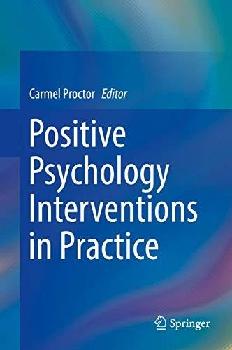
Positive Psychology Interventions in Practice
\"This book presents recent advancements in positive psychology, specifically its application across broad areas of current interest. Chapters include submissions from various international authors in the field and cover discussion and presentation of relevant research, theories, and applications. The volume covers topics such as CBT, Psychotherapy, Coaching, Workplaces, Aging, Education, Leadership, Emotion, Interventions, Measurement, Technology, Design, Health, Relationships, Experiences, Communities. With the growing interest in the applications of positive psychology across diverse fields within psychology and beyond, this book will make a worthwhile contribution to the field. It will also fill the current need for a volume that highlights specifically the various recent advancements in positive psychology into diverse fields and as such will be of benefit to a wide range of professionals, including psychologists, educators, clinicians, therapists, and many others.\" -- Publisher's website.
Book
