
Catalogue Search | MBRL


Are you sure you want to remove the book from the shelf?

{{itemTitle}}
906
result(s) for
"Green, Rachel"
Sort by:

Cat in trouble
Bringing the star of smash-hit Sunday Times bestselling Alfie the Doorstep Cat to a younger readership with a brand new ALFIE story. Alfie is everyone's favourite cat. A big ball of grey fur who changes the lives of every family he meets. When the Clover family move into Alfie's neighbourhood he soon makes friends with eight-year-old Stanley Clover. Stanley wants to be a famous explorer and takes Alfie along on his adventures. But Alfie soon realises that Stanley is unhappy. He is jealous of his talented sister Viola and feels ignored by his mum and dad who only ever seem to notice him when he gets into trouble. Can Alfie help Stanley get noticed for the right reasons?
Book

Ribosomopathies
Ribosomopathies are t issuespecific disorders that result from mutations in ribosomal proteins or ribosome biogenesis factors. Such disorders include Diamond-Blackfan anemia, isolated congenital asplenia, and Treacher Collins syndrome. Mills and Green review the underlying mechanisms of tissue-specific defects in these and related disorders. Because ribosomes are central to all cellular life, it is puzzling why mutations in components of the ribosome disproportionately affect certain tissues. The authors suggest that ribosome homeostasis is an overarching and simplifying principle that governs the sensitivity of specific cells and tissue types to mutation in components of the translational machinery. Science , this issue p. eaan2755 Ribosomopathies are a group of human disorders most commonly caused by ribosomal protein haploinsufficiency or defects in ribosome biogenesis. These conditions manifest themselves as physiological defects in specific cell and tissue types. We review current molecular models to explain ribosomopathies and attempt to reconcile the tissue specificity of these disorders with the ubiquitous requirement for ribosomes in all cells. Ribosomopathies as a group are diverse in their origins and clinical manifestations; we use the well-described Diamond-Blackfan anemia (DBA) as a specific example to highlight some common features. We discuss ribosome homeostasis as an overarching principle that governs the sensitivity of specific cells and tissue types to ribosomal protein mutations. Mathematical models and experimental insights rationalize how even subtle shifts in the availability of ribosomes, such as those created by ribosome haploinsufficiency, can drive messenger RNA–specific effects on protein expression. We discuss recently identified roles played by ribosome rescue and recycling factors in regulating ribosome homeostasis.
Journal Article
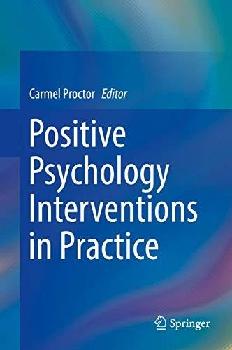
Positive Psychology Interventions in Practice
\"This book presents recent advancements in positive psychology, specifically its application across broad areas of current interest. Chapters include submissions from various international authors in the field and cover discussion and presentation of relevant research, theories, and applications. The volume covers topics such as CBT, Psychotherapy, Coaching, Workplaces, Aging, Education, Leadership, Emotion, Interventions, Measurement, Technology, Design, Health, Relationships, Experiences, Communities. With the growing interest in the applications of positive psychology across diverse fields within psychology and beyond, this book will make a worthwhile contribution to the field. It will also fill the current need for a volume that highlights specifically the various recent advancements in positive psychology into diverse fields and as such will be of benefit to a wide range of professionals, including psychologists, educators, clinicians, therapists, and many others.\" -- Publisher's website.
Book

Stop codon context influences genome-wide stimulation of termination codon readthrough by aminoglycosides
Stop codon readthrough (SCR) occurs when the ribosome miscodes at a stop codon. Such readthrough events can be therapeutically desirable when a premature termination codon (PTC) is found in a critical gene. To study SCR in vivo in a genome-wide manner, we treated mammalian cells with aminoglycosides and performed ribosome profiling. We find that in addition to stimulating readthrough of PTCs, aminoglycosides stimulate readthrough of normal termination codons (NTCs) genome-wide. Stop codon identity, the nucleotide following the stop codon, and the surrounding mRNA sequence context all influence the likelihood of SCR. In comparison to NTCs, downstream stop codons in 3′UTRs are recognized less efficiently by ribosomes, suggesting that targeting of critical stop codons for readthrough may be achievable without general disruption of translation termination. Finally, we find that G418-induced miscoding alters gene expression with substantial effects on translation of histone genes, selenoprotein genes, and S-adenosylmethionine decarboxylase (AMD1). Many genes provide a set of instructions needed to build a protein, which are read by structures called ribosomes through a process called translation. The genetic information contains a short, coded instruction called a stop codon which marks the end of the protein. When a ribosome finds a stop codon it should stop building and release the protein it has made. Ribosomes do not always stop at stop codons. Certain chemicals can actually prevent ribosomes from detecting stop codons correctly, and aminoglycosides are drugs that have exactly this effect. Aminoglycosides can be used as antibiotics at low doses because they interfere with ribosomes in bacteria, but at higher doses they can also prevent ribosomes from detecting stop codons in human cells. When ribosomes do not stop at a stop codon this is called readthrough. There are different types of stop codons and some are naturally more effective at stopping ribosomes than others. Wangen and Green have now examined the effect of an aminoglycoside called G418 on ribosomes in human cells grown in the laboratory. The results showed how ribosomes interacted with genetic information and revealed that certain stop codons are more affected by G418 than others. The stop codon and other genetic sequences around it affect the likelihood of readthrough. Wangen and Green also showed that sequences that encourage translation to stop are more common in the area around stop codons. These findings highlight an evolutionary pressure driving more genes to develop strong stop codons that resist readthrough. Despite this, some are still more affected by drugs like G418 than others. Some genetic conditions, like cystic fibrosis, result from incorrect stop codons in genes. Drugs that promote readthrough specifically in these genes could be useful new treatments.
Journal Article
miRNA-Mediated Gene Silencing by Translational Repression Followed by mRNA Deadenylation and Decay
microRNAs (miRNAs) regulate gene expression through translational repression and/or messenger RNA (mRNA) deadenylation and decay. Because translation, deadenylation, and decay are closely linked processes, it is important to establish their ordering and thus to define the molecular mechanism of silencing. We have investigated the kinetics of these events in miRNA-mediated gene silencing by using a Drosophila S2 cell-based controllable expression system and show that mRNAs with both natural and engineered 3' untranslated regions with miRNA target sites are first subject to translational inhibition, followed by effects on deadenylation and decay. We next used a natural translational elongation stall to show that miRNA-mediated silencing inhibits translation at an early step, potentially translation initiation.
Journal Article

Ribosome pausing, arrest and rescue in bacteria and eukaryotes
Ribosomes translate genetic information into polypeptides in several basic steps: initiation, elongation, termination and recycling. When ribosomes are arrested during elongation or termination, the cell's capacity for protein synthesis is reduced. There are numerous quality control systems in place to distinguish between paused ribosomes that need some extra input to proceed and terminally stalled ribosomes that need to be rescued. Here, we discuss similarities and differences in the systems for resolution of pauses and rescue of arrested ribosomes in bacteria and eukaryotes, and how ribosome profiling has transformed our ability to decipher these molecular events.
This article is part of the themed issue ‘Perspectives on the ribosome’.
Journal Article
Parsimonious Model for Gene Regulation by miRNAs
MicroRNAs (miRNAs) and small interfering RNAs (siRNAs) act with the Argonaute family of proteins to regulate target messenger RNAs (mRNAs) posttranscriptionally. SiRNAs typically induce endonucleolytic cleavage of mRNA with near-perfect complementarity. For targets with less complementarity, both translational repression and mRNA destabilization mechanisms have been implicated in miRNA-mediated gene repression, although the timing, coupling, and relative importance of these events have not been determined. Here, we review gene-specific and global approaches that probe miRNA function and mechanism, looking for a unifying model. More systematic analyses of the molecular specificities of the core components coupled with analysis of the relative timing of the different events will ultimately shed light on the mechanism of miRNA-mediated repression.
Journal Article
A systematically-revised ribosome profiling method for bacteria reveals pauses at single-codon resolution
In eukaryotes, ribosome profiling provides insight into the mechanism of protein synthesis at the codon level. In bacteria, however, the method has been more problematic and no consensus has emerged for how to best prepare profiling samples. Here, we identify the sources of these problems and describe new solutions for arresting translation and harvesting cells in order to overcome them. These improvements remove confounding artifacts and improve the resolution to allow analyses of ribosome behavior at the codon level. With a clearer view of the translational landscape in vivo, we observe that filtering cultures leads to translational pauses at serine and glycine codons through the reduction of tRNA aminoacylation levels. This observation illustrates how bacterial ribosome profiling studies can yield insight into the mechanism of protein synthesis at the codon level and how these mechanisms are regulated in response to changes in the physiology of the cell.
Journal Article

Translational control of stem cell function
Stem cells are characterized by their ability to self-renew and differentiate into many different cell types. Research has focused primarily on how these processes are regulated at a transcriptional level. However, recent studies have indicated that stem cell behaviour is strongly coupled to the regulation of protein synthesis by the ribosome. In this Review, we discuss how different translation mechanisms control the function of adult and embryonic stem cells. Stem cells are characterized by low global translation rates despite high levels of ribosome biogenesis. The maintenance of pluripotency, the commitment to a specific cell fate and the switch to cell differentiation depend on the tight regulation of protein synthesis and ribosome biogenesis. Translation regulatory mechanisms that impact on stem cell function include mTOR signalling, ribosome levels, and mRNA and tRNA features and amounts. Understanding these mechanisms important for stem cell self-renewal and differentiation may also guide our understanding of cancer grade and metastasis.Stem cells are well known to be controlled transcriptionally, but recent studies indicate that pluripotency, cell fate and differentiation depend on the regulation of translation and ribosome biogenesis by mTOR signalling, ribosome levels, and mRNA and tRNA features. Elucidating these stem cell regulatory mechanisms may increase our understanding of tumorigenesis.
Journal Article

Kinetic analysis reveals the ordered coupling of translation termination and ribosome recycling in yeast
Although well defined in bacterial systems, the molecular mechanisms underlying ribosome recycling in eukaryotic cells have only begun to be explored. Recent studies have proposed a direct role for eukaryotic termination factors eRF1 and eRF3 (and the related factors Dom34 and Hbs1) in downstream recycling processes; however, our understanding of the connection between termination and recycling in eukaryotes is limited. Here, using an in vitro reconstituted yeast translation system, we identify a key role for the multifunctional ABC-family protein Rli1 in stimulating both eRF1-mediated termination and ribosome recycling in yeast. Through subsequent kinetic analysis, we uncover a network of regulatory features that provides mechanistic insight into how the events of termination and recycling are obligately ordered. These results establish a model in which eukaryotic termination and recycling are not clearly demarcated events, as they are in bacteria, but coupled stages of the same release-factor mediated process.
Journal Article