
Catalogue Search | MBRL


Are you sure you want to remove the book from the shelf?

{{itemTitle}}
101
result(s) for
"Green, Ronald Michael"
Sort by:


Babies by Design
We stand on the brink of unprecedented growth in our ability to understand and change the human genome. New reproductive technologies now enable parents to select some genetic traits for their children, and soon it will be possible to begin to shape ourselves as a species. Despite the loud cries of alarm that such a prospect inspires, Ronald Green argues that we will-and we should-undertake the direction of our own evolution.
A leader in the bioethics community, Green offers a scientifically and ethically informed view of human genetic self-modification and the possibilities it opens up for a better future. Fears of a terribleBrave New Worldor a new eugenics movement are overblown, he maintains, and in the more likely future, genetic modifications may improve parents' ability to enhance children's lives and may even promote social justice.
The author outlines the new capabilities of genomic science, addresses urgent questions of safety that genetic interventions pose, and explores questions of parenting and justice. He also examines the religious implications of gene modification. Babies by design are assuredly in the future, Green concludes, and by making responsible choices as we enter that future, we can incorporate gene technology in a new age of human adventure.
eBook


Last Word: Imagining the Future
H. G. Wells warned, in 1895, not to allow economic injustices to become to so acute that they ultimately transform human biology. Wells's warning is all the more pertinent today as society contemplates the use of biotechnologies to manipulate or \"enhance\" the human genome.
Journal Article

Global bioethics : issues of conscience for the twenty-first century
Medical care and biomedical research are rapidly becoming global. Ethical questions that once arose only in the narrow context of the physician-patient relationship in relatively prosperous societies are now being raised across societies, cultures, and continents. For example, what should be the \"standard of care\" for clinical trials of medical innovations in poorer countries? Are researchers obligated to compare new therapies or drugs with the best known ones available, or can they use as a benchmark the actual treatments (or lack of treatments) available to poor people? Should pharmaceutical companies seeking to lower the costs of new drug trials be allowed to enrol citizens of less developed countries in them even when those individuals cannot afford and will not be eligible for the resulting drugs? More generally, should the norms of medicine and research be the same across cultures or can they adapt to local social, economic, or religious conditions? Global Bioethics gathers some of the world's leading bioethicists to explore many of the new questions raised by the globalization of medical care and biomedical research. Among the topics covered are the impact of globalization on the norms of medical ethics, the conduct of international research, the ethics of international collaborations, challenges to medical professionalism in the international setting, and the relation of religion to global bioethics.
eBook
10 virtues of outstanding leaders : leadership & character
What makes a good leader? Ten leaders, ten key virtues
This readable distillation of the core common features of successful leaders shows how an individual's character, and especially their virtue, is the defining factor. Without these ten vital virtues, leadership becomes \"misleadership.\" The authors, both renowned business ethicists, combine theory with fascinating biographical detail on exemplary leaders such as Abraham Lincoln, Winston Churchill, and Oprah Winfrey. The result is an accessible text on the ethics of leadership which, unlike many publications that claim to reveal the secrets of success as a leader, is informed by a wealth of exceptional academic experience.
eBook
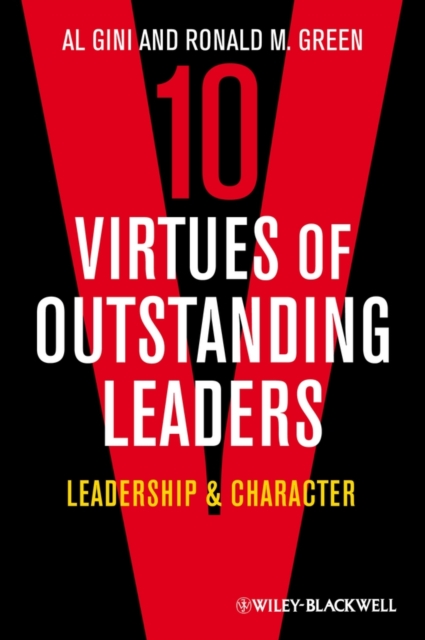
Ten virtues of outstanding leaders
What makes a good leader? Ten leaders, ten key virtuesThis readable distillation of the core common features of successful leaders shows how an individual's character, and especially their virtue, is the defining factor. Without these ten vital virtues, leadership becomes 'misleadership.' The authors, both renowned business ethicists, combine theory with fascinating biographical detail on exemplary leaders such as Abraham Lincoln, Winston Churchill, and Oprah Winfrey. The result is an accessible text on the ethics of leadership which, unlike many publications that claim to reveal the secrets of success as a leader, is informed by a wealth of exceptional academic experience.
eBook

Ten Virtues of Outstanding Leaders
What makes a good leader? Ten leaders, ten key virtuesThis readable distillation of the core common features of successful leaders shows how an individual's character, and especially their virtue, is the defining factor. Without these ten vital virtues, leadership becomes 'misleadership.' The authors, both renowned business ethicists, combine theory with fascinating biographical detail on exemplary leaders such as Abraham Lincoln, Winston Churchill, and Oprah Winfrey. The result is an accessible text on the ethics of leadership which, unlike many publications that claim to reveal the secrets of success as a leader, is informed by a wealth of exceptional academic experience.
Book
U.S. Defunding of UNFPA: A Moral Analysis
Green comments on the decision of Sec of State Colin Powell to halt the US funding for the United Nations Fund for Population Activities (UNFPA). Details on the historical background of the UNFPA and the recent actions of the US administration towards UNFPA are presented.
Journal Article