
Catalogue Search | MBRL


Are you sure you want to remove the book from the shelf?

{{itemTitle}}
35
result(s) for
"Greenberg, Cheryl Lynn"
Sort by:


Troubling the waters
Was there ever really a black-Jewish alliance in twentieth-century America? And if there was, what happened to it? In Troubling the Waters, Cheryl Greenberg answers these questions more definitively than they have ever been answered before, drawing the richest portrait yet of what was less an alliance than a tumultuous political engagement—but one that energized the civil rights revolution, shaped the agenda of liberalism, and affected the course of American politics as a whole. Drawing on extensive new research in the archives of organizations such as the NAACP and the Anti-Defamation League, Greenberg shows that a special black-Jewish political relationship did indeed exist, especially from the 1940s to the mid-1960s—its so-called \"golden era\"—and that this engagement galvanized and broadened the civil rights movement. But even during this heyday, she demonstrates, the black-Jewish relationship was anything but inevitable or untroubled. Rather, cooperation and conflict coexisted throughout, with tensions caused by economic clashes, ideological disagreements, Jewish racism, and black anti-Semitism, as well as differences in class and the intensity of discrimination faced by each group.
eBook
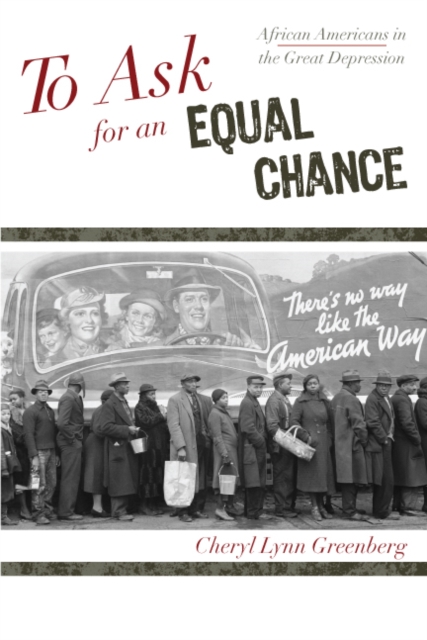
To Ask for an Equal Chance
The Great Depression hit Americans hard, but none harder than African Americans and the working poor.To Ask for an Equal Chance explores black experiences during this period and the intertwined challenges posed by race and class.
eBook


And Why Not Every Man?
In 1945 the American Jewish Congress established its Commission on Law and Social Action (CLSA) to “combat anti-Semitic violence, defamation and discrimination” and to “fight every manifestation of racism and . . . promote the civil and political equality of all minorities in America.” The two commitments were linked because, in the words of its chairman, Shad Polier, “we view the fight for equality as indivisible and as part of the general struggle to protect democracy.” The CLSA’s methods promised make those ideals concrete. It intended to mobilize “the Jewish community as a whole” against all forms of legal and
Book Chapter
Wars and Rumors of Wars
The rise of Nazism proved pivotal for the development of a political relationship between blacks and Jews. The need to organize against the rising tide of hatred in Europe and to some extent at home, challenged the two communities to transcend entrepreneurial tensions and compelled their civil rights groups to reconsider their behind-the-scenes strategies. Earlier approaches were slow to change, but by the early 1940s a wide range of liberal black and Jewish agencies had become more public and more political. In addition, their desire to bolster strength through coalitions with like-minded groups moved them for the first time beyond
Book Chapter
Red Menace
Communism posed particular challenges for liberals engaged in civil rights. Communists as well as noncommunist leftists had long been active in antiracist and civil rights struggles as courageous and committed advocates at a time when few other allies were to be had. Their economic critique of racism and mass-action tactics brought something new and important to the civil rights struggle. But many desired revolution more than democracy. They were also targets of intense fear and antagonism, so collaboration with them intensified attacks from the right. These facts forced liberals into difficult choices.
If the question of whether to work with
Book Chapter
Settling In
Writers discussing “black-Jewish relations” often treat the subject as timeless. Both those who argue for a “natural alliance” of African Americans and American Jews and those positing a more pernicious relationship imply almost by definition a longstanding and ongoing special connection felt by members of the two communities. Whatever the truth of such claims in the twentieth century, they are certainly false for the past, as a quick historical look will reveal. At the same time, many of the components that would shape the future relationship between black and Jewish Americans, for good and for ill, can already be seen
Book Chapter
Of Our Economic Strivings
The economic catastrophe of the Great Depression encouraged greater political activity by both blacks and Jews at the same time as it heightened economic tensions between them. The contradictions between shared political concerns and competing economic interests that had emerged in the early years of the century intensified; relations worsened between the two communities at the same time that their civil rights agencies came into increased contact. The black-Jewish coalition was off to a rocky start.
For African Americans, the era brought gains as well as losses. Economically devastated, black communities organized politically and, as a result, benefited from government
Book Chapter