
Catalogue Search | MBRL


Are you sure you want to remove the book from the shelf?

{{itemTitle}}
33
result(s) for
"Greenberg, Danna"
Sort by:


Building gender inclusivity
Despite increased attention on women in business, concerns abound regarding the extent to which business schools are creating inclusive learning environments that support the leadership development of both male and female students. Using an organizational demography lens, we investigate the interactive effects of student gender, faculty gender, and classroom demography on class participation. We focus on class participation as it is essential to students' overall learning and development especially concerning leadership. Our findings demonstrate that student and faculty demography interacts with context in unexpected ways to affect participation. Specifically, when women students are in the minority and have a female professor, they receive higher participation grades, particularly as class size decreases. The findings from this study have important implications for business school faculty and administrators as they work to build more inclusive learning environments which support all students' development as leaders. (HRK / Abstract übernommen).
Journal Article
The new entrepreneurial leader
In years past, the keywords for leaders were confidence, single-minded purpose, and strategic planning. But today's vastly complex, globalized, and fast-evolving world requires a different kind of leadership. This game-changing book details a new approach—entrepreneurial leadership—developed at Babson College, the number-one school for entrepreneurship in the world. Entrepreneurial leadership is inspired by, but is separate from, entrepreneurship. It can be applied in any organizational situation, not just start-ups. Based on two years of extensive research, it embraces three principles that add up to a fundamentally new worldview of business and a new logic of decision making. First, rapid change and increasing uncertainty require leaders to be “cognitively ambidextrous,” able to shift between traditional “prediction logic” (choosing actions based on analysis) and “creation logic” (taking action despite considerable unknowns). Guiding this different way of thinking and acting is a new view of business, where simultaneous creation of social, environmental, and economic value is the order of the day. Finally, entrepreneurial leaders leverage their understanding of themselves and their social context to guide effective action. Each chapter offers concrete examples of how educators across all disciplines are integrating these ideas into their courses—and even their entire curricula. The New Entrepreneurial Leader lays out a comprehensive new paradigm for reinventing management education in order to mold leaders who will shape social and economic opportunity.
eBook

A conceptual model of entrepreneurial leadership: how entrepreneurial leaders enable entrepreneurial opportunity
Entrepreneurial leadership (EL) to date has not been differentiated from other contingency theories of leadership. We offer a conceptual model of EL to explain the motivational dynamics that enable collaborative action between leader and follower to recognize and pursue entrepreneurial opportunity. Drawing on self-determination theory (Deci & Ryan, 2002a; Ryan & Deci, 2017), we propose EL is demonstrated when the leader, enabled by emotional and social competence and an entrepreneurial mindset, develops a relationship with followers that satisfies three inherent human needs in followers (i.e., autonomy, relatedness, and competence), thereby intrinsically motivating followers to act entrepreneurially. With our conceptual model of EL, we seek to establish new frontiers for scholars to advance research on EL. Further, we believe our model can serve as a guide to support the development of EL in oneself and others.
Journal Article
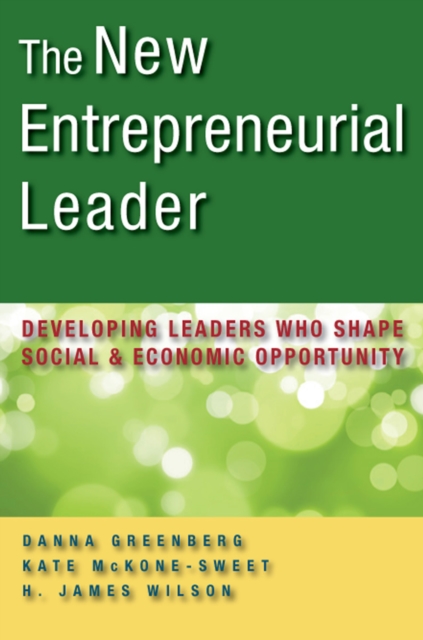
The new entrepreneurial leader
Our economic crisis has shown that we need a fundamentally new kind of business leader--able to make ethical decisions in the face of strategic unknowns, serve the environment and society while also serving the needs of investors and shareholders, and understand how their personality and the social context in which they operate impacts their leadership. This book lays out a compelling model for creating and developing these new entrepreneurial leaders.
eBook

Exploring differences in the antisocial behaviors of adolescent rule-breaking that affect entrepreneurial persistence
PurposeThe authors explore the relationship between adolescent behavior and subsequent entrepreneurial persistence by drawing on scholarship from clinical psychology and criminology to examine different subtypes of antisocial behavior (nonaggressive antisocial behavior and aggressive antisocial behavior) that underlie adolescent rule breaking. The intersection of gender and socioeconomic status on these types of antisocial behavior and entrepreneurial persistence is also studied.Design/methodology/approachUsing a longitudinal research design, this study draws from a national representative survey of USA adolescents, the National Longitudinal Survey of Youth (1997) (NLSY97). Nonaggressive antisocial behavior was assessed with a composite scale that measured economic self-interest and with a second measure that focused on substance abuse. Aggressive antisocial behavior was assessed as a measure of aggressive, destructive behaviors, such as fighting and property destruction. Entrepreneurial persistence was operationalized as years of self-employment experience, which is based on the number of years a respondent reported any self-employment.FindingsAggressive antisocial behavior is positively related to entrepreneurial persistence but nonaggressive antisocial behavior is not. This relationship is moderated by gender and socioeconomic status.Originality/valueThese findings contribute to research on the relationship between adolescent behavior and entrepreneurship in adulthood, the effect of antisocial behavior, and demographic intersectionality (by gender and socioeconomic status) in entrepreneurship. The authors surmise that the finding that self-employment for men from lower socioeconomic backgrounds involved in aggressive antisocial behavior was significantly higher compared to others may indicate that necessity entrepreneurship may be the primary driver of entrepreneurial activity for these individuals.
Journal Article

Negotiating a flexible work arrangement: How women navigate the influence of power and organizational context
Prior work-life research has highlighted that while organizations may be introducing more work-life policies, organizational members are not necessarily using these policies. Empirical research is needed that focuses on the individual and provides insight into who is taking advantage of these policies and how they go about negotiating access. In this study, we explore this issue as we investigate the behavioral dynamics that underlie women's experiences negotiating a flexible work arrangement. Focusing on the individual, we examine the influence that perceptions of power and organizational work-life support have on flexible work arrangement negotiations. The results of our research indicate that both macro level factors such as perceived work life support and micro level factors such as perceptions of power affect both the process and outcomes of these negotiations. We explore the implications these findings have for work-life and negotiation research.
Journal Article

Agency and Social Networks: Strategies of Action in a Social Structure of Position, Opposition, and Opportunity
This study uses social movement concepts to explain the success and failure of actors in a network of relationships trying to influence policies on environmental issues in a small city. Results show that strategies to take action and mobilize others in a network of interorganizational relationships can vary depending on the social context, which consists of the political opportunity structure defined by government regulators, whether the actor faces opposition, and the actor's position in the network. Decisions to engage in strategies to try to influence government regulators directly, to use a broker to reach agreements with the opposition, or to form a coalition with actors in other organizations to influence government decision makers are affected by this social context. Results also show that even peripheral actors, usually assumed to be powerless in network studies, can influence policy if they use a direct-contact strategy and the political opportunity structure is favorable.
Journal Article

Chris Pierce and the Yankee Donut Company: An E-Mail-Based Management Simulation
In this article, the authors describe an e-mail-based simulation that helps students experience the fast-paced, complex world of the middle manager. In this electronic in-basket exercise, students assume the role of a district manager in a doughnut company as they respond to a rapid series of high- and low-priority e-mails ostensibly sent from superiors, subordinates, colleagues, and customers. The simulation creates an engaging learning environment that helps students understand the complex world of managers and stimulates their interest in organizational behavior. Because the exercise is designed around standard e-mail technology, the simulation is straightforward and can be easily customized to support other learning objectives.
Journal Article

EXPANDING THE FOCUS OF ENTREPRENEURSHIP EDUCATION: A PEDAGOGY FOR TEACHING THE ENTREPRENEURIAL METHOD
To date the measure of success of entrepreneurship education is often new venture creation. As such entrepreneurship pedagogy frequently focuses on teaching students either the skills or theory needed to launch a new venture. Yet, this emphasis on teaching skills and theory overlooks the fact that one of the distinguishing features of successful entrepreneurs is they engage a cognitive approach to problem solving that is different than that of traditional managers. This different cognitive approach is referred to as the entrepreneurial method. In this paper, we explore whether a pedagogy can be developed to teach students this method. We discuss the implications that this pedagogy has for expanding the practice and objectives of entrepreneurship education.
Journal Article