
Catalogue Search | MBRL


Are you sure you want to remove the book from the shelf?

{{itemTitle}}
72
result(s) for
"Gregor, Keith"
Sort by:

Transversal Connections: The Cervantes Quatercentenary in Spain and its Comparison with “Shakespeare Lives”
Taking as its cue the 2016 quatercentenaries of the deaths of both Shakespeare and Cervantes, the essay offers some insights into the “transversal connections” between both events as celebrated in Spain and the UK. The questions it raises and attempts to resolve are fourfold: (1) What are the reasons and also the benefits of yoking together two such apparently disparate authors, whose strongest link is, arguably, the fact they both passed away in 1616? (2) What work is being done to restore these writers to life, especially in schools where, for a variety of reasons, literature has lost its core-curricular status, and in general society where the classics seem to have less and less import? (3) What might Shakespeare or Cervantes be said to stand for in their respective cultures, both in terms of the genres they wrote in (it is often forgotten, for instance, that Cervantes was also a poet and a dramatist) and the extra-literary values they are said to transmit? (4) What is the role of the State in the safeguarding and promotion of the nation’s cultural heritage?
Journal Article
Romeo and Juliet in European Culture
With its roots deep in ancient narrative and in various reworkings from the late medieval and early modern period, Shakespeare's Romeo and Juliet has left a lasting trace on modern European culture. This volume aims to chart the main outlines of this reception process in the broadest sense by considering not only critical-scholarly responses but also translations, adaptations, performances and various material and digital interventions which have, from the standpoint of their specific local contexts, contributed significantly to the consolidation of Romeo and Juliet as an integral part of Europe's cultural heritage. Moving freely across Europe's geography and history, and reflecting an awareness of political and cultural backgrounds, the volume suggests that Shakespeare's tragedy of youthful love has never ceased to impose itself on us as a way of articulating connections between the local and the European and the global in cases where love and hatred get in each other's way. The book is concluded by a selective timeline of the play's different materialisations.
eBook
Shakespeare and Tyranny
This book brings together a selection of essays on the reception and dissemination of Shakespeare's plays in England and beyond from the 17th century to the present. Written from the perspective of a nation or cluster of nations in which Shakespeare has been used either to reflect, legitimize or challenge different versions of authoritarian rule, each of the chapters offers a picture of Shakespeare as unwitting commentator on some of the most significant and unsettling political events in Europe and elsewhere. Illustrating and analyzing changing attitudes to Shakespeare and his work in various tyrannical and post-tyrannical contexts in both Western and Eastern Europe, North Africa and South America, the volume provides insights into issues like the role of censorship and self-censorship in the revision and production of Shakespearean material; institutional controls on the dissemination and publication of Shakespeare's work; assumptions and techniques in the staging of his plays; state intervention in the elaboration of a Shakespeare \"canon\"; the role of Shakespeare in the construction of identity under tyranny; and the pertinence or otherwise of the subversion/containment paradigm following events such as the collapse of communism and the so-called \"Arab Spring\".
eBook
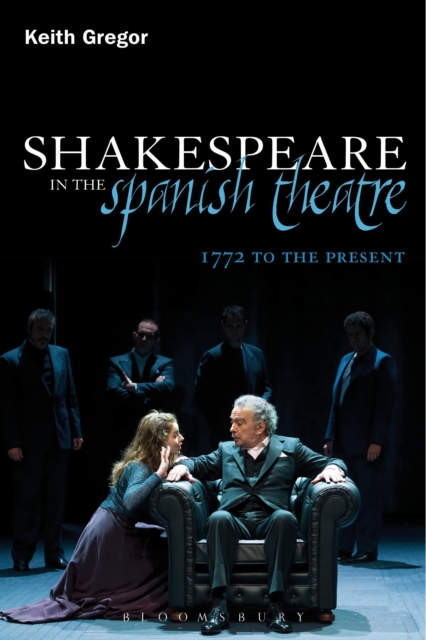
Shakespeare in the Spanish Theatre
Shakespeare in the Spanish Theatre offers an account of Shakespeare's presence on the Spanish stage, from a production of the first Spanish rendering of Jean-François Ducis's Hamlet in 1772 to the creative and controversial work of directors like Calixto Bieito and Alex Rigola in the early 21st century.
eBook


Romeo and Juliet in European Cultures
With its roots deep in ancient narrative and in various reworkings from the late medieval and early modern period, Shakespeare's Romeo and Juliet has left a lasting trace on modern European culture. This volume aims to chart the main outlines of this reception process in the broadest sense.
eBook
Collaborative encounters? Two recent Spanish takes on the Shakespeare–Cervantes relationship
In the context of the commemoration of the deaths of William Shakespeare and Miguel de Cervantes, this article reconsiders the relationship between these two national icons and its implications for the question of authorship. Since Anthony Burgess published his short story A Meeting in Valladolid in 1989, the possibility of an encounter, whether real or imaginary, between the two men, each learning from the other’s fortes and mistakes, has proven an attractive and pervasive one. In Cervantes’s own country Spain the idea of an encounter has given rise to (amongst other artifacts) a stage play called Miguel Will, by José Carlos Somoza in 1997, in which Cervantes helps Shakespeare compose a play about Don Quixote and Sancho, and a movie called Miguel y William, directed by Inés París in 2007, in which the romantic rivalry between the two authors is the inspiration for a collaborative theatrical endeavour. After briefly discussing these two texts and the scholarly and popular myths on which they are predicated, I go on to link them to the larger issues of biography, influence and intertextuality. While, with the possible exception of the lost Cardenio, there was no demonstrable collusion between Shakespeare and Cervantes, Miguel Will and Miguel y William seem to suggest alternative modes of “collaboration” that nonetheless fail to challenge or transcend still prevalent notions of writerly authority. This article is published as part of a collection to commemorate the 400th anniversary of William Shakespeare’s death.
Journal Article

