
Catalogue Search | MBRL


Are you sure you want to remove the book from the shelf?

{{itemTitle}}
829
result(s) for
"Gregory Bradley"
Sort by:


Effect of Vigorous Physical Activity on Executive Control in Middle-School Students
The purpose of this pilot study was to examine the acute effect of vigorous physical activity on executive control in eighth grade students from the U.S. Participants were eighth grade students (N = 68; 26 girls, 42 boys) recruited from one middle school located in the Mountain West region of the U.S. Two groups of participants were assigned to receive either a vigorous physical activity or a sedentary condition within a counter-balanced cross-over design using a 2-week washout. Both groups were administered Trails Making Tests A (TMT-A) and B (TMT-B) at 20- and 25-min post-treatment, respectively. Mixed design ANOVA tests with repeated measures examined differences between treatments on TMT-A and TMT-B performance and the modifying effect of sex. Students who completed the physical activity condition displayed a faster time to completion on the TMT-B compared to students who completed the sedentary condition (Mean difference = −6.5 s, p = 0.026, d = 0.42). There were no differences between treatment groups on TMT-A and no sex × treatment interactions (p > 0.05). This pilot study suggests that vigorous physical activity may improve executive control in middle-school students and adds to the existent literature that continues to examine the emerging link between physical activity and cognition in school-based settings.
Journal Article
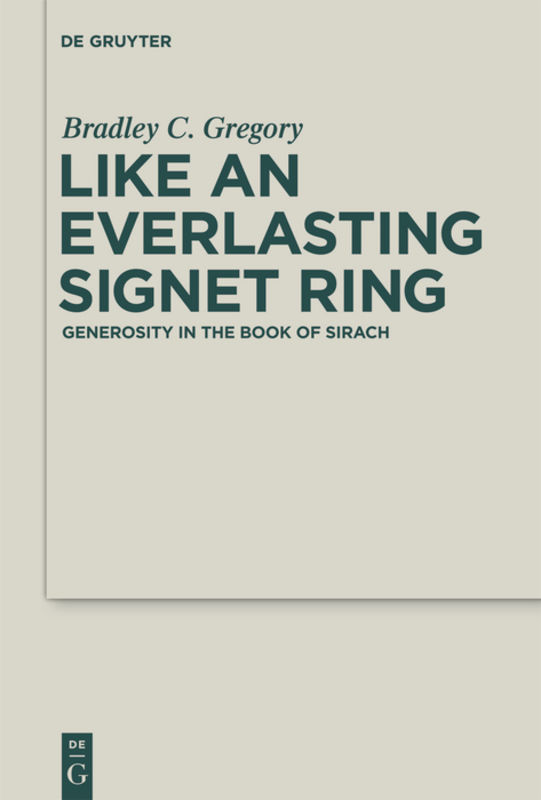
Like an Everlasting Signet Ring
This work explores the theological and social dimensions of generosity in the book of Sirach and contextualizes them within the culture and thought of Second Temple Judaism. Ben Sira's understanding of generosity is predicated on the tension between affirming the classic wisdom principle of retributive justice and recognizing its breakdown in the socio-economic circumstances of Seleucid Judea. He forges a new Wisdom-Torah ethic of mercy in which giving generously is an integral part of living \"the good life\".
While loans and surety are essential practices, almsgiving is the preeminent act of generosity. The fundamental theological logic at work consists in viewing the poor as proxies for God and is based on the economic structure of Proverbs 19:17. Giving to the poor is, in reality, a deposit in a heavenly treasury and will pay future dividends. By situating Ben Sira's view of almsgiving within the wider framework of retributive justice and its breakdown, new light is shed on the practical tensions regarding the extent of almsgiving and its relationship to the support of the Jerusalem priesthood.
The various dynamics of Ben Sira's thought on generosity are situated within the broader Hellenistic world and in their foundational role for later Jewish and Christian thought.
eBook

Pride and Sin in Sirach 10:13 (15): A Study in the Interdependence of Text and Tradition
Ben Sira, a Jewish sage who lived and worked in Jerusalem in the early second century b.c.e., takes up the topic of pride in a discussion of politics in order to indict those who behave proudly as betraying the created nature of humans. Within his reflections on anthropology he links pride and sin in Sir 10:13 and then proceeds to assure his students that God will surely punish the proud through humiliation and calamity. Yet, from its rather unassuming role in Ben Sira's discussion of power, the link between pride and sin in Sir 10:13 became a locus of scribal activity and interpretation in subsequent centuries. As the text was transmitted and translated in Second Temple Judaism and late antiquity the versions of this verse in the Greek, Syriac, and Latin texts show vividly the interdependence between textual transmission and theological tradition. When placed within their historical context, the transformations of Sir 10:13 found in the forms of the verse evidence a dialogical interaction with current discussions regarding virtues and vices in moral theology in early Judaism and Christianity. A significant historical turning point occurred when Augustine made the Vulgate version of Sir 10:13a, “pride is the beginning of every sin,” a key prooftext in his discussions of sin. Thereafter this verse came to play a central role in Western Christian hamartiology, especially as it was connected to the placement of pride at the head of the capital vices or “Seven Deadly Sins.” This article will begin with a discussion of the role of pride in Ben Sira and then trace the textual transmission of Sir 10:13 and the theological influences that shaped its transmission and translation. Additionally, the story of how Sir 10:13a became a central text in Western discussions of the nature of sin will be shown to have significant theological implications for an understanding of the relationship between canonical text and the development of theological traditions.
Journal Article

Vice and Virtue in the Moral Vision of the Latin of Sirach
Beginning in the Second Temple period some Jewish literature begins to reflect an increased influence from Hellenistic conceptions of virtue and vice. This paper analyzes the expansions and alterations found in the Latin version of Ben Sira to show how the vices of pride, desire, and avarice are elevated in importance and integrated into the larger contours of the moral theology of the book. Their content, amount, and distribution suggest that their piecemeal production arose from attempts to integrate the virtue/vice thinking prominent in late antiquity into the teaching already found in the Book of Sirach.
Journal Article