
Catalogue Search | MBRL


Are you sure you want to remove the book from the shelf?

{{itemTitle}}
6
result(s) for
"Grenby, M. O. (Matthew Orville), 1970-"
Sort by:

The child reader, 1700-1840
\"Children's literature, as we know it today, first came into existence in Britain in the eighteenth century. This is the first major study to consider who the first users of this new product were, which titles they owned, how they acquired and used their books, and what they thought of them. Evidence of these things is scarce. But by drawing on a diverse array of sources, including inscriptions and marginalia, letters and diaries, inventories and parish records, and portraits and pedagogical treatises, and by pioneering exciting new methodologies, it has been possible to reconstruct both sociological profiles of consumers and the often touching experiences of individual children. Grenby's discoveries about the owners of children's books, and their use, abuse and perception of this new product, will be key to understanding how children's literature was able to become established as a distinct and flourishing element of print culture\"-- Provided by publisher.
Book
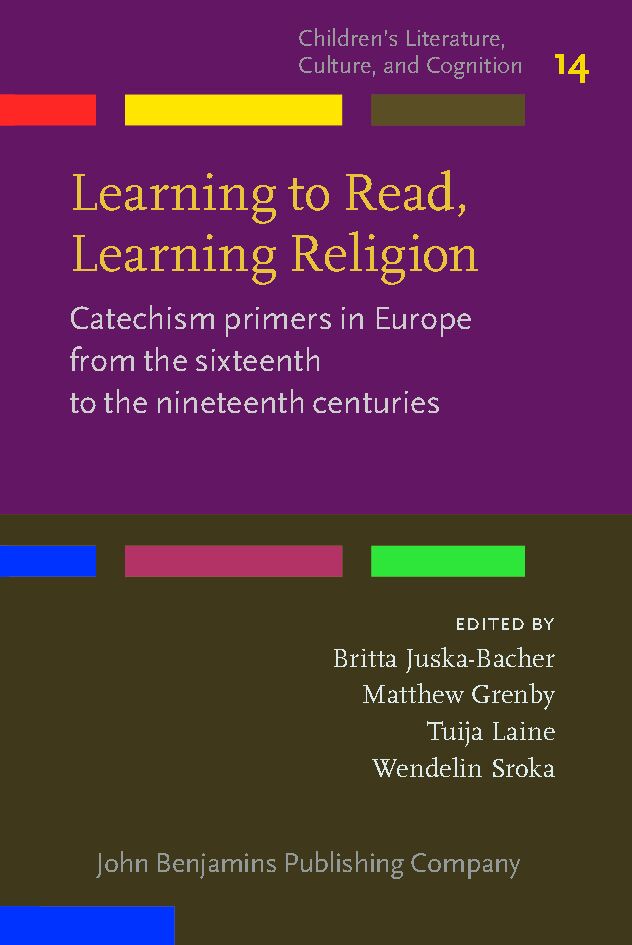
Learning to read, learning religion
Catechism primers are inconspicuous but telling little books for children combining the teaching of reading skills and religious catechesis. From the 16th to the 19th centuries, they have been produced, disseminated and used in huge numbers in many regions of the world, in particular in Europe. Remarkably, similar texts appeared across the continent, spanning confessional traditions that were in other respects highly divergent. In different places, and across the whole period, different denominations used not only similar pedagogical and religious strategies, but also shared the same formats and iconography.This volume, edited by scholars from Finland, Germany, Switzerland, and the United Kingdom, is the result of a collaborative transnational and interdisciplinary effort including education, language teaching, children's literature, book history, and religious studies. With contributions on seventeen European countries and regions, it sheds new light on a fascinating but largely neglected part of European cultural heritage, and, by establishing a comprehensive and authoritative summary of the field, offers fresh impetus for further transnational research.
eBook


The Cambridge Companion to Children's Literature
Some of the most innovative and spell-binding literature has been written for young people, but only recently has academic study embraced its range and complexity. This Companion offers a state-of-the-subject survey of English-language children's literature from the seventeenth century to the present. With discussions ranging from eighteenth-century moral tales to modern fantasies by J. K. Rowling and Philip Pullman, the Companion illuminates acknowledged classics and many more neglected works. Its unique structure means that equal consideration can be given to both texts and contexts. Some chapters analyse key themes and major genres, including humour, poetry, school stories, and picture books. Others explore the sociological dimensions of children's literature and the impact of publishing practices. Written by leading scholars from around the world, this Companion will be essential reading for all students and scholars of children's literature, offering original readings and new research that reflects the latest developments in the field.
eBook
Children's literature
Introducing students to the unique challenges of working with children's literature, this title outlines what is different about writing for children followed by a succinct account of the often neglected history of children's literature.
eBook
The Anti-Jacobin Novel
The French Revolution sparked an ideological debate which also brought Britain to the brink of revolution in the 1790s. Just as radicals wrote 'Jacobin' fiction, so the fear of rebellion prompted conservatives to respond with novels of their own; indeed, these soon outnumbered the Jacobin novels. This was the first survey of the full range of conservative novels produced in Britain during the 1790s and early 1800s. M. O. Grenby examines the strategies used by conservatives in their fiction, thus shedding new light on how the anti-Jacobin campaign was understood and organised in Britain. Chapters cover the representation of revolution and rebellion, the attack on the 'new philosophy' of radicals such as Godwin and Wollstonecraft, and the way in which hierarchy is defended in these novels. Grenby's book offers an insight into the society which produced and consumed anti-Jacobin novels, and presents a case for reexamining these neglected texts.
eBook