
Catalogue Search | MBRL


Are you sure you want to remove the book from the shelf?

{{itemTitle}}
121
result(s) for
"Grier, David Alan"
Sort by:

When Computers Were Human
Before Palm Pilots and iPods, PCs and laptops, the term \"computer\" referred to the people who did scientific calculations by hand. These workers were neither calculating geniuses nor idiot savants but knowledgeable people who, in other circumstances, might have become scientists in their own right. When Computers Were Human represents the first in-depth account of this little-known, 200-year epoch in the history of science and technology. Beginning with the story of his own grandmother, who was trained as a human computer, David Alan Grier provides a poignant introduction to the wider world of women and men who did the hard computational labor of science. His grandmother's casual remark, \"I wish I'd used my calculus,\" hinted at a career deferred and an education forgotten, a secret life unappreciated; like many highly educated women of her generation, she studied to become a human computer because nothing else would offer her a place in the scientific world. The book begins with the return of Halley's comet in 1758 and the effort of three French astronomers to compute its orbit. It ends four cycles later, with a UNIVAC electronic computer projecting the 1986 orbit. In between, Grier tells us about the surveyors of the French Revolution, describes the calculating machines of Charles Babbage, and guides the reader through the Great Depression to marvel at the giant computing room of the Works Progress Administration. When Computers Were Human is the sad but lyrical story of workers who gladly did the hard labor of research calculation in the hope that they might be part of the scientific community. In the end, they were rewarded by a new electronic machine that took the place and the name of those who were, once, the computers.
eBook
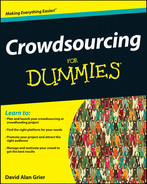
Crowdsourcing For Dummies
Give your business the edge with crowd-power!
Crowdsourcing is an innovative way of outsourcing tasks, problems or requests to a group or community online. There are lots of ways business can use crowdsourcing to their advantage: be it crowdsourcing product ideas and development, design tasks, market research, testing, capturing or analyzing data, and even raising funds. It offers access to a wide pool of talent and ideas, and is an exciting way to engage the public with your business.
Crowdsourcing For Dummies is your plain-English guide to making crowdsourcing, crowdfunding and open innovation work for you. It gives step-by-step advice on how to plan, start and manage a crowdsourcing project, where to crowdsource, how to find the perfect audience, how best to motivate your crowd, and tips for troubleshooting.
eBook

Crowdsourcing For Dummies
Give your business the edge with crowd-power!Crowdsourcing is an innovative way of outsourcing tasks, problems or requests to a group or community online. There are lots of ways business can use crowdsourcing to their advantage: be it crowdsourcing product ideas and development, design tasks, market research, testing, capturing or analyzing data, and even raising funds. It offers access to a wide pool of talent and ideas, and is an exciting way to engage the public with your business.Crowdsourcing For Dummiesis your plain-English guide to making crowdsourcing, crowdfunding and open innovation work for you. It gives step-by-step advice on how to plan, start and manage a crowdsourcing project, where to crowdsource, how to find the perfect audience, how best to motivate your crowd, and tips for troubleshooting.
Book


Time to Push the Cloud
Cloud computing is a transformative technology with significant potential to solve data-related problems. Cloud computing is a very flexible concept that that includes three major service models - the most well known being software as a service (SaaS), which includes Web services. These Web services perform functions traditionally done with software installed on an individual computer. The second service module is platform as a service (PaaS). This model provides computing services as Website.The final service model is infrastructure as a service (IaaS). It includes business-to-business (B2B) services that are usually invisible to customers.
Journal Article

The Best of Bad Times
Spring 1930. It was the first vernal season of the Great Depression, though the economic collapse was not yet potent enough to touch the annual meeting of the National Research Council. The council was the visible symbol of the First World War’s scientific legacy. Formed to coordinate research for the American military effort, it had grown in stature and influence during the 1920s. As part of the National Academy of Sciences, the council occupied a marble-clad building on the National Mall. The entrance to the building stood across the street from the memorial to Abraham Lincoln. Visitors to the facility
Book Chapter
Darwin’s Cousins
In 1894, when the playwright George Bernard Shaw (1856–1950) needed to invent a character that captured the challenges faced by the young women of his age, he made her a mathematician. Vivian Warren, the central character of the play Mrs. Warren’s Profession, is a graduate of Newnham College, a women’s school at Cambridge. Such colleges were still new in the 1890s and were trying to find their way amidst the older and wealthier men’s schools. One measure of success for the women’s schools was the scores of their students on the Tripos, the Cambridge mathematical honors exam. In 1890,
Book Chapter
Scientific Relief
Malcolm Morrow (1906–1982) was the faceless bureaucrat of computation, the government worker who created the largest human computing group of the 1930s but left little record of himself. He lived in a working-class district of Washington, D.C., only a few blocks from the original Naval Observatory and the building that had once housed Simon Newcomb’s Nautical Almanac Office.¹ He held jobs in several of the New Deal agencies and eventually settled into the executive office of the Work Projects Administration (WPA)² as an assistant statistician. His title gives us little information about his mathematical ability, as the WPA employed
Book Chapter