
Catalogue Search | MBRL


Are you sure you want to remove the book from the shelf?

{{itemTitle}}
13
result(s) for
"Grindle, Merilee Serrill"
Sort by:


Audacious reforms : institutional invention and democracy in Latin America
Audacious Reforms examines the creation of new political institutions in three Latin American countries: direct elections for governors and mayors in Venezuela, radical municipalization in Bolivia, and direct election of the mayor of Buenos Aires in Argentina. Diverging from the usual incremental processes of political change, these cases marked a significant departure from traditional centralized governments. Such \"audacious reforms, \" explains Merilee S. Grindle, reinvent the ways in which public problems are manifested and resolved, the ways in which political actors calculate the costs and benefits of their activities, and the ways in which social groups relate to the political process.
Grindle considers three central questions: Why would rational politicians choose to give up power? What accounts for the selection of some institutions rather than others? And how does the introduction of new institutions alter the nature of political actions? The case studies of Venezuela, Bolivia, and Argentina demonstrate that institutional invention must be understood from theoretical perspectives that stretch beyond immediate concerns about electoral gains and political support building. Broader theoretical perspectives on the definition of nation and state, the nature of political contests, the legitimacy of political systems, and the role of elites all must be considered. While past conflicts are not erased by reforms, in the new order there is often greater potential for more responsible, accountable, and democratic government.
eBook

الاقتصاد السياسي للتعليم في العالم العربي
يتلمس مؤلفو کتاب \"الاقتصاد السياسي للتعليم في العالم العربي\" إجابات في الاقتصادات السياسية ... التي تشكل بنية الحكم الوطني في المنطقة، وقد أظهروا بوضوح، من خلال ما قدموه من دراسات عن شمال إفريقيا ومنطقة الخليج، إضافة إلى وجهات نظر مقارنة تجارب دول شرق آسيا وأمريكا اللاتينية، أن الجهود المبذولة لتحسين التعليم، وتعزيز التنمية الاقتصادية تبعا لذلك وتوسيع قاعدة المواطنة التي تشكل عمدة استقرار وفعالية أنظمة حكم، ستفشل إلى الحد الذي تصبح معه النخب الحاكمة غير قادرة على زيادة قوتها السياسية والاقتصادية على حساب الصالح العام، يتكون الكتاب من أحد عشر بحثا توزعتها أقسام ثلاثة، بالإضافة إلى قسم تمهيدي مكون من دراستين هما بمثابة المدخلين للإشكاليات التي تناولها الكتاب، فالأولى تتمثل في البحث الأول المشترك بين هشام العلوي وروبرت سبرينغبورغ حيث عرضا بشكل عام لإشكاليات التعليم في العالم العربي من وجهة نظر الاقتصاد السياسي، واضعين القارئ في سياق الكتاب وهويته البحثية، وتتمثل الثانية في بحث إسحاق ديوان الذي تناول بدراسة رصدية إحصائية وتحليلية العلاقة بين إشكاليتي التعليم والديمقراطية في العالم العربي.
Book
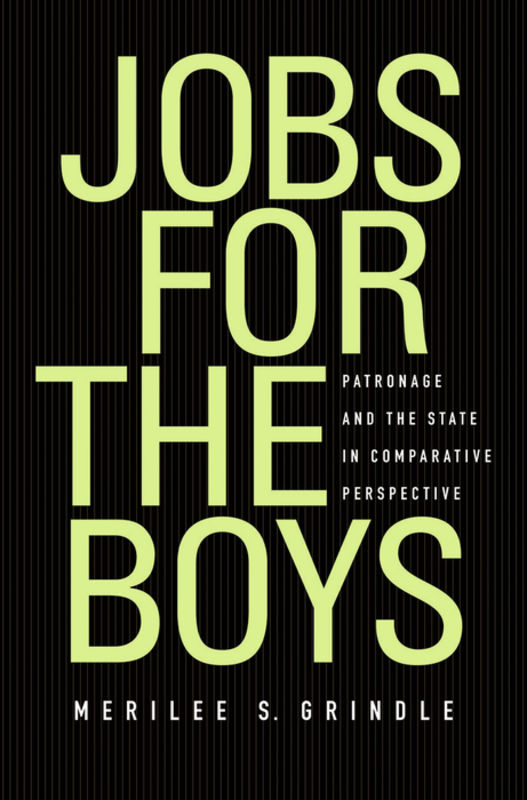
Jobs for the boys : patronage and the state in comparative perspective
Patronage systems in public service are reviled as undemocratic and corrupt. Yet patronage was the prevailing method of staffing government for centuries, and in some countries it still is. Grindle considers why patronage has been ubiquitous in history and explores the processes through which it is replaced by merit-based civil service systems.
eBook

Social Policy in Development: Coherence and Cooperation in the Real World
Ideas about social policy and its role in development have shifted over time, signaling the difficulty of finding clarity in approaches to social investment, poverty alleviation, and equity. In consequence, research and practice related to social policy and poverty alleviation have left a legacy of a very broad agenda of â[euro]oethings that need to be done,â[euro] along with important unanswered questions about how to integrate social and economic development. While these legacies contribute to the difficulty of developing overarching solutions to problems of social development and poverty alleviation, they also suggest the fruitfulness of focusing more on the distinctions among countries in terms of their capacities, generating ideas about priorities and sequences, and working to reduce what is often an overwhelming social policy agenda. The development community needs to get much better at matching ideas to realities, at considering how policy priorities could be assessed in terms of contextually specific feasibility, and at generating contextually grounded processes for taking the next step. While these are less ambitious questions than are often asked, they hold some promise of bringing ideas into better touch with the real world.
Paper
Sanctions, Benefits, and Rights: Three Faces of Accountability
As countries throughout the world democratize and decentralize, citizen participation in public life should increase. In this paper, I suggest that democratic participation in local government is enhanced when citizens can reply affirmatively to at least three questions about their ability to hold local officials accountable for their actions: Can citizens use the vote effectively to reward and punish the general or specific performance of local public officials and/or the parties they represent? Can citizens generate response to their collective needs from local governments? Can citizens be ensured of fair and equitable treatment from public agencies at local levels? The findings of a study of 30 randomly selected municipalities in Mexico indicate that, over the course of a decade and a half, voters were able to enforce alternation in power and the circulation of elites, but not necessarily to transmit unambiguous messages to public officials or parties about performance concerns. More definitively, citizens were able to build successfully on prior political experiences to extract benefits from local governments. At the same time, the ability to demand good performance of local government as a right of citizenship lagged behind other forms of accountability.
Paper
Good Governance: The Inflation of an Idea
Good governance has grown rapidly to become a major ingredient in analyses of whatâ[euro](TM)s missing in countries struggling for economic and political development. Intuitively and in research, good governance is a seductive ideaâ[euro]\"who, after all, can reasonably defend bad governance? Nevertheless, the popularity of the idea has far outpaced its capacity to deliver. In its brief life, it has also muddied the waters of thinking about the development process, and has become conflated with the capacity to generate growth, alleviate poverty, and bring effective democracy to peoples in poor countries. Scholars and practitioners need to develop a reasonable understanding of what good governance can deliverâ[euro]\"and what it cannot. They must also assume more realistic expectations about how much good governance can be expected in poor countries struggling with a plethora of demands on their capacities to pursue change. In this paper, I explore how and why the concept of good governance emerged and grew, and then suggest ways that academics and practitioners can become more sensitive to the limitations of fads and to curb the tendency toward idea inflation.
Paper
Constructing, Deconstructing, and Reconstructing Career Civil Service Systems in Latin America
Patronageâ[euro]\"the discretionary allocation of public sector jobsâ[euro]\"continues to be a dominant way government is staffed in most Latin American countries and it is proving resistant to the imprecations of public sector reformers. Despite the ubiquity of patronage systems, however, all major countries in Latin America have legislation establishing a formal civil service system. In fact, such reform initiatives are swept aside or significantly altered after they have been legislated. In this paper, public sector reform initiatives in Brazil, Argentina, Mexico, and Chile confirm that implementation is fraught with opportunities for distorting the intent of law and indicate a series of similar strategies used by the opponents of reform to offset the impact of new legislation. Taken together, such strategies have been remarkably successful in blocking the systematic implementation of civil service laws. Nevertheless, there is evidence that public sectors in each of the case study countries have made advances in the degree of stability, professionalism, and expertise in public offices, even in the absence of a Weberian civil service.
Paper

Power, Expertise and the “Tecnico”: Suggestions from a Mexican Case Study
Excoriation of public employees has a long tradition in literature which describes the political systems of Latin America. Inefficiency, corruption, partisanship, conservatism, lack of responsiveness to public demands, and vested interests have all been attributed to the personnel staffing the administrative agencies of government. Similarly, throughout Latin America, in spite of the large number of individuals who work for the government, public employees are frequently held in at least mild disapprobation, if not in open contempt. The official who is never in his office, who owes first allegiance to a personalistic politician, who is not permitted to delegate responsibilities, who becomes lost in a maze of paperwork and procedures when it suits his personal interests, and who ultimately demands a “tip” in order to carry out his legally assigned tasks is a stereotype of the Latin American bureaucrat which infuses much literary and popular opinion on the subject.
Journal Article