
Catalogue Search | MBRL


Are you sure you want to remove the book from the shelf?

{{itemTitle}}
52
result(s) for
"Grunig, James E"
Sort by:


Decomposing organisational reputation: The effects of organisation–public relationship outcomes on cognitive representations of organisations and evaluations of organisational performance
The purpose of this study is to decompose common reputation measurement systems into behavioural organisation–public relationship outcomes, cognitive representations of an organisation in the minds of publics and evaluations of organisational performance. In the proposed model, propensity for active communication behaviour and familiarity are suggested as correlated precursors of organisation–public relationship outcomes (eg trust, satisfaction, commitment and control mutuality) and organisation–public relationship outcomes are hypothesised to have a direct effect on evaluations of organisational performance as well as an indirect effect via the mediation of cognitive representations of the organisation. The authors investigated different types of five Korean‐based organisations )two domestic corporations in different industries, a multinational corporation, a sports association and a non‐profit organisation) to validate the model across different types of organisations. The findings of this study suggest that relationship outcomes lead to favourable representations of an organisation and positive evaluations of performance of the organisation.
Journal Article
Implications of the IABC excellence study for PR education
The 15-year study of excellence in public relations and communication management in the USA, the UK and Canada produced an explanation of the value of PR to an organisation and a set of theoretical principles describing how the communication function should be organised, structured and practised in an organisation. These principles provide a theoretical benchmark for auditing the quality of a PR unit. This paper identifies the implications of these principles for PR education at the undergraduate, postgraduate and continuing education levels and for management education in MBA programmes. The excellence study suggests, first, that all PR education must instil in students the view that PR is a strategic managerial function rather than a technical support function for other managerial functions. Undergraduate programmes should continue to develop superior communication skills in their students, but they must frame these technical skills in principles of strategic management, research and ethics and social responsibility. Postgraduate and continuing education programmes should focus on strategic management and research skills and educate future managers to be ethics officers in the organisation. MBA programmes should include a unit on PR in a subject area such as strategic management, public affairs or corporate social responsibility to prepare them to work with PR professionals when they become senior executives. PR education at all of these levels and in both communication and MBA programmes should educate students to practise PR globally.
Journal Article


Furnishing the Edifice
This chapter traces the origins and continuing development of a research tradition that conceptualizes public relations as a strategic management function rather than as a messaging, publicity, and media relations function. The tradition began serendipitously with the development of the situational theory of publics in the late 1960s, followed by the application of organization theory to public relations, the symmetrical model of public relations, and evaluation of communication programs. The Excellence Study, which began in 1985, brought these middle-level theories together and produced a general theory, a theoretical edifice, focused on the role of public relations in strategic management and the value of relationships with strategic publics to an organization. Since the completion of the Excellence Study, scholars in this research tradition have continued to improve and furnish the edifice by conducting research to help public relations professionals participate in strategic decision processes. This research has been on environmental scanning and publics, scenario building, empowerment of public relations, ethics, relationships, ROI, evaluation, relationship cultivation strategies, specialized areas of public relations, and global strategy. I conclude that the greatest challenge for scholars now is to learn how to institutionalize strategic public relations as an ongoing, accepted practice in most organizations.
Book Chapter

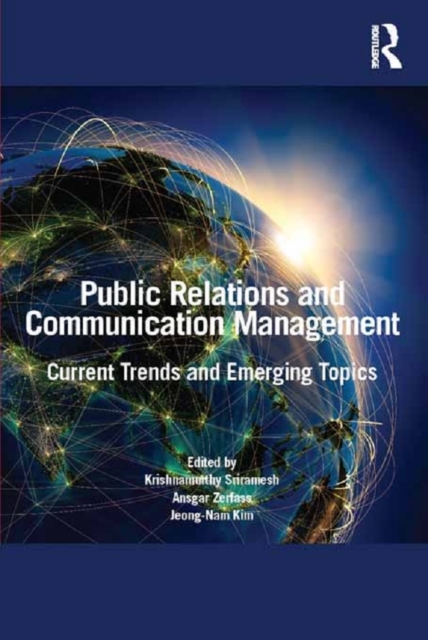
Public Relations and Communication Management
Public Relations and Communication Management serves as a festschrift honoring the work of public relations scholars James E. Gruning and Larissa A. Grunig. Between them, the Grunigs have published 12 books and more than 330 articles, book chapters, and various academic and professional publications, and have supervised 34 doctoral dissertations and 105 master's theses. This volume recognizes the Grunig's contributions to public relations scholarship over the past four decades.
To honor the Grunig's scholarship, this volume continues to expand their body of work with essays from renowned colleagues, former students, and research associates. The chapters discuss current trends in the field as well as emerging issues that drive the field forward. Sample topics include theories and future aspects of the behavioral, strategic management approach to managing public relations, and its linkages and implications to related subfields and key field issues. Contributions stimulate academic discussion and demonstrate the relevance of applied theories for the practice of public relations and communication management with up-to-date concepts, theories, and thoughts.
eBook
The Relationship between Public Relations and Marketing in Excellent Organizations
Our basic premise is that organizations are best served by the inherent diversity of perspectives provided by separate public relations and marketing functions. Theory developed in the IABC Excellence Project shows that public relations makes an organization more effective when it identifies strategic constituencies in the environment and then develops communication programs to build long-term, trusting relationships with them. Participation in strategic management provides the integrating link for public relations to enhance organizational effectiveness. To provide its unique contribution, however, public relations must be separate from other management functions. However, communication programs should be integrated or coordinated by a public relations department; and that department should have a matrix arrangement with other departments it serves. Therefore, we advocate integrated marketing communication of advertising and marketing public relations. We add that an IMC program should be coordinated through the broader public relations function. Data are presented from the Excellence Study confirming that public relations is most excellent when it is strategic and when marketing does not dominate public relations. However, public relations was equally excellent when housed in a single department or in specialized communication departments. Beyond structure, we add that marketing communication theories, if applied by an integrated department, differ in important ways from public relations theory and that discussion and research are needed to resolve these differences and to integrate the theories into a broader communication theory.
Book Chapter