
Catalogue Search | MBRL


Are you sure you want to remove the book from the shelf?

{{itemTitle}}
44,163
result(s) for
"Guo, Wei"
Sort by:

هذه هي الصين : قوة تسير نحو العالم
يركز كتاب \"هذه هي الصين\" على سرد قصص تنمية الصين في العصر الجديد. وقد غير الدكتور تشانغ وي وي طريقته المعروفة بالتوجيه والإرشاد في البرامج الأيديولوجية والنظرية في الماضي، وعبر عنها بلغة شعبية سائغة، وحجج منطقية صارمة، وبيانات حقيقية، وتصادمات صريحة للأفكار، وتقنيات عرض مبتكرة لمساعدة الجمهور على فهم النموذج الصيني والطريق الصيني، وتعزيز ثقتهم بمستقبل الصين.
Book

Representability of algebraic topology for biomolecules in machine learning based scoring and virtual screening
This work introduces a number of algebraic topology approaches, including multi-component persistent homology, multi-level persistent homology, and electrostatic persistence for the representation, characterization, and description of small molecules and biomolecular complexes. In contrast to the conventional persistent homology, multi-component persistent homology retains critical chemical and biological information during the topological simplification of biomolecular geometric complexity. Multi-level persistent homology enables a tailored topological description of inter- and/or intra-molecular interactions of interest. Electrostatic persistence incorporates partial charge information into topological invariants. These topological methods are paired with Wasserstein distance to characterize similarities between molecules and are further integrated with a variety of machine learning algorithms, including k-nearest neighbors, ensemble of trees, and deep convolutional neural networks, to manifest their descriptive and predictive powers for protein-ligand binding analysis and virtual screening of small molecules. Extensive numerical experiments involving 4,414 protein-ligand complexes from the PDBBind database and 128,374 ligand-target and decoy-target pairs in the DUD database are performed to test respectively the scoring power and the discriminatory power of the proposed topological learning strategies. It is demonstrated that the present topological learning outperforms other existing methods in protein-ligand binding affinity prediction and ligand-decoy discrimination.
Journal Article
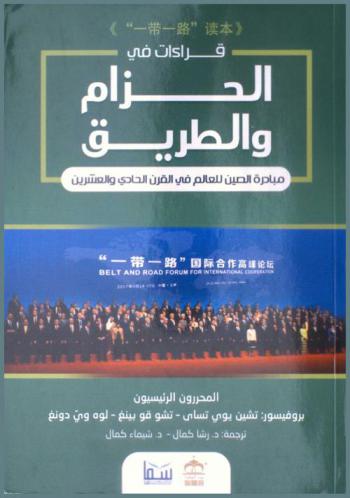
قراءات في الحزام والطريق : مبادرة الصين للعالم في القرن الحادي والعشرين
في العاشر من سبتمبر عام 2013، أعلن الرئيس الصيني شي جين بينغ خلال زيارته لآسيا الوسطى ومنطقة جنوب شرق آسيا، عن المبادرة الكبرى الحزام والطريق \"الحزام الاقتصادي لطريق الحرير وطريق الحرير البحري للقرن الحادي والعشرين\"، لتحظى المبادرة باهتمام كبير على الصعيد الدولي، حيث تعد سياسة استراتيجية دولية كبرى للصين، وقد وضعت بناء على التخطيط الشامل للمشهدين الدولي والمحلي، وتتسم المبادرة باهمية كبيرة، ومغزى بعيد المدى فيما يتعلق بإنشاء آلية اقتصادية ذات طبيعة منفتحة، وتشكيل نمط جديد للانفتاح نحو الخارج بكل الاتجاهات، وفي هذا الكتاب الذي أعده مجموعة من باحثو \"مركز الابتكار التعاوني لمبادرة الحزام والطريق بجامعة تشيجيانغ\"، ليشكفوا عن كل الأسرار المتعلقة بالمبادرة الصينية الكبرى التي قدمتها للعالم في قرنه الحادي والعشرين، وذلك عملا على تعميق معرفة القاريء \"بالحزام والطريق\"، والنشر على مستوى عالمي للمحتوى الثري والمغزى العميق لهذه المبادرة، ويركز أسلوب هذا الكتاب على الشرح والتحليل والمقارنة، فيتطرق إلى الاطر الاستراتيجية للبمادرة وتنافسية الدول الكبرى ومزايا مناطق الصين وربوعها و ثمار التعاون الدولي وغيرها بالتحليل الدقيق، انطلاقا من الموضوعات التي تهم كل مهتم في العالم بمستقبل الصين، وما ستقدمه للعالم.
BOOK

Algebraic graph-assisted bidirectional transformers for molecular property prediction
The ability of molecular property prediction is of great significance to drug discovery, human health, and environmental protection. Despite considerable efforts, quantitative prediction of various molecular properties remains a challenge. Although some machine learning models, such as bidirectional encoder from transformer, can incorporate massive unlabeled molecular data into molecular representations via a self-supervised learning strategy, it neglects three-dimensional (3D) stereochemical information. Algebraic graph, specifically, element-specific multiscale weighted colored algebraic graph, embeds complementary 3D molecular information into graph invariants. We propose an algebraic graph-assisted bidirectional transformer (AGBT) framework by fusing representations generated by algebraic graph and bidirectional transformer, as well as a variety of machine learning algorithms, including decision trees, multitask learning, and deep neural networks. We validate the proposed AGBT framework on eight molecular datasets, involving quantitative toxicity, physical chemistry, and physiology datasets. Extensive numerical experiments have shown that AGBT is a state-of-the-art framework for molecular property prediction.
Despite considerable efforts, quantitative prediction of various molecular properties remains a challenge. Here, the authors propose an algebraic graph-assisted bidirectional transformer, which can incorporate massive unlabeled molecular data into molecular representations via a self-supervised learning strategy and assisted with 3D stereochemical information from graphs.
Journal Article
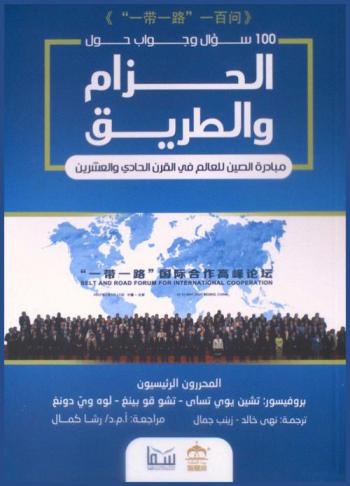
مائة سؤال وجواب حول الحزام والطريق : مبادرة الصين للعالم في القرن الحادي والعشرين
في العاشر من سبتمبر عام 2013، أعلن الرئيس الصيني شي جين بينغ خلال زيارته لآسيا الوسطى ومنطقة جنوب شرق آسيا، عن المبادرة الكبرى الحزام والطريق \"الحزام الاقتصادي لطريق الحرير وطريق الحرير البحري للقرن الحادي والعشرين\"، لتحظى المبادرة باهتمام كبير على الصعيد الدولي، حيث تعد سياسة استراتيجية دولية كبرى للصين، وقد وضعت بناء على التخطيط الشامل للمشهدين الدولي والمحلي، وتتسم المبادرة باهمية كبيرة، ومغزى بعيد المدى فيما يتعلق بإنشاء آلية اقتصادية ذات طبيعة منفتحة، وتشكيل نمط جديد للانفتاح نحو الخارج بكل الاتجاهات، وفي هذا الكتاب الذي أعده مجموعة من باحثو \"مركز الابتكار التعاوني لمبادرة الحزام والطريق بجامعة تشيجيانغ\"، ليشكفوا عن كل الأسرار المتعلقة بالمبادرة الصينية الكبرى التي قدمتها للعالم في قرنه الحادي والعشرين، وذلك عملا على تعميق معرفة القاريء \"بالحزام والطريق\"، والنشر على مستوى عالمي للمحتوى الثري والمغزى العميق لهذه المبادرة، ويعتمد أسلوب هذا الكتاب على السؤال والجواب، انطلاقا من الموضوعات التي تهم كل مهتم في العالم بمستقبل الصين، وما ستقدمه للعالم.
BOOK

Mathematical deep learning for pose and binding affinity prediction and ranking in D3R Grand Challenges
Advanced mathematics, such as multiscale weighted colored subgraph and element specific persistent homology, and machine learning including deep neural networks were integrated to construct mathematical deep learning models for pose and binding affinity prediction and ranking in the last two D3R Grand Challenges in computer-aided drug design and discovery. D3R Grand Challenge 2 focused on the pose prediction, binding affinity ranking and free energy prediction for Farnesoid X receptor ligands. Our models obtained the top place in absolute free energy prediction for free energy set 1 in stage 2. The latest competition, D3R Grand Challenge 3 (GC3), is considered as the most difficult challenge so far. It has five subchallenges involving Cathepsin S and five other kinase targets, namely VEGFR2, JAK2, p38-α, TIE2, and ABL1. There is a total of 26 official competitive tasks for GC3. Our predictions were ranked 1st in 10 out of these 26 tasks.
Journal Article
TopologyNet: Topology based deep convolutional and multi-task neural networks for biomolecular property predictions
Although deep learning approaches have had tremendous success in image, video and audio processing, computer vision, and speech recognition, their applications to three-dimensional (3D) biomolecular structural data sets have been hindered by the geometric and biological complexity. To address this problem we introduce the element-specific persistent homology (ESPH) method. ESPH represents 3D complex geometry by one-dimensional (1D) topological invariants and retains important biological information via a multichannel image-like representation. This representation reveals hidden structure-function relationships in biomolecules. We further integrate ESPH and deep convolutional neural networks to construct a multichannel topological neural network (TopologyNet) for the predictions of protein-ligand binding affinities and protein stability changes upon mutation. To overcome the deep learning limitations from small and noisy training sets, we propose a multi-task multichannel topological convolutional neural network (MM-TCNN). We demonstrate that TopologyNet outperforms the latest methods in the prediction of protein-ligand binding affinities, mutation induced globular protein folding free energy changes, and mutation induced membrane protein folding free energy changes.
weilab.math.msu.edu/TDL/.
Journal Article
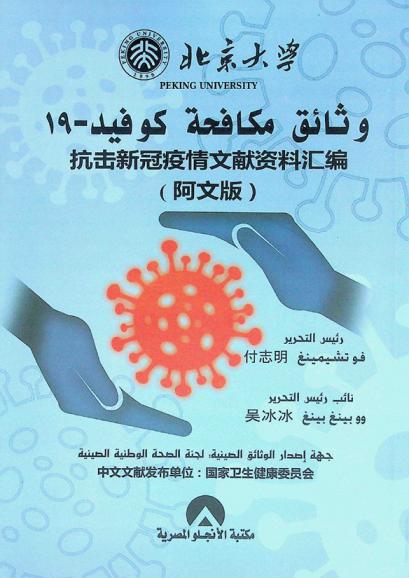
وثائق مكافحة كوفيد-19
بين يدي القارئ كتاب يجمع بين دفتيه الترجمة العربية لوثائق مكافحة كوفيد 19- التي أصدرتها لجنة الصحة الوطنية الصينية، ومـن بـين هذه الوثائق النسخ الست مـن آليات الوقاية مـن الالتهاب الرئوي الناجم عـن فيروس كـورونا المستجد ومكافحته، والنسخة التجريبية السابعة لآليات تـشخيص الالتـِهاب الـرئوي الناجِم عـن فـيروس كـورونا المستجد وعلاجه وغـيرها مـن الـمرفقات. وعـمل على ترجمة النـسخة الـعربية لوثائق مكافحة كـوفيد 19- الصينية فريـق ترجمة به أكـثر من عشريـن أستاذا وطالبا مـن قسم اللغة العربية بكلية اللغات الأجنبية بجامعة بكين بـالتعاون مع كلية الآداب في جامعة القاهرة والمعهد العالي للغات بتونس في جامعة قرطاج، في الفترة مـن مارس وحتى مايو 2020، قام خلالها فـريق الترجمة بترجمة قرابة 100 ألـف رمز صيني.
BOOK

Analyzing scRNA-seq data by CCP-assisted UMAP and tSNE
Single-cell RNA sequencing (scRNA-seq) is widely used to reveal heterogeneity in cells, which has given us insights into cell-cell communication, cell differentiation, and differential gene expression. However, analyzing scRNA-seq data is a challenge due to sparsity and the large number of genes involved. Therefore, dimensionality reduction and feature selection are important for removing spurious signals and enhancing downstream analysis. Correlated clustering and projection (CCP) was recently introduced as an effective method for preprocessing scRNA-seq data. CCP utilizes gene-gene correlations to partition the genes and, based on the partition, employs cell-cell interactions to obtain super-genes. Because CCP is a data-domain approach that does not require matrix diagonalization, it can be used in many downstream machine learning tasks. In this work, we utilize CCP as an initialization tool for uniform manifold approximation and projection (UMAP) and t-distributed stochastic neighbor embedding (tSNE). By using 21 publicly available datasets, we have found that CCP significantly improves UMAP and tSNE visualization and dramatically improve their accuracy. More specifically, CCP improves UMAP by 22% in ARI, 14% in NMI and 15% in ECM, and improves tSNE by 11% in ARI, 9% in NMI and 8% in ECM.
Journal Article