
Catalogue Search | MBRL


Are you sure you want to remove the book from the shelf?

{{itemTitle}}
55
result(s) for
"Gurminder K. Bhambra"
Sort by:
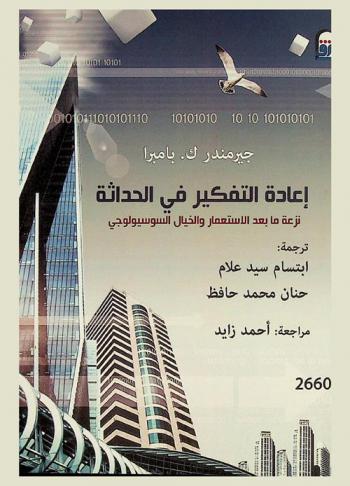
إعادة التفكير في الحداثة : نزعة ما بعد الاستعمار والخيال السوسيولوجي
تكشف مؤلفة هذا الكتاب، من داخل الفهم السوسيولوجى للحداثة، الادعاءات عن \"الآخرين\" غير الأوروبيين، غير المنظرين للسرد والأطر التحليلية المهيمنة علم علم الاجتماع. كما تقدم فهماً للتواريخ المترابطة لإعادة تشكيل علم الاجتماع التاريخي عالميا، وتوجه اهتماما إلى لحظات التأسيس للحداثة، التى تمثلت فى عصر النهضة-الثورة الفرنسية-الثورة الصناعية، لتحديد هوية أساطير النشأة سواء للحداثة أو الحداثات المتعددة. وتعرض الباحثه لخفايا التصورات الغربية وما تضمنه النموذج النظرى من محافظة على الأوضاع القائمة وتقديم التبريرات بما يدعم الاستغلال لتظل العلاقات غير المتكافئة، والتى تدعم النظرية والعكس صحيح، مما نلمح منه بعض التماس مع موقف الغرب مما يحدث في الشرق الأوسط اليوم، والذى يصل إلى حد التطابق مع الموقف الاستعمارى بصورته الفجة.
BOOK

Rethinking modernity : postcolonialism and the sociological imagination
Arguing for the idea of connected histories, Bhambra presents a fundamental reconstruction of the idea of modernity in contemporary sociology. She criticizes the abstraction of European modernity from its colonial context and the way non-Western \"others\" are disregarded. It aims to establish a dialogue in which \"others\" can speak and be heard.
eBook

Historical Sociology, Modernity, and Postcolonial Critique
Bhambra assesses four developments in sociology and history that take into account the world beyond the West in the understandings of modernity: third wave cultural historical sociology, multiple modernities, microhistories, and global history. Among other things, third wave cultural historical sociology is defined by its attempts to historicize understandings of modernity, that is, to examine the diverse, complex histories that are regarded as embodying and constituting modern transformations. There is an explicit move away from earlier forms of historical sociology, which were concerned with issues of causal explanation, to, as Julia Adams, Elisabeth S. Clemens, and Ann Shola Orloff suggest, a more \"genealogical\" project \"associated with the formation of historically evolving cultural categories and practices.\" In this way, third wave cultural historical sociology merges with cultural history. It offers up a diversity of now-disaggregated histories in which Eurocentric history is decentered, but the more difficult issues associated with the grand narratives of (European) modernity are not addressed.
Journal Article

Postcolonial Reflections on Sociology
This contribution addresses the impact of postcolonial critiques on sociology by drawing parallels with the emergence of feminism and queer theory within the academy. These critiques were facilitated by the expansion of public higher education over the last five decades and the article also addresses the implications of the privatisation and marketisation of the university on the processes of knowledge production.
Journal Article
Introduction: Global Challenges for Sociology
With the 50th anniversary of the journal, this special issue takes stock of the progress that has been made within sociology to become a more globally oriented discipline and discusses the new challenges for the future that emerge as a consequence. From its inception, classical sociology was primarily concerned with the European origins of processes of modernity that were to become global. There was little discussion of how the global might be understood in terms of structures, processes and social movements not directly identified as European but nonetheless contributing to modernity. The challenge for sociology has been to take into account these other phenomena and to rethink its core categories and concepts in light of newly understood alternative formations of the global and the social movements that bring them about.
Journal Article

Citizens and Others: The Constitution of Citizenship through Exclusion
Citizenship is one of the defining social and political categories of modernity. Its conceptualization is strongly tied to the emergence of nation-states and the structuring of international relations in terms of the sovereignty of nation-states. However, it is also predicated upon a deeper, racialized structuring of the social world, which rarely informs debates about its constitution. In this article, I look at the ways in which citizenship has been understood, examine its dominant intellectual genealogy, and address its deeper racialized structures. I use the perspective of \"connected sociologies\" with which to undertake this task.
Journal Article

The Trap of “Capitalism”, Racial or Otherwise
Loïc Wacquant’s essay, “The Trap of ‘Racial Capitalism’”, asks whether the term is “a conceptual solution or a conceptual problem”. His answer is forthright. He argues that racial capitalism has no place in a properly defined and understood social science. In this contribution, we set out the limitations, as we perceive them, of Wacquant’s own analysis and, at the same time, discuss other difficulties of the idea of racial capitalism. These, we suggest, are associated with an absence common to Wacquant and the major proponents of racial capitalism alike; namely, a failure to reckon systematically with the ways in which modern capitalism arises and develops within the global structures of European colonialism.
Journal Article
Sociology and Postcolonialism: Another 'Missing' Revolution?
Sociology is usually represented as having emerged alongside European modernity. The latter is frequently understood as sociology's special object with sociology itself a distinctively modern form of explanation. The period of sociology's disciplinary formation was also the heyday of European colonialism, yet the colonial relationship did not figure in the development of sociological understandings. While the recent emergence of postcolonialism appears to have initiated a reconsideration of understandings of modernity, with the development of theories of multiple modernities, I suggest that this engagement is more an attempt at recuperating the transformative aspect of postcolonialism than engaging with its critiques. In setting out the challenge of postcolonialism to dominant sociological accounts, I also address 'missing feminist/queer revolutions', suggesting that by engaging with postcolonialism there is the potential to transform sociological understandings by opening up a dialogue beyond the simple pluralism of identity claims.
Journal Article

The Possibilities of, and for, Global Sociology: A Postcolonial Perspective
This article addresses the way in which perceptions about the globalized nature of the world in which we live are beginning to have an impact within sociology such that sociology has to engage not just with the changing conceptual architecture of globalization, but also with recognition of the epistemological value and agency of the world beyond the West. I address three main developments within sociology that focus on these concerns: first, the shift to a multiple modernities paradigm; second, a call for a multicultural global sociology; and third, an argument in favor of a global cosmopolitan approach. While the three approaches under discussion are based on a consideration of the “rest of the world,” their terms, I suggest, are not adequate to the avowed intentions. None of these responses is sufficient in their address of earlier omissions and each falls back into the problems of the mainstream position that is otherwise being criticized. In contrast, I argue that it is only by acknowledging the significance of the “colonial global” in the constitution of sociology that it is possible to understand and address the necessarily postcolonial (and decolonial) present of “global sociology.”
Book Chapter

Global Social Theory: Building resources
There has been an intensification of student protests around the world addressing issues of racial exclusion and racialised hierarchy within the university, including its teaching and research practices. These movements point to urgent concerns about what and how we teach and research, and how the resources of universities might be used to support the amelioration of injustice rather than its reproduction. This short piece focuses on the curriculum and points to actions that we can take to build resources for a more dynamic and adequate curriculum within our universities. In particular, it discusses one collaborative initiative that all the authors have been involved in, the website Global Social Theory. This site provides resources for the diversification and expansion of the curriculum for those teaching and studying social theory.
Journal Article