
Catalogue Search | MBRL


Are you sure you want to remove the book from the shelf?

{{itemTitle}}
145
result(s) for
"Gushee, David P"
Sort by:

The Future of Faith in American Politics
David Gushee argues convincingly that there is in U.S. politics an \"evangelical center\" of voters who do not identify with the politics and religion of either the right or the left. Although evangelical Christians are portrayed by the media as conservatives, Gushee claims that the evangelical movement includes nearly even numbers of voters on the right, in the center, and on the left of the political spectrum. He provides portraits of the major figures in each of the three camps, outlines the core convictions of the adherents, and analyzes the strengths and weaknesses of each group's positions. He suggests that the evangelical center is poised for growth; this book could be its manifesto.
eBook

2018 AAR Presidential Address
This paper begins by describing the author’s exit from white US evangelicalism, and his revulsion at the overwhelming support of white US evangelicals for Donald Trump. The author describes this as an unveiling of the moral collapse of a once-moralistic white evangelicalism, then situates that collapse within the long historical trajectory of white supremacist Christianity in the United States. This corrupted white Christianity is exposited here through scenes from major works in the African American literary canon. The categories of moral debasement (greed, pride, slander, arbitrary use of power, unchecked anger and violence, and alienation), religious powerlessness, and perceptual blindness are deployed to summarize how racist white Christians and Christianity are described in these fictional (but historically realistic) literary works. Citing three recent dissertations by young (ex-) evangelicals, the author claims that white evangelicalism has always been corrupted by white supremacism but now appears to have been swallowed up by the politics of white reactionary grievance. The only way forward is complete repudiation of this history and the development of a post-white evangelical Christianity, and scholarship, undertaken humbly and in the context of diverse interracial friendship and community.
Journal Article
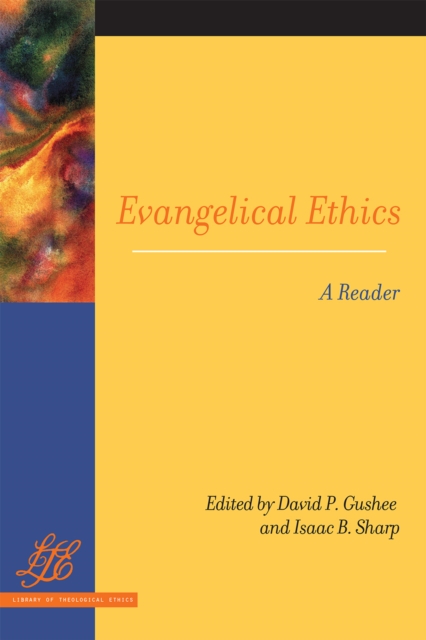
Evangelical Ethics
Introduction WHO ARE THE EVANGELICALS? Evangelicalism is notoriously difficult to define. Everything within the postmodern academy suffers from contestation ad nauseam, but evangelicalism has proven time and again a particularly thorny concept. Even if we choose to focus exclusively on evangelicalism within the United States, and almost entirely restrict the conversation to the post-World War II period, as we will do here, there is much to contest. Due to the multiplicities of meaning associated with the descriptor and the attempts, time and again, to offer a concise definition for a group that defies easy categorization, some scholars have suggested that we jettison the term evangelical altogether.1 Feeling that the broader cultural association of the term with a particularly narrow political agenda--an anti-gay and anti-abortion agenda-- has left the label unredeemable, some within the evangelical community itself are today choosing to self-disassociate with evangelicalism and are using terms like \"post-evangelical\" or even \"ex-evangelical.\"2 In this sense a particular social-political theological ethic within a sector of evangelicalism is undercutting evangelicalism itself. But that gets ahead of our story. If no one can agree on anything else about evangelicalism there is, at least, a consensus among those who know it best that evangelicalism is a slippery term. Some scholars approach the study of evangelicalism through a sociological lens and then disagree about who counts as an evangelical. Others define the movement in terms of religious history and then disagree about when and from whence it came. Still others view evangelicalism in terms of theological beliefs: a lens most often chosen by those \"on the inside\" and frequently deployed in times of hottest disagreement in order to decide who is still in and, more importantly,
who is now out. Evangelicals, in part due to a distinctive historical journey we are about to describe, do an awful lot of arguing about who counts as an evangelical and who does not. In another attempt at enumerating evangelical theological characteristics, evangelical historian George Marsden includes the five following \"essential evangelical beliefs\": 1. Harkening ever back to the Protestant Reformation, evangelicals maintain the \"final authority of the Bible\"; 2. the belief that Scripture records the real historical narrative of \"God''s saving work\"; 3. redemption through the salvific work of Jesus Christ and yielding eternal life; 4. \"the importance of evangelism and missions\"; 5. the necessity \"of a spiritually transformed life.\"4 Union Seminary professor Gary Dorrien, contra Donald Dayton''s suggestion that the term evangelical has lost its usefulness, instead agrees with Marsden and further quips about his \"favorite definition of an evangelical, which is ''anyone who likes Billy Graham.''\"5 This quip is revelatory of a sociological reality about evangelicalism; it has often produced hugely visible and charismatic figures ranging from Aimee Semple Macpherson to Billy Sunday to Billy Graham to Jerry Falwell to Rick Warren to John Piper to Jim Wallis to Rob Bell to . . . whoever comes next. An \"evangelical\" in this sense would be someone who knows who these evangelical icons are and who takes as authoritative one, some, or all of them. Noting the importance of the denominational and confessional diversity of evangelicalism, evangelical church historian Timothy Weber sees evangelicalism as \"a large extended family\" with four main branches including: 1. classical: loyalists to the Reformation, with a tendency toward creedalism and away from the value of religious experience 2. pietistic: also within the Reformation stream but including
an emphasis on religious experience and including both pietism and Puritanism; 3. fundamentalist: defined as opposing \"liberal, critical, and evolutionary teaching\" but also including \"their ''neo-evangelical'' offspring\"; 4. progressive: including those who attempt to reconcile modernity with a variety of evangelical beliefs.6 This sophisticated and helpful definition points already at sociological diversities within evangelicalism. Or we could just go back to the etymological origins of the word evangelical, which at least are clear. The English word evangelical and associated words like evangelism come from the Greek word εύαγγέλιον (euangelion). Every definition of these terms must, therefore, reckon with their original meaning: \"good news.\"7 (Evangelicals themselves will sometimes argue about which versions of our faith still represent \"good news\" to a suffering and unjust world and thus still merit the term \"evangelical.\") And as traced by Mark Noll--who is evangelicalism''s foremost historian--the use of the term evangelical as an adjective dates back at least to the Middle Ages, when writers used it to describe the prophet Isaiah or the followers of St. Francis.8 More history helps us gain some clarity. The term evangelical began taking on its modern shape during the sixteenth century with the advent of the Protestant Reformation, at which point it began to be used as a synonym for Protestant--as is still the case in Germany today, where Evangelische means Protestant and especially Lutheran.9 The movement that would become what we are describing when we say evangelicalism, however, offers a particular fl of Christian faith that neither includes all Protestants nor is limited solely to Reformation-descended Protestantism. As we will see, though, the reformist impulse, implanted at its birth, continues to impact evangelicalism even
now. This impulse has at times focused on doctrine and therefore on renewing theological seriousness or offering resistance to theological (or ethical) liberalism. Some of evangelicalism''s greatest contributions to Christianity, however, have been about the renewal of passion in moribund Christianity and the drive to move people back toward devout \"biblical\" Christianity. The first \"modern\" evangelicals were born when some newly minted Protestants were insultingly called \"evangelicals\" and chose to accept the label. The ensuing religious foment of sixteenththrough eighteenth-century Europe and the fledgling American colonies then gave rise to several more movements varyingly described as evangelical including Puritanism, Pietism, and the revival movements of the first American \"Great Awakening.\" Formed for a variety of activist and evangelistic goals, evangelical \"associations\" then began taking root in the fertile, more disestablished religious soil of nineteenth-century North America.10 Evangelicalism as a movement was always multi-denominational and multi-confessional, including Calvinists (but also Arminians), Wesleyans, Anabaptists, Baptists, Methodists, Presbyterians, Holiness, and eventually charismatics, Pentecostals, and others. There are even evangelical Episcopalians, now often called Anglicans in the U.S. setting, and some speak of evangelical Catholics. The historic black churches are almost all evangelical by any theological definition, though they have often not been institutionally close to predominantly white evangelical bodies due to the tortured history of race in America. Evangelicalism has never been confined to official denominational structures--sometimes evangelicals are a minority within a broader denomination while at other times they dominate a particular denomination--thus there are self-identified evangelicals in
the mainline Presbyterian and Methodist denominations while the Southern Baptist Convention as a whole is normally viewed as evangelical. Meanwhile, evangelicals have tended to produce a lush crop of parachurch organizations for various mission and activist purposes. So evangelicals include groups ranging from the Salvation Army to the Vineyard churches to the World Relief and World Vision social ministries. In some ways the leaders of these groups act as each era''s current evangelical gatekeepers, an unofficial house of bishops for a decentralized evangelicalism attempting to retain its vitality and identity. These evangelical institutions--some old and some new, including churches, colleges, publishing houses, and parachurch groups--continue to help define and shape the evangelical subculture. If you know Wheaton, Gordon, and Azusa Pacific universities; if you have heard of Books & Culture, Relevant, and Charisma magazines; if you read books published by Thomas Nelson, Baker, and Zondervan publishing houses; if you participated in Campus Crusade, RUF, or Intervarsity Christian Fellowship while in college; if you sang worship songs from Hillsong or have attended the Passion conference held in Atlanta each year--you probably are, or were, an evangelical. Each nation with a strong evangelical presence could tell its own version of the same story; meanwhile, there are institutions of global evangelicalism, such as the World Evangelical Fellowship and the Lausanne Movement. AMERICAN EVANGELICALISM AND ITS SOCIAL ETHICS But now let us focus more tightly on the trajectory of American evangelicalism and its social ethics. The waves of religious and cultural change cresting around the turn of the twentieth century left an indelible imprint on all aspects of American Christianity, including what became American evangelicalism. American Christian
approaches.
eBook

Christian Ethics: Retrospect and Prospect
This SCE presidential address attempts an interpretation of the history of American Christian ethics that is simultaneously an intellectual autobiography. Seven types of Christian ethics receive attention: ecclesial-formational, Protestant social ethics, Niebuhrian, Catholic, evangelical, Hauerwasian, and liberationist. The discipline is described as methodologically fractured and professionally endangered, especially in the case of its founding strand, Protestant social ethics. The essay ends with a call for mutual respect and support among Christian ethicists, sustained attention to one another's work, and shared efforts to advance the discipline.
Journal Article
Reconciling Evangelical Christianity with Our Sexual Minorities: Reframing the Biblical Discussion
Most evangelical Christians have understood their faith, rooted in a high view of biblical authority, to be irreconcilable with \"homosexuality.\" This has meant that devoted LGBT people raised as evangelical Christians must choose between their sexuality and their faith/religious community. This creates enormous psychic distress, turns LGBT Christians and their allies away from (evangelical) Christianity, and contributes to intense alienation between the gay community and evangelicals all over the world. But traditional evangelical attitudes on LGBT people and their relationships are beginning to change. This paper offers a description of the state of the conversation in the North American evangelical community on this issue, and summarizes my own normative proposal.
Journal Article

Challenging Sociological Reductionism
The author analyzes Christian Smith's What Is a Person? from a Christian theological‐ethical perspective, assessing the way in which he tackles sociological theories that reflect secularized and reductionist assumptions about the human person, and offering a friendly critique of the Christian personalist, humanist, and virtue ethic that he deploys to challenge his field.
Journal Article
THE CONTEMPORARY U.S. TORTURE DEBATE IN CHRISTIAN HISTORICAL PERSPECTIVE
The U.S. turn toward torture tested the moral resources of all faiths, but perhaps especially of Christianity, which has the greatest number of adherents in the United States. This moral crucible revealed that American Christian scholars and leaders were generally blind to the resources available in relation to the resources available to address torture in a study of scripture, early Christian experience under empire, Christian abuses of suspected heretics, and the just war theory, all of which are considered here. Uses of just war theory have revealed a fracture in that theory between deontological/virtue orientations and consequentialist reasoning, the latter proving susceptible to exploitation in defense of torture. Just war theory also revealed a lacuna of explicit reasoning about torture through the centuries, in a world where torture has so often been an instrument of state power.
Journal Article

CHALLENGING SOCIOLOGICAL REDUCTIONISM: A Christian Ethical Analysis
The author analyzes Christian Smith's What Is a Person? from a Christian theological-ethical perspective, assessing the way in which he tackles sociological theories that reflect secularized and reductionist assumptions about the human person, and offering a friendly critique of the Christian personalist, humanist, and virtue ethic that he deploys to challenge his field.
Journal Article
Challenging Sociological Reductionism
The author analyzes C hristian S mith's What Is a Person? from a C hristian theological‐ethical perspective, assessing the way in which he tackles sociological theories that reflect secularized and reductionist assumptions about the human person, and offering a friendly critique of the C hristian personalist, humanist, and virtue ethic that he deploys to challenge his field.
Journal Article