
Catalogue Search | MBRL


Are you sure you want to remove the book from the shelf?

{{itemTitle}}
39
result(s) for
"Guthner, Mark"
Sort by:

The Options Edge
Capture the fortune you're losing with every trade by learning to exploit options The Options Edge + Free Trial shows you how to capture the fortune you lose out on every day. Buying and selling traditional investments often entails instruments with optionality. Sometimes this optionality is explicit, while other times it is hidden. If you're not leveraging these embedded options to their fullest advantage, you're losing money. Most retail investors don't truly understand the nuances involved in successful options trading and instead rely on more comfortable instruments with fewer complex mechanics. If you're interested in optimizing your portfolio, it's time to step out of your comfort zone and learn what you've been missing. This book gives you the background you need to take full advantage of options in this booming market. The companion website features easy to use analytical tools that help investors find the best opportunities so you can start applying these methods right away. Whether or not you ultimately decide to start actively trading options, the concepts discussed will make you a better all-around trader with greater security in your financial affairs. Most investors buy and sell options every day without ever knowing it. This book relates stories of those who have leveraged options to make fortunes and those who have lost by not understanding the optionality of their financial endeavors. You must know the fundamentals of options, and then learn to recognize hidden options, in order to improve success in all of your investment activities. After taking these steps, you can go on to: * Create hidden options at little or no cost * Structure your finances to reduce risk and increase wealth * Utilize a practical pricing model for smarter investing The listed options are currently the only growing exchange traded financial product in the developed markets, with a current average volume of 20 million contracts—equivalent to 2 billion shares—per day. Now is the perfect opportunity to fortify your finances, and The Options Edge + Free Trial gives you the understanding and practical tools you need to optimize your portfolio today.
eBook
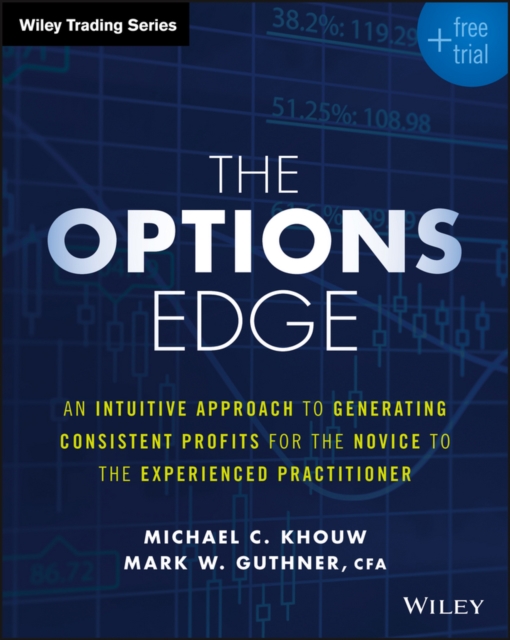
Options play: an intuitive approach to generating consistent profits for the novice to the experienced practitioner
Capture the fortune you're losing with every trade by learning to exploit options The Options Edge + Free Trial shows you how to capture the fortune you lose out on every day. Buying and selling traditional investments often entails instruments with optionality. Sometimes this optionality is explicit, while other times it is hidden. If you're not leveraging these embedded options to their fullest advantage, you're losing money. Most retail investors don't truly understand the nuances involved in successful options trading and instead rely on more comfortable instruments with fewer complex mechanics. If you're interested in optimizing your portfolio, it's time to step out of your comfort zone and learn what you've been missing. This book gives you the background you need to take full advantage of options in this booming market. The companion website features easy to use analytical tools that help investors find the best opportunities so you can start applying these methods right away. Whether or not you ultimately decide to start actively trading options, the concepts discussed will make you a better all-around trader with greater security in your financial affairs. Most investors buy and sell options every day without ever knowing it. This book relates stories of those who have leveraged options to make fortunes and those who have lost by not understanding the optionality of their financial endeavors. You must know the fundamentals of options, and then learn to recognize hidden options, in order to improve success in all of your investment activities. After taking these steps, you can go on to: Create hidden options at little or no cost Structure your finances to reduce risk and increase wealth Utilize a practical pricing model for smarter investing The listed options are currently the only growing exchange traded financial product in the developed markets, with a current average volume of 20 million contracts-equivalent to 2 billion shares-per day. Now is the perfect opportunity to fortify your finances, and The Options Edge + Free Trial gives you the understanding and practical tools you need to optimize your portfolio today.
eBook

The options edge + free trial : an intuitive approach to generating consistent profits for the novice to the experienced practitioner
Intro -- Series Page -- Title Page -- Copyright -- Table of Contents -- Dedication -- Introduction -- Additional Resources -- Chapter 1: What Is an Option, and How Do Options Work? -- How Options Are Created, Extinguished, and Settled -- Exercising an Option -- Assignment -- Deliverables -- Behavior of Option Prices -- Option Premium -- Moneyness -- The Relationship between Puts, Calls, and the Underlying Asset -- Leverage and Risk -- Chapter 2: Valuing Options with the Black-Scholes-Merton Option-Pricing Model -- Assumptions of the Black-Scholes-Merton Option Pricing Model -- The Black-Scholes-Merton Option-Pricing Model -- Intuition behind the Option-Pricing Model -- Understanding the Drivers of Option Prices -- Putting It All Together: The Total Differential and Return Attribution -- Notes -- Chapter 3: Trading Volatility -- Realized Volatility -- Implied Volatility -- Skew and the Volatility Smile -- Term Structure of Volatility -- Volatility Surface -- The Relationship between Realized Volatility and Implied Volatility -- How to Trade Volatility -- Gamma Scalping -- Straddles -- Strangles -- Calendar Spreads -- Chapter 4: Are Options Fairly Priced? -- Modern Portfolio Theory (MPT) -- Capital Asset Pricing Model (CAPM) -- Evaluating Historical Returns on Put Options -- Evaluating Historical Returns on Call Options -- Conclusions about Option Returns -- Why Do Options Behave as If They Are Overpriced? -- Notes -- Chapter 5: Fundamental Option Strategies -- Single-Leg Puts and Calls -- Vertical Spreads -- Ratio Spreads -- Risk Reversals -- Call Spread Risk Reversals -- Income-Generating Strategies -- Chapter 6: Portfolio Hedging Producing Enhanced Returns -- Anticipatory Hedging -- Permanent Hedging -- Optimal Hedging Strategies -- Hedging High-Yield Debt with Equity -- Building a Proper Hedge -- Diagonal Put Spreads.
Book
Portfolio Hedging Producing Enhanced Returns
One of the most important uses of option is hedging. One can buy puts on a particular asset to insure against a drop in the value of that holding. One can buy put options on an index to protect the value of an entire portfolio. The structure one uses can be as simple or complex as the investor desires to obtain the desired result and ease of implementation. An important step is to define the optimal hedge. In doing so, a basis is established to examine a number of different strategies and structures to find those that generate alpha or at least do not destroy value. The practice of cross asset class hedging is one many investors overlook. The power of this technique is explored by through an example of hedging a high yield debt portfolio with options on an equity index. Also discussed are issues concerning hedging equity portfolios with options on equity indexes.
Book Chapter
Valuing Options with the Black‐Scholes‐Merton Option‐Pricing Model
Pricing options is important for successful trading. This chapter introduces the Black‐Scholes‐Merton option pricing model and the assumptions that go into its derivation. With a model in hand, one can estimate how the price of an option changes if one or more of the pricing factors change. Practitioners describe these price sensitivities through derivatives of the pricing model and are know as an option's “Greeks”. The most important “Greeks” are called delta, gamma, vega, theta, rho, and phi. Combining the effects of all these factors into a total differential, one can predict how on option's price will behave when multiple factors change at the same time. Since the BSM option‐pricing model is based on a statistical view of the underlying assets price behavior, additional Greeks are presented that estimate the probability an option will be exercised at expiration and the probability an option will trade in the money sometime over the life of the contract.
Book Chapter
Extracting Information from Options Prices
Aggressive traders use options to take levered positions. When they do so, they leave a footprint in the markets. Using options math in unique ways, allows investors to unlock that information. By examining the implied distribution of future prices, investors can see if the smart money is more bullish or bearish than the efficient market hypothesis would suggest. In deed one can figure out the probability of an asset being within a particular range at some future date. Short sellers borrow stock and sell it in the hopes it will fall in price. After the drop in price, the short seller buys it back and returns the borrowed shares to the rightful owner. There are times when a stock is widely believed to be over valued, and hedge funds must compete with each other to borrow available shares. Those that own the shares can demand a fee to borrow the shares. One can determine that fee from option prices and indeed earn that fee with the appropriate option structure.
Book Chapter
Option Strategies for Special Situations
Options are a great tool for taking positions in special situations, such as a heavily shorted stock with the potential for a sharp short covering rally. Investors often look for catalysts that could cause a stock price to move such as an earnings announcement, potential takeover announcement, new product introduction, drug trial results, etc. With an anticipated event in hand, option investors often take positions in anticipation of a big move, while seeking protection in case something unexpected happens. Ratio spreads is a structure traders can use to take advantage of a big move while minimizing loss if nothing occurs. When markets come under stress, skew often becomes extended. This creates a short‐term opportunity of trading out of the money options against at the money options. Finally, every now and again, companies may want to recapitalize by borrowing money and issuing a special dividends. Investors who correctly anticipate such an event will find it cheaper to buy a call and exercise the option after the special dividend is announced, than to buy the stock outright.
Book Chapter
Fundamental Option Strategies
Many investors simply buy or sell a put or call option to express an investment thesis. While these single‐leg structures are common, more experienced options traders often use combinations of options to either manage risk or reduce premium outlays of both. The most commonly used structures are the two‐legged strategies such as vertical and calendar spreads. These entail buying and selling an equal number of options. These structures are often modified into ratio spreads where the number of options bought and sold differs. There is another structure know as a risk reversal, which causes one exposure to shift depending on the price of the underlying asset. Some structures such as covered puts and call combine an option with a position in the underlying asset. Some strategies are designed for capital gains while other are designed to produce income. This chapter discusses the ins and outs of various structures to help the reader select the appropriate structure given their investment thesis.
Book Chapter