
Catalogue Search | MBRL


Are you sure you want to remove the book from the shelf?

{{itemTitle}}
90
result(s) for
"Guzzini, Stefano"
Sort by:

The return of geopolitics in Europe? : social mechanisms and foreign policy identity crises
\"The end of the Cold War demonstrated the historical possibility of peaceful change and seemingly showed the superiority of non-realist approaches in International Relations. Yet in the post-Cold War period many European countries have experienced a resurgence of a distinctively realist tradition: geopolitics. Geopolitics is an approach which emphasises the relationship between politics and power on the one hand; and territory, location and environment on the other. This comparative study shows how the revival of geopolitics came not despite of, but because of, the end of the Cold War. Disoriented in their self-understandings and conception of external roles by the events of 1989, many European foreign policy actors used the determinism of geopolitical thought to find their place in world politics quickly. The book develops a constructivist methodology to study causal mechanisms and its comparative approach allows for a broad assessment of some of the fundamental dynamics of European security\"-- Provided by publisher.
Book

Securitization as a causal mechanism
The article seeks to offer a way forward in discussions about the status of securitization theory. In my reading, this debate has been inhibited by the difficulty of finding an appropriate version of 'understanding/explanation' that would be consistent with the meta-theoretical commitments of a post-structuralist theory. By leaving 'explanation' and/or all versions of causality to the positivist other, the Copenhagen School also left its own explanatory status often implicit, or only negatively defined. Instead, the present article claims that the explanatory theory used in securitization research de facto relies on causal mechanisms that are non-positivistically conceived. Using the appropriate methodological literature renders this explanatory status explicit, exposing the theory's non-positivist causality and thus, hopefully, enhancing its empirical theory.
Journal Article


Critical and Interpretivist Foreign Policy Analysis: Reflecting on Three Challenges Ahead
Abstract This text concludes the Special Issue on “New Directions for Foreign Policy Analysis” that aims at exploring some recent research avenues in the critical and interpretivist tradition in International Relations. Rather than summarising the contributions to the Special Issue, it reflects on a series of challenges ahead, focusing on three: the theoretical challenges in identity-focused or practice-theory inspired FPA, the international division of knowledge production in the context of a semi-peripheral academic community like Brazil, and the challenges for developing a truly critical FPA that does not take its Western-established categories for granted. Doing so, it issues an invitation to explore these challenges together. Resumo Este texto conclui a Edição Especial “Novas direções para a Análise de Política Externa”, que tem como objetivo explorar alguns caminhos de pesquisa recentes na tradição crítica e interpretativista das Relações Internacionais. Ao invés de resumir as contribuições para a Edição Especial, reflete-se sobre uma série de desafios futuros, concentrando-se em três: os desafios teórico da APE inspirada na identidade ou na teoria/ prática, a divisão internacional da produção de conhecimento no contexto de uma comunidade acadêmica semiperiférica como o Brasil e os desafios para o desenvolvimento de uma APF verdadeiramente crítica que não tome como certas as categorias estabelecidas pelo Ocidente. O texto faz então um convite para explorar tais desafios.
Journal Article
Forum on Recognition in Foreign Policy (Analysis) and (The Study of) Diplomacy
Abstract What if the quest for recognition, not power, rank or security, were the overriding objective of foreign policies? What if practices of recognition both empower and subjugate by fixing identities and reproducing the terms upon which agents become recognisable in the first place? Can recognition as encounter become the diplomatic task of, and condition for, a post-colonial international order? This Forum addresses some implications of putting recognition at the centre of foreign policy (analysis) and (the study of) diplomacy. A first intervention on recognition and domination provides the dual theoretical backdrop. On the one hand, theories of recognition are understood as a specific theory of action that remedies some of the shortcomings of rational choice theories within Foreign Policy Analysis. On the other hand, recognition can be the basis of a political theory of diplomacy co-constitutive of international order, where it corresponds to an ethical strategy both reproducing yet also addressing relations of domination. A second intervention exemplifies the implication for foreign policy analysis. It analyses the foreign policy of South Africa as a pursuit of relational recognition, in which the relevant circle of recognition is not that of great power status within international society at large, but the more immediate African environment in which also self-recognition is achieved. The concluding intervention places recognition into diplomatic theory. It analyses the necessity and yet inherent pitfalls of recognition without encounter through the colonial (non-)recognition practices, exemplified through the treatment of the Abyssinian Emperor Tewodros II by the British Empire.1 Resumo E se a busca por reconhecimento, e não por poder, posição ou segurança, fosse o objetivo primordial das políticas externas? E se as práticas de reconhecimento tanto empoderassem quanto subjugassem, fixando identidades e reproduzindo os termos nos quais os agentes se tornam reconhecíveis em primeiro lugar? O reconhecimento como encontro pode se tornar a tarefa diplomática e a condição para uma ordem internacional pós-colonial? Este Fórum aborda algumas implicações de colocar o reconhecimento no centro da (análise) política externa e (do estudo da) diplomacia. Uma primeira intervenção sobre reconhecimento e dominação fornece o duplo pano de fundo teórico. Por um lado, as teorias de reconhecimento são entendidas como uma teoria específica de ação que corrige algumas das deficiências das teorias de escolha racional na Análise de Política Externa. Por outro lado, o reconhecimento pode ser a base de uma teoria política da diplomacia co-constitutiva da ordem internacional, na qual ele corresponde a uma estratégia ética que reproduz, mas também aborda, as relações de dominação. Uma segunda intervenção exemplifica a implicação para a análise da política externa. Ela analisa a política externa da África do Sul como uma busca de reconhecimento relacional, na qual o círculo relevante de reconhecimento não é o do status de grande potência dentro da sociedade internacional em geral, mas o ambiente africano mais imediato no qual o autorreconhecimento também é alcançado. A intervenção final coloca o reconhecimento na teoria diplomática. Ela analisa a necessidade e as armadilhas inerentes ao reconhecimento sem encontro com as práticas coloniais de (não) reconhecimento, exemplificadas pelo tratamento dado pelo Império Britânico ao imperador abissínio Tewodros II.
Journal Article
Benjamin Cohen on global political order: when Keynes meets realism - and beyond
This article analyses the trajectory of Benjamin J. Cohen's work by focusing on his ongoing concern with the nature and governance of world order. It does so by playing out his debt to realism and to Keynesianism. In a first moment, Cohen criticises the economic determinism of dependency scholarship, while turning to political realism, and then to possible Keynesian co-operation under anarchy: agents have the power to affect positive change. Later, Cohen the disillusioned Keynesian, watching how the possible reform of financial markets is marginalised by politicians and academics alike, shifts his analysis to more structural aspects of governance or rule that affect actors' preferences. I draw two conclusions. First, in this shift towards theorising the global political order away from steering capacity towards impersonal rule and bias, Cohen also questions the very setup of the theories with which we deal with that world - only to see that this very inspiration of original IPE is abandoned in the course of the ongoing 'professionalisation' of IPE as practised in the United States. Second, his analysis seems to incorporate a warning. The underlying grand question is nothing less than the bargain between capitalism and liberal democracy as we know it, since the present system undermines equality before the law - money trumps equal political rights - and undermines democratic accountability. One of the main achievements of the post-war Keynesian turn was the reappropriation of political space from anti-democratic forces. Therefore, the decline of Keynesianism could provoke a Polanyian nightmare in which the 'double movement' by which the laissez-faire is answered by moves to protect society does not strengthen democracies, as in earlier times of 'embedded liberalism', but undermines them instead.
Journal Article

Embrace IR Anxieties (or, Morgenthau’s Approach to Power, and the Challenge of Combining the Three Domains of IR Theorizing)
This article addresses the call made by the ISA Sapphire panel to focus on “the opportunities and the challenges of theory-building in interdisciplinary scholarship.” The article focuses on the multiple anxieties that exist in the discipline of IR, its departmental subalternity, its fragmentation of content, its methodological diversity, and its hybrid constitution of practical and observational knowledge. However, rather than arguing for any restriction, the article pleads for these anxieties to be embraced and for IR to be treated as a privileged space in which to integrate that knowledge. It invites scholars to link three distinct yet important domains of IR theorizing: the philosophical, the explanatory, and the practical. It invites the discipline to see the three domains as equally fundamental for its identity. Using Morgenthau’s theory of power as a foil, the article shows the need to think about these three domains of theorizing concomitantly, despite the difficulties involved in providing a coherent link between them, something Morgenthau did not achieve.
Journal Article

Power and cause
Conceiving power relations as a subset of causal relations can be used to expose the problems of a certain behaviouralist take on causality and develop an interpretivist approach to explanation. The first section of this article shows that a behaviouralist approach ultimately clashes with a relational understanding of power, since the latter requires endogenising values and understandings in an analysis in which several causal paths to the same outcome can exist (equifinality) with radically different implications for attributing power. Power relations can be non-linear, and power dispositional or latent, as well as not translating into influence. The second section draws the consequences of these contradictions by conceptualising causal/social mechanisms for and in an interpretivist framework. Such mechanisms can be part of a wider analysis of contingent processes that answer ‘how possible’ questions. Although interpretivist process-tracing provides explanations without strict regularity, such processes include mechanisms which are transferable to other cases, hence generalisable. Finally, the article establishes a specific discursive mechanism of crisis reduction in foreign policy identity discourses, as developed in the comparative study of the processes that make us understand the unexpected return of geopolitical thought in Europe in the 1990s.
Journal Article

Militarizing politics, essentializing identities
This reply to the Symposium on Stefano Guzzini (ed.) The return of geopolitics in Europe?, answers the criticisms by John Agnew, Jeffrey Checkel, Dan Deudney and Jennifer Mitzen. It justifies (1) its specific definition and critique of geopolitics as a theory – and not just a foreign policy strategy; (2) its proposed interpretivist process tracing; (3) the role of mechanisms in constructivist theorizing and foreign policy theory; and (4) its usage of non-Humean causality in the analysis of multiple parallel processes and their interaction. At the same time, it develops the logic of the book’s main mechanism of foreign policy identity crisis reduction.
Journal Article
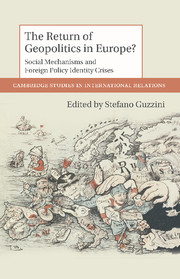
The Return of Geopolitics in Europe?
The end of the Cold War demonstrated the historical possibility of peaceful change and seemingly showed the superiority of non-realist approaches in International Relations. Yet in the post-Cold War period many European countries have experienced a resurgence of a distinctively realist tradition: geopolitics. Geopolitics is an approach which emphasizes the relationship between politics and power on the one hand; and territory, location and environment on the other. This comparative study shows how the revival of geopolitics came not despite, but because of, the end of the Cold War. Disoriented in their self-understandings and conception of external roles by the events of 1989, many European foreign policy actors used the determinism of geopolitical thought to find their place in world politics quickly. The book develops a constructivist methodology to study causal mechanisms and its comparative approach allows for a broad assessment of some of the fundamental dynamics of European security.
eBook