
Catalogue Search | MBRL


Are you sure you want to remove the book from the shelf?

{{itemTitle}}
12
result(s) for
"Gygi, Craig"
Sort by:

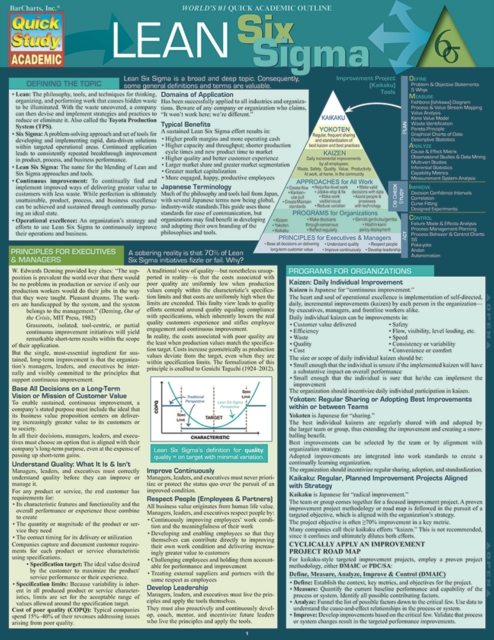
Lean Six Sigma - Quick Study
Whether curious as to how Lean Six Sigma works, in training for certification or a very experienced champion, everyone will find this tool essential as the ultimate quick reference guide to the combined process improvement methods of Lean and Six Sigma. This amazingly thorough 6-page laminated guide was developed by Craig Gygi, best-selling author, trainer, consultant, and internationally recognized leader in operational excellence. Color-coded sections, diagrams, examples, definitions, equations, flow of the process and tools for improvement are organized and designed for ease of reading and referencing at a moments notice. See for yourself, and then order a set for your team or organization. Suggested uses: Introduction - curious about Lean Six Sigma as a certification or for implementation within your business Training Tool - certification for yourself, your company or your team Expert or Practitioner - as a handy reference to core principles or tools like charts and equations, but also as a giveaway to colleagues who need some support Team - make this your company crib sheet
eBook


Identification of a unique TGF-β–dependent molecular and functional signature in microglia
Microglia are resident myeloid cells of the central nervous system integral for neuroprotective and neurodegenerative processes. Here the authors describe a unique TGF-β dependent molecular and functional microglia signature that distinguishes these cells from other immune and glial cells in the periphery and brain.
Microglia are myeloid cells of the CNS that participate both in normal CNS function and in disease. We investigated the molecular signature of microglia and identified 239 genes and 8 microRNAs that were uniquely or highly expressed in microglia versus myeloid and other immune cells. Of the 239 genes, 106 were enriched in microglia as compared with astrocytes, oligodendrocytes and neurons. This microglia signature was not observed in microglial lines or in monocytes recruited to the CNS, and was also observed in human microglia. We found that TGF-β was required for the
in vitro
development of microglia that express the microglial molecular signature characteristic of adult microglia and that microglia were absent in the CNS of TGF-β1–deficient mice. Our results identify a unique microglial signature that is dependent on TGF-β signaling and provide insights into microglial biology and the possibility of targeting microglia for the treatment of CNS disease.
Journal Article

Scaffold-mediated gating of Cdc42 signalling flux
Scaffold proteins modulate signalling pathway activity spatially and temporally. In budding yeast, the scaffold Bem1 contributes to polarity axis establishment by regulating the GTPase Cdc42. Although different models have been proposed for Bem1 function, there is little direct evidence for an underlying mechanism. Here, we find that Bem1 directly augments the guanine exchange factor (GEF) activity of Cdc24. Bem1 also increases GEF phosphorylation by the p21-activated kinase (PAK), Cla4. Phosphorylation abrogates the scaffold-dependent stimulation of GEF activity, rendering Cdc24 insensitive to additional Bem1. Thus, Bem1 stimulates GEF activity in a reversible fashion, contributing to signalling flux through Cdc42. The contribution of Bem1 to GTPase dynamics was borne-out by in vivo imaging: active Cdc42 was enriched at the cell pole in hypophosphorylated cdc24 mutants, while hyperphosphorylated cdc24 mutants that were resistant to scaffold stimulation displayed a deficit in active Cdc42 at the pole. These findings illustrate the self-regulatory properties that scaffold proteins confer on signalling pathways.
Journal Article
Correction: Corrigendum: Identification of a unique TGF-β–dependent molecular and functional signature in microglia
Nat. Neurosci. 17, 131–143 (2014); published online 8 December 2013; corrected after print 19 December 2013 In the version of this article initially published, the x-axis labels for the sets of graphs in Figure 2f corresponding to astrocyte, oligodendrocyte and neuron molecules consisted of six items, even though there were only five bars.
Journal Article
Identification of a unique TGF-beta-dependent molecular and functional signature in microglia
Microglia are myeloid cells of the CNS that participate both in normal CNS function and in disease. We investigated the molecular signature of microglia and identified 239 genes and 8 microRNAs that were uniquely or highly expressed in microglia versus myeloid and other immune cells. Of the 239 genes, 106 were enriched in microglia as compared with astrocytes, oligodendrocytes and neurons. This microglia signature was not observed in microglial lines or in monocytes recruited to the CNS, and was also observed in human microglia. We found that TGF-[beta] was required for the in vitro development of microglia that express the microglial molecular signature characteristic of adult microglia and that microglia were absent in the CNS of TGF-[beta]1-deficient mice. Our results identify a unique microglial signature that is dependent on TGF-[beta] signaling and provide insights into microglial biology and the possibility of targeting microglia for the treatment of CNS disease.
Journal Article