
Catalogue Search | MBRL


Are you sure you want to remove the book from the shelf?

{{itemTitle}}
439
result(s) for
"Hacking, Ian"
Sort by:


Autistic autobiography
Autism narratives are not just stories or histories, describing a given reality. They are creating the language in which to describe the experience of autism, and hence helping to forge the concepts in which to think autism. This paper focuses on a series of autobiographies that began with Grandin's Emergence. These are often said to show us autism from the 'inside'. The paper proposes that instead they are developing ways to describe experience for which there is little pre-existing language. Wittgenstein has many well-known aphorisms about how we understand other people directly, without inference. They condense what he had found in Wolfgang Köhler's Gestalt Psychology. These phenomena of direct understanding what other people are doing are, Köhler wrote, 'the common property and practice of mankind'. They are not the common property and practice of people with autism. Ordinary language is rich in age-old ways to describe what others are thinking, feeling and so forth. Köhler's phenomena are the bedrock on which such language rests. There is no such discourse for autism, because Köhler's phenomena are absent. But a new discourse is being made up right now, i.e. ways of talking for which the autobiographies serve as working prototypes.
Journal Article


Rewriting the soul
Twenty-five years ago one could list by name the tiny number of multiple personalities recorded in the history of Western medicine, but today hundreds of people receive treatment for dissociative disorders in every sizable town in North America. Clinicians, backed by a grassroots movement of patients and therapists, find child sexual abuse to be the primary cause of the illness, while critics accuse the \"MPD\" community of fostering false memories of childhood trauma. Here the distinguished philosopher Ian Hacking uses the MPD epidemic and its links with the contemporary concept of child abuse to scrutinize today's moral and political climate, especially our power struggles about memory and our efforts to cope with psychological injuries.
What is it like to suffer from multiple personality? Most diagnosed patients are women: why does gender matter? How does defining an illness affect the behavior of those who suffer from it? And, more generally, how do systems of knowledge about kinds of people interact with the people who are known about? Answering these and similar questions, Hacking explores the development of the modern multiple personality movement. He then turns to a fascinating series of historical vignettes about an earlier wave of multiples, people who were diagnosed as new ways of thinking about memory emerged, particularly in France, toward the end of the nineteenth century. Fervently occupied with the study of hypnotism, hysteria, sleepwalking, and fugue, scientists of this period aimed to take the soul away from the religious sphere. What better way to do this than to make memory a surrogate for the soul and then subject it to empirical investigation?
Made possible by these nineteenth-century developments, the current outbreak of dissociative disorders is embedded in new political settings.Rewriting the Soulconcludes with a powerful analysis linking historical and contemporary material in a fresh contribution to the archaeology of knowledge. As Foucault once identified a politics that centers on the body and another that classifies and organizes the human population, Hacking has now provided a masterful description of the politics of memory : the scientizing of the soul and the wounds it can receive.
eBook
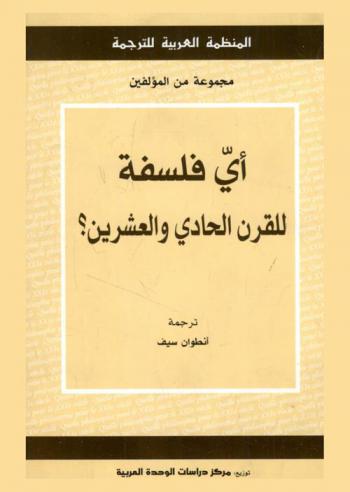
أي فلسفة للقرن الحادي والعشرين ؟ : أورغانون القرن الجديد
هو من المؤلفات الهامة، حيث يضم عشرة أبحاث ودراسات لعشرة مفكرين معاصرين، يعالج كل واحد منهم مقولة واحدة من مقولات أرسطو العشر ويقدم قراءة معاصرة لها، في محاولة للبحث عن فلسفة تشمل القرن الحادي والعشرين. ومقولات أرسطو هي : الجوهر، الكمية، الكيفية، الإضافة، المكان، الزمان، الوضع، الملك، الفعل، الانفعال. وفي الحقيقة لا يعتبر هذا العمل مشتركا، فكل واحد من هؤلاء الباحثين والمؤلفين قدم قراءة معاصرة في مقولة أرسطو بمعزل عن الآخر، وإنما جمعها في هذا الكتاب اتحاد الموضوع فقط.
BOOK

Humans, Aliens & Autism
A nasty variant was used in a disturbing autism awareness sound bite given wide distribution a couple of years ago by the advocacy organization CAN : In America, the term \"resident alien\" is used for noncitizens allowed to live and work in the United States - a term so demeaning that, colloquially, Americans tend to refer to immigrants as having a green card, rather than as being resident aliens. [...] human and alien are a tightly bonded pair.
Journal Article
Why Race Still Matters
Hacking answers questions on why race matters in so many time and places in correlation with nature, genealogy, cognitive science, empire and pollution rules. Superficial differences between races do exist in nature, and these are readily recognized.
Journal Article

Natural Kinds: Rosy Dawn, Scholastic Twilight
The rosy dawn of my title refers to that optimistic time when the logical concept of a natural kind originated in Victorian England. The scholastic twilight refers to the present state of affairs. I devote more space to dawn than twilight, because one basic problem was there from the start, and by now those origins have been forgotten. Philosophers have learned many things about classification from the tradition of natural kinds. But now it is in disarray and is unlikely to be put back together again. My argument is less founded on objections to the numerous theories now in circulation, than on the sheer proliferation of incompatible views. There no longer exists what Bertrand Russell called ‘the doctrine of natural kinds’—one doctrine. Instead we have a slew of distinct analyses directed at unrelated projects.
Journal Article
Genetics, Biosocial Groups & the Future of Identity
Paul Rabinow, the anthropologist of the genome industry, wrote about 'biosociality' in 1992.1 He invented the word partly as a joke, to counter the sociobiology that had been fashionable for some time. 3 In it, he describes Francis Galton, the genius who, among many other accomplishments (including the invention of the silent whistle for police dogs), developed a system to identify criminals using their fingerprints.
Journal Article

HOW WE HAVE BEEN LEARNING TO TALK ABOUT AUTISM: A ROLE FOR STORIES
Autism fiction has become a genre of novel-writing in its own right. Many examples are given in the essay. What does this activity do for us? There used to be no language in which autistic experience could be described. One characteristic difficulty for autistic people is understanding what other people are doing. So absence of a discourse of autistic experience is to be expected. Analyses advanced by Wolfgang Köhler and Lev Vygotsky already made plain long ago that social interaction is a precondition for a language of the inner life. One role for the wave of autism stories now being published, is to create such a language of autism. This in turn affects how autistic people think of themselves. It certainly affects how nonautistic, \"neurotypical,\" individuals think about autism. Not all of this is a good thing, for all too many stories foster images of \"the\" autistic person as having special gifts that ordinary people lack.
Journal Article