
Catalogue Search | MBRL


Are you sure you want to remove the book from the shelf?

{{itemTitle}}
80
result(s) for
"Haggerty, Sheryllynne"
Sort by:


‘Merely for Money’?
In 1780 Richard Sheridan noted that merchants worked ‘merely for money’. However, rather than being a criticism, this was recognition of the important commercial role that merchants played in the British empire at this time. Of course, merchants desired and often made profits, but they were strictly bound by commonly-understood socio-cultural norms which formed a private-order institution of a robust business culture. In order to elucidate this business culture, this book examines the themes of risk, trust, reputation, obligation, networks and crises to demonstrate how contemporary merchants perceived and dealt with one another and managed their businesses. Merchants were able to take risks and build trust, but concerns about reputation and fulfilling obligations constrained economic opportunism. By relating these themes to an array of primary sources from ports around the British-Atlantic world, this book provides a more nuanced understanding of business culture during this period. A theme which runs throughout the book is the mercantile community as a whole and its relationship with the state. This was an important element in the British business culture of this period, although this relationship came under stress towards the end of period, forming a crisis in itself. This book argues that the business culture of the British-Atlantic mercantile community not only facilitated the conduct of day-to-day business, but also helped it to cope with short-term crises and long-term changes. This facilitated the success of the British-Atlantic economy even within the context of changing geo-politics and an under-institutionalised environment. Not working ‘merely for money’ was a successful business model.
eBook


Commerce and Credit: Female Credit Networks in Eighteenth-Century Kingston, Jamaica
Recent work on white women in Jamaica has shown that they were active participants in Jamaica’s slave economy. This article adds to this recent literature through an innovative use of social network analysis (SNA) to examine the credit networks in which women operated in the thriving eighteenth-century British Atlantic town of Kingston, Jamaica. In particular, it uses closeness and centrality measures to quantify the distinctive role that white women had in local credit networks. These were different from those of men involved in transatlantic trade, but were vital in facilitating female access to credit enabling domestic retail trade. White female traders in particular facilitated female access to credit networks, acting as significant conduits of money and information in ways that were crucial to the local economy. Their connectedness within trade networks increased over time, despite their greater exposure than larger traders to economic shocks. We therefore demonstrate that white women were active protagonists in the developing economy of eighteenth-century Jamaica.
Journal Article
Networking with a Network: The Liverpool African Committee 1750–1810
Historians are increasingly using networks as an analytical framework. However, recent research has stressed the inherent problems with networks, including networking institutions. Historians therefore have to consider why and in what ways actors do, or did, engage with networks. This article posits a novel interdisciplinary methodology by bringing together regression analysis, visual analytics, and history to analyze actors’ relationships with an institution rather than with one another. This methodology, illustrated by the case study of the Liverpool African Committee, from 1750 to 1810, demonstrates that actors’ relationships with an institution may be affective or instrumental, reflecting different relationships with and uses of the network. Moreover, actors’ relationships with an institution are not static and change over time. The methodology and case study presented in this article suggest a reassessment of the understanding of metropolitan business networking institutions to reflect the complexity of their use.
Journal Article
Visual Analytics of an Eighteenth-Century Business Network
A social network consists of a finite set or sets of actors and the relation or relations defined upon them. The presence of relational information is a critical and defining feature of a social network. Historians have become increasingly interested in networks as an analytical tool for eighteenth-century commerce. In much of the historiography these networks are treated as inherently beneficial for the wider economy and the actors themselves. Recently, however, historians have started to problematize networks and to complicate our understanding of them. Indeed, the quote above stresses that a network is not simply the actors within it, but the relationships between them. Realizing this facilitates an understanding of how such networks function.
Journal Article

Merely for Money?
In 1780 Richard Sheridan noted that merchants worked ‘merely for money’. However, rather than being a criticism, this was recognition of the important commercial role that merchants played in the British empire at this time. Of course, merchants desired and often made profits, but they were strictly bound by commonly-understood socio-cultural norms which formed a private-order institution of a robust business culture. In order to elucidate this business culture, this book examines the themes of risk, trust, reputation, obligation, networks and crises to demonstrate how contemporary merchants perceived and dealt with one another and managed their businesses. Merchants were able to take risks and build trust, but concerns about reputation and fulfilling obligations constrained economic opportunism. By relating these themes to an array of primary sources from ports around the British-Atlantic world, this book provides a more nuanced understanding of business culture during this period. A theme which runs throughout the book is the mercantile community as a whole and its relationship with the state. This was an important element in the British business culture of this period, although this relationship came under stress towards the end of period, forming a crisis in itself. This book argues that the business culture of the British-Atlantic mercantile community not only facilitated the conduct of day-to-day business, but also helped it to cope with short-term crises and long-term changes. This facilitated the success of the British-Atlantic economy even within the context of changing geo-politics and an under-institutionalised environment. Not working ‘merely for money’ was a successful business model.
This book argues that a business culture based on embedded socio-cultural norms was an important element in the success of the British-Atlantic economy 1750-1815.
eBook
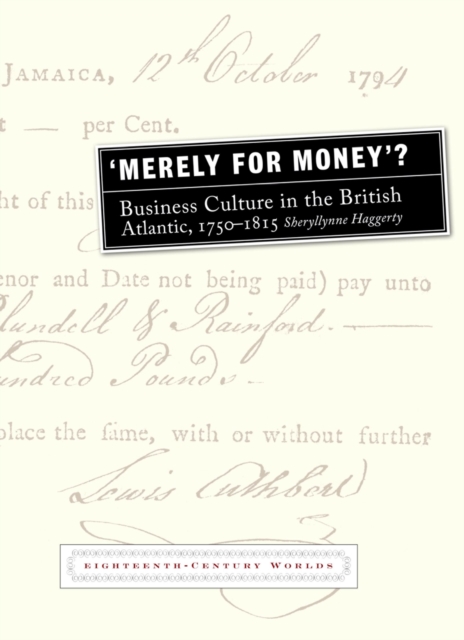
Merely for Money?: Business Culture in the British Atlantic, 1750-1815: Business Culture in the British Atlantic, 1750-1815
In 1780 Richard Sheridan noted that merchants worked 'merely for money'. However, rather than being a criticism, this was recognition of the important commercial role that merchants played in the British empire at this time. Of course, merchants desired and often made profits, but they were strictly bound by commonly-understood socio-cultural norms which formed a private-order institution of a robust business culture. In order to elucidate this business culture, this book examines the themes of risk, trust, reputation, obligation, networks and crises to demonstrate how contemporary merchants perceived and dealt with one another and managed their businesses. Merchants were able to take risks and build trust, but concerns about reputation and fulfilling obligations constrained economic opportunism. By relating these themes to an array of primary sources from ports around the British-Atlantic world, this book provides a more nuanced understanding of business culture during this period. A theme which runs throughout the book is the mercantile community as a whole and its relationship with the state. This was an important element in the British business culture of this period, although this relationship came under stress towards the end of period, forming a crisis in itself. This book argues that the business culture of the British-Atlantic mercantile community not only facilitated the conduct of day-to-day business, but also helped it to cope with short-term crises and long-term changes. This facilitated the success of the British-Atlantic economy even within the context of changing geo-politics and an under-institutionalised environment. Not working 'merely for money' was a successful business model.
eBook
Visual Analytics of an Eighteenth-Century Business Network
A social network consists of a finite set or sets of actors and the relation or relations defined upon them. The presence of relational information is a critical and defining feature of a social network. Historians have become increasingly interested in networks as an analytical tool for eighteenth-century commerce. In much of the historiography these networks are treated as inherently beneficial for the wider economy and the actors themselves. Recently, however, historians have started to problematize networks and to complicate our understanding of them. Indeed, the quote above stresses that a network is not simply the actors within it, but the relationships between them. Realizing this facilitates an understanding of how such networks function.
Journal Article