
Catalogue Search | MBRL


Are you sure you want to remove the book from the shelf?

{{itemTitle}}
4
result(s) for
"Haidt, Jonathan author"
Sort by:

The anxious generation : how the great rewiring of childhood is causing an epidemic of mental illness
\"From New York Times bestselling coauthor of The Coddling of the American Mind, an essential investigation into the collapse of youth mental health-and a plan for a healthier, freer childhood After more than a decade of stability or improvement, the mental health of adolescents plunged in the early 2010s. Rates of depression, anxiety, self-harm, and suicide rose sharply, more than doubling on most measures. Why? In The Anxious Generation, social psychologist Jonathan Haidt lays out the facts about the epidemic of teen mental illness that hit many countries at the same time. He then investigates the nature of childhood, including why children need play and independent exploration to mature into competent, thriving adults. Haidt shows how the \"play-based childhood\" began to decline in the 1980s, and how it was finally wiped out by the arrival of the \"phone-based childhood\" in the early 2010s. He presents more than a dozen mechanisms by which this \"great rewiring of childhood\" has interfered with children's social and neurological development, covering everything from sleep deprivation to attention fragmentation, addiction, loneliness, social contagion, social comparison, and perfectionism. He explains why social media damages girls more than boys and why boys have been withdrawing from the real world into the virtual world, with disastrous consequences for themselves, their families, and their societies. Most important, Haidt issues a clear call to action. He diagnoses the \"collective action problems\" that trap us, and then proposes four simple rules that might set us free. He describes steps that parents, teachers, schools, tech companies, and governments can take to end the epidemic of mental illness and restore a more humane childhood. Haidt has spent his career speaking truth backed by data in the most difficult landscapes-communities polarized by politics and religion, campuses battling culture wars, and now the public health emergency faced by Gen Z. We cannot afford to ignore his findings about protecting our children-and ourselves-from the psychological damage of a phone-based life\"-- Provided by publisher.
Book
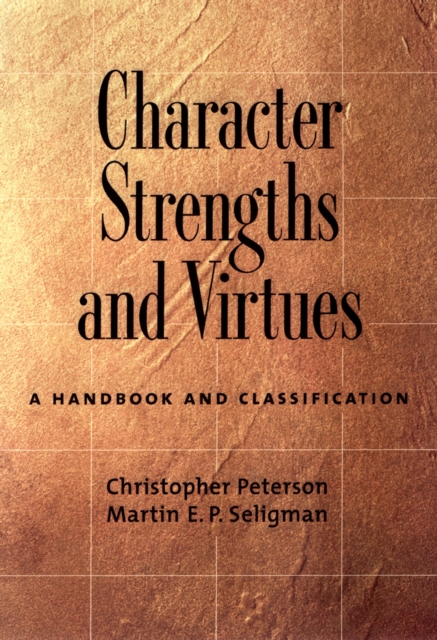
Character strengths and virtues : a handbook and classification
This groundbreaking handbook of human strengths and virtues is the first progress report from a prestigious group of researchers in the Values in Action Classification Project, which has undertaken a systematic classification and measurement of universal strengths and virtues. This landmark work makes possible for the first time a science of human strengths that goes beyond armchair philosophy and political science. The handbook begins with the background of the VIA classification scheme and defines terms before describing in thorough detail the current state of knowledge with respect to each of the 24 character strengths in the classification. Addressing issues of assessment and measurement, practical applications, and directions for future research, this work will demand the attention of any psychologist who is interested in positive psychology and its relevance to clinical, personality, and social psychology.
eBook

The coddling of the American mind : how good intentions and bad ideas are setting up a generation for failure
\"Something has been going wrong on many college campuses in the last few years. Speakers are shouted down. Students and professors say they are walking on eggshells and are afraid to speak honestly. Rates of anxiety, depression, and suicide are rising--on campus as well as nationally. How did this happen? First Amendment expert Greg Lukianoff and social psychologist Jonathan Haidt show how the new problems on campus have their origins in three terrible ideas that have become increasingly woven into American childhood and education: What doesn't kill you makes you weaker; always trust your feelings; and life is a battle between good people and evil people. These three Great Untruths contradict basic psychological principles about well-being and ancient wisdom from many cultures. Embracing these untruths--and the resulting culture of safetyism--interferes with young people's social, emotional, and intellectual development. It makes it harder for them to become autonomous adults who are able to navigate the bumpy road of life. Lukianoff and Haidt investigate the many social trends that have intersected to promote the spread of these untruths. They explore changes in childhood such as the rise of fearful parenting, the decline of unsupervised, child-directed play, and the new world of social media that has engulfed teenagers in the last decade. They examine changes on campus, including the corporatization of universities and the emergence of new ideas about identity and justice. They situate the conflicts on campus within the context of America's rapidly rising political polarization and dysfunction. This is a book for anyone who is confused by what is happening on college campuses today, or has children, or is concerned about the growing inability of Americans to live, work, and cooperate across party lines\"-- Provided by publisher.

The coddling of the American mind : how good intentions and bad ideas are setting up a generation for failure
\"Something has been going wrong on many college campuses in the last few years. Speakers are shouted down. Students and professors say they are walking on eggshells and are afraid to speak honestly. Rates of anxiety, depression, and suicide are rising--on campus as well as nationally. How did this happen? First Amendment expert Greg Lukianoff and social psychologist Jonathan Haidt [posit that] the new problems on campus have their origins in three ... ideas that have become increasingly woven into American childhood and education: what doesn't kill you makes you weaker; always trust your feelings; and life is a battle between good people and evil people\"-- Provided by publisher.
BOOK