
Catalogue Search | MBRL


Are you sure you want to remove the book from the shelf?

{{itemTitle}}
7
result(s) for
"Halenko, Nicola"
Sort by:

Thrivers and Survivors during Study Abroad: The Individual Cases of Japanese Learners of English
Whilst study abroad (SA) periods hold much promise for foreign language development, increasing research suggests sojourners’ experiences are unique, and language development does not always follow a linear trajectory. For some learners, SA has little impact on their language performance despite the affordances of L2 immersion (the Survivors). Other learners maximise the potential of SA, and this has a positive impact on their language development (the Thrivers). This paper examines the selected cases of four Japanese learners of English and their request language performance during a 10-month SA in the UK. Changes in pragmatic knowledge (based on appropriateness ratings) were documented at three equidistant time points. Language contact profile data also provided quantitative insights into the learners’ extracurricular language use and qualitative personal reflections. The selected cases illustrate two learners surviving the SA experience, showing minimal change in their request performance. The other two learners thrived during SA, showing accelerated performance in terms of lexical variation at the production level. This paper reports on the case histories of these learners to better understand these unique experiences and pragmatic discrepancies. Suggestions for how learners might be more pragmatically successful during SA are also offered.
Journal Article
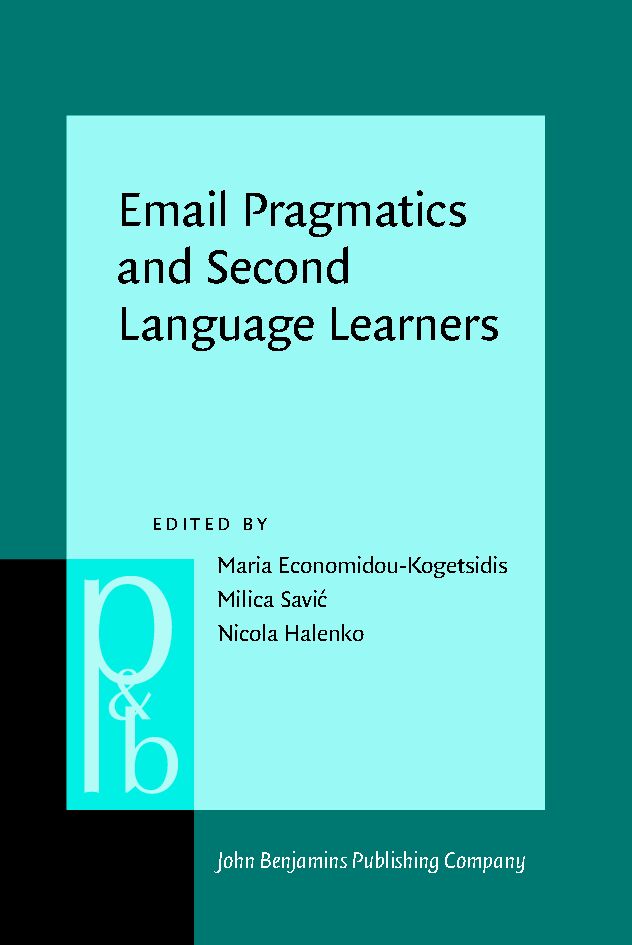
Email Pragmatics and Second Language Learners
This is the first edited collection focusing exclusively on how second language users interpret and engage with the processes of email writing. With chapters written by an international array of scholars, the present volume is dedicated to furthering the study of the growing field of L2 email pragmatics and addresses a range of interesting topics that have so far received comparatively scant attention. Utilising both elicited and naturally-occurring data, the research in this volume takes the reader from a consideration of learners' pragmatic development as reflected in email writing, and their perceptions of the email medium, to relational practices in various email functions and in a variety of academic contexts. As a whole, the contributions incorporate research with learners from a range of proficiency levels, language and cultural backgrounds, and employ varied research designs in order to examine different email speech acts. The book provides valuable new insights into the dynamic and complex interplay between cultural, interlanguage, pedagogical, and medium-specific factors shaping L2 email discourse, and it is undoubtedly an important reference and resource for researchers, graduate students and experienced language teachers.
eBook

Surveying pragmatic performance during a study abroad stay: A cross-sectional look at the language of spoken requests
This paper documents a cross-sectional look at L1 transfer and L2 contact for learners of English in a UK study abroad (SA) context. The study employed an instructional experimental design over a 6-month period with 34 Chinese students assigned to either an explicitly instructed group or a control group receiving no instruction. Instruction took place prior to departure for the UK and performance was measured based on a pretest-posttest design using an oral computer-animated production test (CAPT). This paper explores the data in two specific ways. Firstly, the request data were analysed at the pre-and delayed test stages (six months into the study abroad period) to analyse the extent to which participants’ reliance on L1 request strategies and language changes over time. Secondly, we measured the amount and type of contact with English which participants reported prior to and six months into the study abroad period. Results show that instruction facilitated development of pragmatically appropriate request language over time, with instructed learners showing significantly less reliance on L1 transfer than non-instructed learners. Contact with English increased significantly for both groups on all measures of language production but not all receptive contact with English. When compared, there was no significant difference between the groups’ contact with English at each stage, suggesting that instruction did not result in significantly more interaction with English during the study abroad period.
Journal Article

Evaluating the Explicit Pragmatic Instruction of Requests and Apologies in a Study Abroad Setting: The Case of Chinese ESL Learners at a UK Higher Education Institution
This study aimed to determine the effects of an explicit instructional treatment, within a study abroad context, for improving the spoken pragmatic competence of Chinese English as a Second Language (ESL) learners in the UK. The intervention in this study specifically focused on the speech acts of requests and apologies, and the effects of differentiated training materials, i.e., paper-based versus computer-based tasks. Instructional effects were compared to a control group receiving no instruction to further investigate the extent to which exposure to the second language environment naturally enhanced the development of request and apology language. The data were captured from 61 undergraduate Chinese learners of English. Two experimental groups (paper-based vs. computer-based training materials) participated in ten hours of explicit instruction on the linguistic and cultural aspects of making requests and apologies in an academic setting. A language contact questionnaire tracked learners’ engagement with English outside the classroom. A pretest and multiple posttest design using oral and written production tasks analysed instructional effects over time, measured against the uninstructed control group. The oral task took the format of innovative computer-based virtual role plays, which were also employed for communicative practice with one of the experimental groups. The data were: i) rated for socio-pragmatic success by experienced tutors, and ii) linguistically analysed, including identifying what were considered the essential components for successful requests and apologies. Results showed that explicit instruction was highly effective, with the group using computer-based tasks outperforming the other groups. Some evidence of attrition was found in the longer term, however. Exposure to the L2 environment facilitated little change in the production of request and apology language though increased L2 interaction appeared concomitant with prolonged L2 stay. The outcomes underline the positive benefits of explicit pragmatic instruction and technology-enhanced teaching, but indicate a need for regular input and practice opportunities for long-term retention of pragmatic knowledge.
Dissertation