
Catalogue Search | MBRL


Are you sure you want to remove the book from the shelf?

{{itemTitle}}
252
result(s) for
"Hallion, Richard"
Sort by:


The Naval Air War in Korea
“In The Naval Air War in Korea , Dr. Hallion has captured the fact, feel- ing, and fancy of a very important conflict in aviation history, in- cluding the highly significant facets of the transition from piston to jet-propelled combat aircraft.”—Norman Polmar, author of Naval Institute Guide to the Ships and Aircraft of the U.S. Fleet, 18th Edition
eBook


Strike From the Sky
Chronicles the history of battlefield air attack from 1911, when the airplane was first used in war, to the end of World War II.
eBook
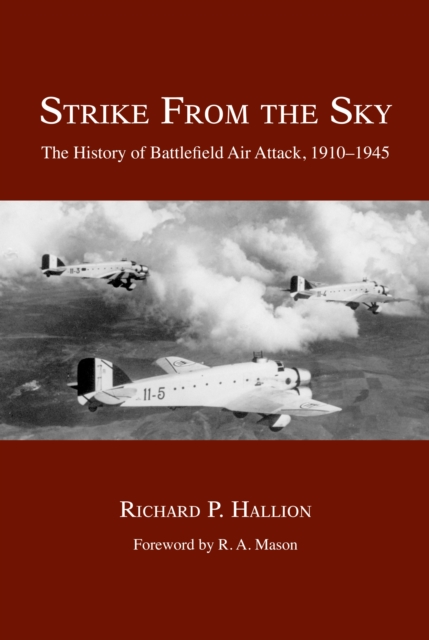
Strike from the sky: the history of battlefield air attack, 1911-1945
Chronicles the history of battlefield air attack from 1911, when the airplane was first used in war, to the end of World War II.
eBook

An Air Fighter's Scrapbook/Jagdstaffel 356: The Story of a German Fighter Squadron/Night Raiders of the Air: Being the Experiences of a Night Flying Pilot, Who Raided Hunland on Many Dark Nights During the War
An Air Fighter's Scrapbook, first published in 1938 after its author had retired from the Royal Air Force (he was recalled to duty for the Second World War), consists of a series of reflections and anecdotes conveying his impressions and experiences of flying in the war and afterwards and his opinions of friend and foe. While fighter pilot memoirs from the Great War abound, memoirs of other airmen are far less common. [...]this is a most welcome work Elisabeth Kähnert's Jagdstaffel 356 (Fighter Squadron 356), purported to be based on the thinly-disguised wartime experiences of a German pilot, is actually a work of fiction, not established fact, though it does contain a nice selection of evocative photographs of German aviators, their aircraft, and air operations.
Journal Article


Allies in Air Power
In the past century, multinational military operations have
become the norm; but while contributions from different nations
provide many benefits-from expanded capability to political
credibility-they also present a number of challenges. Issues such
as command and control, communications, equipment standardization,
intelligence, logistics, planning, tactics, and training all
require consideration. Cultural factors present challenges as well,
particularly when language barriers are involved.
In Allies in Air Power, experts from around the world
survey these operations from the birth of aviation to the present
day. Chapters cover conflicts including World War I, multiple
theaters of World War II, the Korean War, the Vietnam War, the Gulf
War, Kosovo, the Iraq War, and various United Nations peacekeeping
missions. Contributors also analyze the role of organizations such
as the UN, NATO, and so-called \"coalitions of the willing\" in
laying the groundwork for multinational air operations.
While multinational military action has become commonplace,
there have been few detailed studies of air power cooperation over
a prolonged period or across multiple conflicts. The case studies
in this volume not only assess the effectiveness of multinational
operations over time, but also provide vital insights into how they
may be improved in the future.
eBook

The future of air power
Hallion discusses the future of aerospace power, noting that term necessarily includes consideration of space-based navigation. He describes how aerospace power, particularly for long-range joint strike operations, will become of even greater significance as the importance of information technology increases.
Journal Article

THE AIR WAR IN KOREA
The Korean air war constituted the last significant non-air-refuelled air war, and this created a major problem at the war’s outset for those seeking to employ air power effectively in South Korea’s defence. While the air-refuelling issue did not strongly influence United States Air Force (USAF) bomber operations, it had a profound impact upon the USAF’s tactical air power application, particularly after the North Korean People’s Army (NKPA) had overrun most of South Korea’s airfields. As a result, naval aviation power projection from carriers was essential in preventing communist forces from completely overrunning the Korean Peninsula. Air superiority operations, including
Book Chapter