
Catalogue Search | MBRL


Are you sure you want to remove the book from the shelf?

{{itemTitle}}
65
result(s) for
"Halpérin, Jean-Louis"
Sort by:

From Durkheim to Jellinek
Abstract In his 1887 report about the positivist science of morals in Germany, Durkheim referred to two books: Der Zweck im Recht by Rudolf von Jhering and Die socialetische Bedeutung von Recht, Unrecht und Strafe by Georg von Jellinek. Despite the absence of commentary from Durkheim about this 1878 book from the ‘young’ Jellinek (later known as a master of public law), the analysis of this dissertation (rejected by the University of Vienna) shows that it contained a claim for a social-science-inspired understanding of crime and penalty and had some points of contact with Durkheim's argumentation, notably about the importance of religious feelings in the social reaction against crimes. The article proposes to deepen this comparison between Jellinek's and Durkheim's books with an investigation about their indirect sources.
Journal Article

Personal Laws: Undetermined Norms and Undetermined Concept?
Many Asian and African constitutional and statutory texts use the phrase personal laws in order to determine the rules applicable to family matters such a marriage, divorce, maintenance and in some countries inheritance. However, this term is extremely vague and often without a clear definition in the legal texts. This paper tries to show the high degree of un-determination of the statutory references to personal laws. This chaotic situation can be explained by historical and political factors. Nevertheless, the paper proposes to stipulate a conventional definition of personal laws in order to facilitate the comparison between the Asian and African countries with a plurality of personal laws. Based on common features of these legal systems knowing a plurality of personal laws, such a definition can be useful for practical as well as for theoretical purposes.
Journal Article
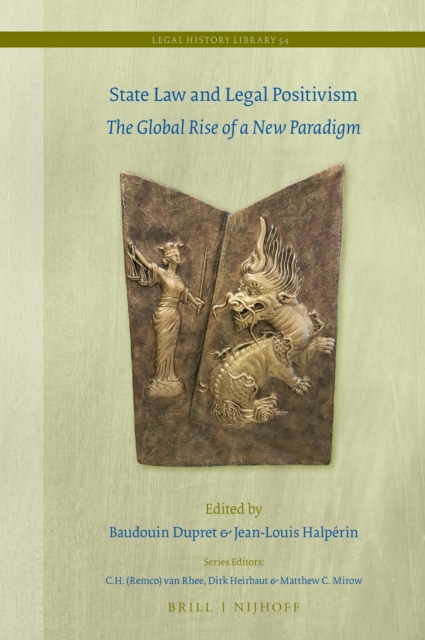
State law and legal positivism : the global rise of a new paradigm
There was a truly global revolution that reflected a Great Divide between ancient and new legal regimes. The volume emphasizes its depth and scale and explores the phenomenon in the contexts of Morocco, Egypt, India, the Ottoman empire, China, and Japan.
eBook

For a Renewed History of Lawyers
Considering a relative reluctance of legal historians to study the evolution of the sociology of lawyers during different periods of the past, this paper tries to draw up the guidelines for renewed research about legal education, day-to-day work of judges, attorneys or professors and influence of lawyers.
Journal Article

Les sources du droit, source de la légende ?
La démonstration de Francesca Trivellato, dans Juifs et capitalisme, part du premier chapitre des Us et coustumes de la mer d’Étienne Cleirac (1647) consacré à l’assurance et à la lettre de change. Les difficultés à intégrer ces deux instruments du droit commercial au sein du système des sources de tradition romaniste conduisent Cleirac à en attribuer l’invention aux Juifs. Cette opération essentiellement technique d’ajustement de la systématique des sources du droit entre néanmoins en consonance avec une mentalité répandue parmi la société des époques moderne puis contemporaine. En montrant le rôle des juristes dans l’élaboration d’une légende antisémite, le livre de F. Trivellato suscite une réflexion sur les apports réciproques développés ces dernières années entre l’histoire des idées et l’histoire du droit.
Journal Article

Du statut au contrat
Cet article propose de remettre en perspective le projet de LPPR dans l'évolution des textes législatifs et réglementaires concernant l'Université (depuis 1808) et la recherche (depuis les années 1930). Cette analyse du discours juridique dans la longue durée montre la lente émergence des garanties statutaires pour les enseignants et les chercheurs, comme le passage au second plan des règles statutaires à travers les récents codes de l'éducation et de la recherche. Une évolution du statut au contrat que la LPPR ne ferait qu'aggraver dangereusement.
This paper proposes to put into perspective the draft LPPR (loi de programmation pluriannuelle de la recherche) and to consider its place within the evolution of statutory laws and regulations concerning the University (from 1808) and research (from the 1930s). This analysis of the legal discourse over the long term shows the slow emergence of statutory guarantees for professors and researchers, as well as the secondary place assigned to these guarantees by the recent \"Code de l'éducation\" and \"Code de la recherche\"; an evolution from statute to contract that the LPPR threatens to seriously accelerate.
Journal Article

Une géographie comparée du droit sans ou avec les États ?
Jusqu’à maintenant les auteurs se revendiquant de « droit et géographie » ont adopté une position critique à l’égard du positivisme juridique, affirmant qu’il fallait abandonner les comparaisons classiques réduites à des normes étatiques à l’intérieur de frontières nationales. Après avoir clarifié les définitions possibles du positivisme juridique, cet article entend faire la part entre les reproches justifiés adressés à la notion ancienne de « familles de droit » et les apories auxquelles conduisent les idées radicales de dépassement des frontières et de complète autonomie des ordres juridiques non étatiques. Plaidant pour un pluralisme, dans lequel ordres juridiques étatiques et non étatiques interagissent, l’article propose de renouveler la géographie du droit sur deux terrains. Le premier consiste à établir de nouvelles grilles de lecture pour comparer les systèmes juridiques des États. Le second correspond à la comparaison des différentes formes de zonage à l’intérieur des États. L’élaboration de cartes à titre d’hypothèses paraît particulièrement adaptée à ces collaborations entre droit et géographie qui pourrait conduire à une réflexion sur la densité des conflits juridiques. Until now, the advocates of » Law and Geography » have adopted a critical viewpoint towards legal positivism : they have claimed that one has to abandon the classical comparison reduced to state norms inside national frontiers. After clarifying the possible definitions of legal positivism, this article tries to strike a balance between the justified reproaches towards the old notion of « legal families » and the shortcomings to which the radical ideas of extending beyond national borders or those of complete autonomy of non-state legal orders. Pleading for a pluralism, in which the state and non-state legal orders are interacting, the paper proposes to relaunch legal geography on two fields. The first one consists in establishing new tools for reading and comparing the legal orders of States. The second one corresponds to the comparison of different forms of zoning organized by legal norms inside the States. The making of maps presenting sets of hypotheses seems particularly adapted to these types of collaboration between law and geography that could lead to a reflexion about the density of legal conflicts.
Journal Article
Les sources du droit, source de la légende ?
La démonstration de Francesca Trivellato, dans Juifs et capitalisme , part du premier chapitre des Us et coustumes de la mer d’Étienne Cleirac (1647) consacré à l’assurance et à la lettre de change. Les difficultés à intégrer ces deux instruments du droit commercial au sein du système des sources de tradition romaniste conduisent Cleirac à en attribuer l’invention aux Juifs. Cette opération essentiellement technique d’ajustement de la systématique des sources du droit entre néanmoins en consonance avec une mentalité répandue parmi la société des époques moderne puis contemporaine. En montrant le rôle des juristes dans l’élaboration d’une légende antisémite, le livre de F. Trivellato suscite une réflexion sur les apports réciproques développés ces dernières années entre l’histoire des idées et l’histoire du droit. Francesca Trivellato’s analysis begins with the first chapter of Étienne Cleirac’s Us et coustumes de la mer (1647), focusing on insurance and bills of exchange. The difficulties of integrating these two instruments of commercial law into the framework set out in Romanist legal sources led Cleirac to attribute their invention to Jews. This essentially technical endeavor to adjust the system of legal sources was nevertheless in line with the prevailing mindset of the early modern period, and that of the centuries that followed. By revealing the role of jurists in crafting an antisemitic narrative, The Promise and Peril of Credit prompts a reflection on the reciprocal contributions in recent years between intellectual history and legal history.
Journal Article

From Durkheim to Jellinek
In his 1887 report about the positivist science of morals in Germany, Durkheim referred to two books: Der Zweck im Recht by Rudolf von Jhering and Die socialetische Bedeutung von Recht, Unrecht und Strafe by Georg von Jellinek. Despite the absence of commentary from Durkheim about this 1878 book from the ‘young’ Jellinek (later known as a master of public law), the analysis of this dissertation (rejected by the University of Vienna) shows that it contained a claim for a social-science-inspired understanding of crime and penalty and had some points of contact with Durkheim’s argumentation, notably about the importance of religious feelings in the social reaction against crimes. The article proposes to deepen this comparison between Jellinek’s and Durkheim’s books with an investigation about their indirect sources.
Journal Article
