
Catalogue Search | MBRL


Are you sure you want to remove the book from the shelf?

{{itemTitle}}
25
result(s) for
"Hamlin, Amanda"
Sort by:
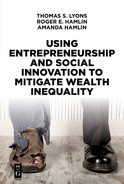
Using Entrepreneurship and Social Innovation to Mitigate Wealth Inequality
Economic inequality continues to contribute to political and social instability around the world. This instability stifles development and results in widening the wealth gap between the \"haves\" and \"have nots,\" further eroding stability. It has been argued that entrepreneurship is a prime contributor to this vicious cycle. Using Entrepreneurship and Social Innovation to Mitigate Wealth Inequality contends that this is only true when the opportunity for entrepreneurship is limited to a few. The authors maintain that when entrepreneurship is open to anyone who is properly motivated, innovative, and has a goal of growth for their enterprise, it helps build wealth for a greater number of people. The concept of \"social entrepreneurship\" is introduced, where entrepreneurship becomes a vehicle for explicitly addressing community-based economic and social challenges using markets. The book uses examples of entrepreneurial projects and programs that have attempted to address inequality to discuss entrepreneurship as an economic development strategy and its role in addressing the challenges of economic inequality. It advocates thinking and acting systemically, creating and sustaining entrepreneurial support ecosystems, in order to generate the synergy required to scale-up development and transform our economies and provides a distinctive perspective on a pressing social and economic issue, with significant implications for the future of the United States and the world.
eBook

Liberating the Read-Aloud: Supporting Teachers' Critical Literacy Practice Around Race, Ethnicity, and Equity
This study followed the course of a professional development intervention to support kindergarten teachers in using a critical literacy approach to teach their students about race, ethnicity, and equity. The purpose of the design-based intervention, which took place in a diverse but somewhat racially segregated school district, was to empower students to critique discrimination, racism, and systems of inequity. The research itself aimed to gain insight into how and to what degree teacher-participants took on an anti-racist teaching role through participation in a collaborative professional learning community “study group.” The study that found that White participants employed many and various rationales to demarcate boundaries around what they were comfortable with and willing to teach. Despite White participants’ ambitious goals for societal change through shaping student attitudes, their avoidance and resistance limited the curriculum they ultimately taught. Implications of the study include the importance of balancing consciousness-raising and White racial identity development efforts with anti-racist classroom actions for White teacher education. Additionally, the process of conducting this study shed light on ways to improve the intervention for future iterations. Keywords: Critical literacy, early childhood, professional development, race, ethnicity, equity, White racial identity development
Dissertation