
Catalogue Search | MBRL


Are you sure you want to remove the book from the shelf?

{{itemTitle}}
639
result(s) for
"Har, Jason"
Sort by:
Advances in computational dynamics of particles, materials and structures
Computational methods for the modeling and simulation of the dynamic response and behavior of particles, materials and structural systems have had a profound influence on science, engineering and technology.
eBook

An Overview and Recent Advances in Vector and Scalar Formalisms: Space/Time Discretizations in Computational Dynamics—A Unified Approach
An overview of recent advances in computational dynamics for modeling and simulation is described. The targeted objectives are towards a wide variety of science and engineering applications in particle and continuum dynamics of structures and materials which fall in this class. Starting with the supposition that in the beginning, the well known Newton’s law of motion for N-body systems is given, and is a statement of the principle of balance of linear momentum, subsequently, using this as a landmark, firstly, the principal relations to various other distinctly different fundamental principles which are of primary interest here are established. Likewise, for continuum dynamics of structures, via the principle of balance of linear momentum, analogous developments are also established. Consequently, these distinctly different fundamental principles are shown to serve as the starting point for the various developments. Stemming from three distinctly different fundamental principles, we present recent advances in N-body dynamical systems, and also continuous-body dynamical systems with focus on numerical aspects in space/time discretization. The fundamental principles are the following: the Principle of Virtual Work in Dynamics, Hamilton’s Principle and as an alternate (due to inconsistencies associated with Hamilton’s principle), Hamilton’s Law of Varying Action, and the Principle of Balance of Mechanical Energy. Both vector and scalar formalisms are described in detail with particular focus towards general numerical discretizations in space and/or time for N-body and continuum-elastodynamics applications which are encountered in a wide class of holonomic-scleronomic problems. The formulations include the classical Newtonian mechanics framework with vector formalism, and new scalar formalisms with descriptive functions such as the Lagrangian, the Hamiltonian, and the Total Mechanical Energy to readily enable numerical discretizations. The concepts emanating from the present developments and distinctly different fundamental principles inherently: (1) can independently be shown to yield the strong form of the governing mathematical model equations of motion that are continuous in space and/or time together with the natural boundary conditions; the various frameworks for the case of holonomic-scleronomic systems with the mentioned limitations are indeed all equivalent, (2) can explain naturally how the weak statement of the Bubnov-Galerkin weighted-residual form that is customarily employed for discretization with vector formalism arises for both space and time, and (3) can circumvent relying upon traditional practices of conducting numerical discretizations starting either from balance of linear momentum (Newton’s second law) involving Cauchy’s equations of motion (governing equations) arising from continuum mechanics or via (1) and (2) above if one chooses this option. The concepts instead provide new avenues for numerical space/time discretization for continuum-dynamical systems or time discretization for N-body systems, and consequently, they enable equivalences to be drawn from amongst the various frameworks under certain restrictions to provide a unified approach and viewpoint. In addition, for the time discretization, focusing attention upon the class of Linear Multi Step (LMS) methods which are the most popular in research and commercial software, we particularly describe from a unified viewpoint, new avenues of discretization of the equations of motion via a new Total Energy framework. The resulting developments lead to improved physical insight, inherit computationally attractive features for developing algorithms by design, and new and optimal algorithm designs, while recovering most of the developments that currently exist from traditional and/or classical practices.
Journal Article
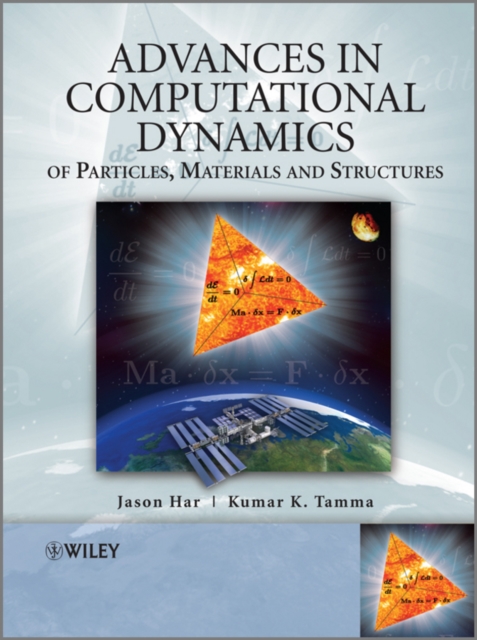
Advanced Computational Dynamics of Particles, Materials, and Structures: A Unified Approach
Computational methods for the modeling and simulation of the dynamic response and behavior of particles, materials and structural systems have had a profound influence on science, engineering and technology. Complex science and engineering applications dealing with complicated structural geometries and materials that would be very difficult to treat using analytical methods have been successfully simulated using computational tools. With the incorporation of quantum, molecular and biological mechanics into new models, these methods are poised to play an even bigger role in the future. Advances in Computational Dynamics of Particles, Materials and Structures not only presents emerging trends and cutting edge state-of-the-art tools in a contemporary setting, but also provides a unique blend of classical and new and innovative theoretical and computational aspects covering both particle dynamics, and flexible continuum structural dynamics applications. It provides a unified viewpoint and encompasses the classical Newtonian, Lagrangian, and Hamiltonian mechanics frameworks as well as new and alternative contemporary approaches and their equivalences in [start italics]vector and scalar formalisms[end italics] to address the various problems in engineering sciences and physics. Highlights and key features Provides practical applications, from a unified perspective, to both particle and continuum mechanics of flexible structures and materials Presents new and traditional developments, as well as alternate perspectives, for space and time discretization Describes a unified viewpoint under the umbrella of Algorithms by Design for the class of linear multi-step methods Includes fundamentals underlying the theoretical aspects and numerical developments, illustrative applications and practice exercises The completeness and breadth and depth of coverage makes Advances in Computational Dynamics of Particles, Materials and Structures a valuable textbook and reference for graduate students, researchers and engineers/scientists working in the field of computational mechanics; and in the general areas of computational sciences and engineering.
eBook
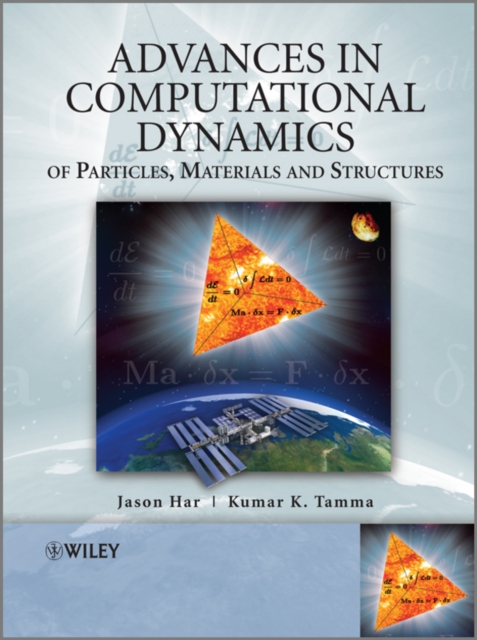
Advanced computational dynamics of particles, materials, and structures
Computational methods for the modeling and simulation of the dynamic response and behavior of particles, materials and structural systems have had a profound influence on science, engineering and technology. Complex science and engineering applications dealing with complicated structural geometries and materials that would be very difficult to treat using analytical methods have been successfully simulated using computational tools. With the incorporation of quantum, molecular and biological mechanics into new models, these methods are poised to play an even bigger role in the future. Advances in Computational Dynamics of Particles, Materials and Structures not only presents emerging trends and cutting edge state-of-the-art tools in a contemporary setting, but also provides a unique blend of classical and new and innovative theoretical and computational aspects covering both particle dynamics, and flexible continuum structural dynamics applications. It provides a unified viewpoint and encompasses the classical Newtonian, Lagrangian, and Hamiltonian mechanics frameworks as well as new and alternative contemporary approaches and their equivalences in [start italics]vector and scalar formalisms[end italics] to address the various problems in engineering sciences and physics. Highlights and key features Provides practical applications, from a unified perspective, to both particle and continuum mechanics of flexible structures and materials Presents new and traditional developments, as well as alternate perspectives, for space and time discretization Describes a unified viewpoint under the umbrella of Algorithms by Design for the class of linear multi-step methods Includes fundamentals underlying the theoretical aspects and numerical developments, illustrative applications and practice exercises The completeness and breadth and depth of coverage makes Advances in Computational Dynamics of Particles, Materials and Structures a valuable textbook and reference for graduate students, researchers and engineers/scientists working in the field of computational mechanics; and in the general areas of computational sciences and engineering.
eBook

Total energy framework, finite elements, and discretization via Hamilton’s law of varying action
Within the total energy framework which we introduce here for the first time (in contrast to Lagrangian or Hamiltonian mechanics framework), we provide an alternative and have developed in this paper a general numerical discretization for continuum-elastodynamics directly stemming from Hamilton’s law of varying action (HLVA) involving a measurable built-in scalar function, namely, Total Energy
. The Total Energy we use herein for enabling the space discretization is defined as the kinetic energy plus the potential energy for N-body systems, and the kinetic energy plus the total potential energy for continuum-body systems. It thereby provides a direct measure and sound physical interpretation naturally, while enabling this framework to permit general numerical discretizations such as with finite elements. In the variational formulation proposed here, we place particular emphasis upon the notion that the scalar function which represents the autonomous total energy of the continuum/N-body dynamical systems can be a crucial mathematical function and physical quantity which is a constant of motion in conservative systems. In addition, we prove that the autonomous total energy possesses the three invariant properties and can be viewed as the so-called total energy version of Noether’s theorem; therefore, the autonomous total energy has time/translational/rotational symmetries for the continuum/N-body dynamical systems. The proposed concepts directly emanating from HLVA inherently involving the scalar function, namely, total energy: (i) can be shown to yield the same governing mathematical model equations of motion that are continuous in space and time together with the natural boundary conditions just as Hamilton’s principle (HP) is routinely used to derive such equations, but without obvious inconsistency via such a principle as explained in the paper; (ii) explain naturally the Bubnov–Galerkin weighted-residual form that is customarily employed for discretization for both space and time, and alternately, (iii) circumvent relying on traditional practices of conducting numerical discretizations starting either from the balance of linear momentum (Newton’s second law) involving Cauchy’s equations of motion (governing equations) arising from continuum mechanics or via (i) and (ii) above if one chooses this option, and instead provides new avenues of discretization for continuum-dynamical systems. The present developments naturally embody the weak form in space and time that can be described by a discrete Total Energy Differential Operator (TEDO). Thereby, a novel yet simple, space-discrete Total Energy formulation proposed here only needs to employ the discrete TEDO which provides new avenues and directly yields the semi-discrete ordinary differential equations in time which can be readily shown to preserve the same physical attributes as the continuous systems for continuum-dynamical applications unlike traditional practices. The modeling of complicated structural dynamical systems such as Euler-Bernoulli beams and Reissner–Mindlin plates is particularly shown here for illustration.
Journal Article
Finite element formulations using the theorem of power expended: total energy framework with a differential formulation
Traditional practices involving variational calculus have historically dominated most finite element formulations to-date, and have no doubt served as indispensable tools. Besides these practices, our recent contributions in Acta Mechanica (Har and Tamma, 2009, in press) described new alternatives and developments emanating from Hamilton’s Law of Varying Action (HLVA) as a starting point with a measurable built-in scalar function, namely, the Total Energy. The associated framework (in contrast to Lagrangian or Hamiltonian mechanics framework) demonstrated certain new advances, and also provided some fundamental insight into explaining traditional practices of finite element discretization. Here we additionally provide other advances, new directions, and viable alternatives in contrast to all these past practices which routinely employ variational concepts. In particular, focusing on elastodynamics applications, in this paper we provide for the first time finite element formulations stemming instead from a differential formulation and the theorem of power expended with a measurable built-in scalar function, namely, the Total Energy
, as a starting point to capitalize on certain added advantages. The autonomous total energy has time/translational/rotational symmetries for the continuum/
N
-body dynamical systems. The proposed concepts: (i) can be shown to yield the same governing mathematical model equations of motion that are continuous in space and time together with the natural boundary conditions just as balance laws such as linear momentum or Hamilton’s principle are routinely used to derive such equations, but without resorting to any variational concepts, or approaches such as variational principles, (ii) explain naturally how the classical Bubnov–Galerkin weighted-residual form that is customarily employed for discretization can be readily constructed for both space and time, and alternately, (iii) circumvents relying on traditional practices of conducting numerical discretizations starting either from the balance of linear momentum (Newton’s law) involving Cauchy’s equations of motion (governing equations) arising from continuum mechanics or via (1) and (2) above, and instead provides new avenues of discretization for continuum-dynamical systems. For illustration, numerical discretizations are presented for the modeling of complicated structural dynamical systems.
Journal Article

A parallel finite element procedure for contact-impact problems
An efficient parallel finite element procedure for contact-impact problems is presented within the framework of explicit finite element analysis with thepenalty method. The procedure concerned includes a parallel Belytschko-Lin-Tsay shell element generation algorithm and a parallel contact-impact algorithm based on the master-slave slideline algorithm. An element-wise domain decomposition strategy and a communication minimization strategy are featured to achieve almost perfect load balancing among processors and to show scalability of the parallel performance. Throughout this work, a prototype code, named GT-PARADYN, is developed on the IBM SP2 to implement the procedure presented, under message-passing paradigm. Some examples are provided to demonstrate the timing results of the algorithms, discussing the accuracy and efficiency of the code.[PUBLICATION ABSTRACT]
Journal Article

A new scalable parallel finite element approach for contact-impact problems
Parallel processing using a multiple instruction multiple data (MIMD) parallel computer is a promising approach to the solution of contact-impact problems, which usually requires several hundred hours of CPU time on pipelined vector super-computers to simulate structural behaviors. The goal of this research is to advance contact-impact analysis through improved nonlinear mechanics combined with the development of new parallel algorithms to achieve better accuracy and efficiency. The underlying focus of the method is on its effectiveness and efficiency for inclusion in future finite element systems implemented in parallel computers. For scalable parallel processing, a domain decomposition algorithm and an interprocessor communication minimization are explored in the strategy. A prototype code, named GT-PARADYN, is developed and implemented to investigate the behavior of nonlinear shell structures in contact using the IBM SP2, a distributed-memory multicomputer, and MPI, a standard message passing interface. A new and improved scalable parallel contact-impact finite element method is presented for implementation on future parallel computers.
Dissertation