
Catalogue Search | MBRL


Are you sure you want to remove the book from the shelf?

{{itemTitle}}
31
result(s) for
"Hardy, Jessica K."
Sort by:

Using Positive Reinforcement With Young Children
Positive reinforcement is a research-based practice essential for supporting young children’s use of appropriate behaviors and skills. The application of positive reinforcement also is consistent with recommendations by national organizations for early childhood and early childhood special education. In this article, we describe eight guidelines for planning, implementing, and evaluating positive reinforcement in early childhood contexts that are based on current research and recommendations of these professional organizations. Examples of the use of guidelines and tools for supporting implementation are provided.
Journal Article

Comparing the Effects of Protagonist Race on Preschoolers’ Engagement in Book Reading
In the current study, single case research methodology was used to examine whether preschool children’s engagement in book reading activities was greater when the protagonist in the book was of the same or different race as the child participant. Initiations, accurate responses to questions, passive engagement, teacher redirections, and child preference were measured. There was no functional relation demonstrating children’s engagement was greater when read books with protagonists of a corresponding race to the child. However, the non-experimental measure of preference demonstrated that children, when given an opportunity, more often chose books with a protagonist of the same race. Findings are discussed relative to the common recommendation in early childhood education to use diverse children’s books.
Journal Article
Preparation of Early Childhood Special Education Personnel: Alignment with Personnel Preparation Guidance
Preparation of early childhood special educators, including early interventionists, includes knowledge and application of different practices than either early childhood generally or school-age special education. Several organizations, including the Division of Early Childhood of the Council for Exceptional Children, have identified relevant recommended practices and personnel preparation guidelines. Faculty in early childhood special education and early intervention programs were surveyed to determine how program development and delivery align with recommended practices and personnel preparation guidelines. Forty-seven respondents completed the survey and results indicate variable alignment with personnel preparation guidance. Future directions for the field are provided.
Journal Article
Coaching Quality in Pre-kindergarten Classrooms: Perspectives from a Statewide Study
Forty-nine coaches, 947 teachers, and 189 administrators in a state-wide prekindergarten program responded to survey questions about coaching dosage and activities. The survey responses were aligned with the Coaching Quality Framework, an organization of characteristics of quality coaching proposed by the authors, and analyzed to identify similarities and differences in stakeholders’ perspectives of coaching. The vast majority of coaches, teachers, and administrators surveyed agreed that coaching was an effective professional development strategy for supporting teachers’ use of evidence-based practices. Coaches and teachers responded similarly to questions of dosage and many of the coaching quality indicators. Coaches and teachers disagreed on some aspects of the coaching activities, particularly planning for coaching, that may affect the perceptions and effectiveness of coaching. Qualitative analyses of coach and teacher responses reveal programmatic planning components that support or impede coaching. These results have implications for how coaches, teachers, and administrators prepare for large-scale coaching.
Journal Article

The Effects of Play-Based Intervention on Vocabulary Acquisition by Preschoolers at Risk for Reading and Language Delays
Closing the vocabulary gap for young children at risk for reading and language delays due to low socioeconomic status may have far reaching effects, as the relationship between early vocabulary knowledge and later academic achievement has been well-established. Vocabulary instruction for young children at risk for reading and language delays during classroom play is understudied, but appears to be a useful context for such interventions. A multiple probe design across behaviors replicated across participants was conducted to evaluate the effects of Enhanced Milieu Teaching (EMT) techniques embedded in play sessions on target vocabulary word acquisition for preschool participants. Participants acquired target word sets in an average of 14 sessions, which, in addition to a book with target vocabulary, included interventionist’s use of the words in conversation and prompts to use target words in play routines. Implications for vocabulary instruction during play and future research are included.
Journal Article
What Equivocal Data From Single Case Comparison Studies Reveal About Evidence-Based Practices in Early Childhood Special Education
Although comparison studies are important in early intervention/early childhood special education (EI/ECSE), results of well-designed comparison studies are likely to be unpublished because of undifferentiated or differently differentiated results across participants. The purpose of this article is to highlight the utility of comparison designs in the identification of evidence-based interventions for individual children. We present results from three single case comparative studies analyzing embedded and massed-trial instruction, high- and low-fidelity instruction, and small group versus 1:1 instruction conducted in ECSE settings. All participants learned all targeted behaviors in both instructional conditions and learned no behaviors assigned to control conditions. Results suggest that evidence-based practices are not a “one-size-fits-all” conclusion and that data-based decision making is critical even when empirically supported interventions are used.
Journal Article

Preparing Yourself for Coaching
The data the coach records while observing provide objective information about your teaching and children's behavior and learning. Some teachers prefer to watch videos with the coach, while others prefer for each partner to watch separately and then meet to review their individual observations and reflections. * As with the in-person observation, talk with your coach about what she will be looking for in the videos. ABOUT THE AUTHORS Ragan McLeod, PhD, is an assistant professor in the Department of Special Education and Multiple Abilities at the University of Alabama. Ragan has worked on national projects to develop coaching materials and deliver trainings that support implementation of coaching in early childhood programs. rhmcleod@ua.edu Kathleen Artman-Meeker, PhD, is an assistant professor in the College of Education at the University of Washington, Seattle. Kathleen has worked on national projects designing and researching best practices in coaching. kameeker@uw.edu Jessica K. Hardy, PhD, is an assistant professor in the College of Education and Human Development at the University of Louisville, in Kentucky. \"Effects of Distance Coaching on Teachers' Use of Pyramid Model Practices: A Pilot Study.\" National Association for the Education of Young Children. \"Effects of Web-Mediated Professional Development Resources on Teacher-Child Interactions in PreKindergarten Classrooms.\"
Journal Article
Inclusion of Infants and Toddlers: Perspectives from Childcare Providers
Infants, toddlers, and two-year-olds with disabilities or developmental delays often participate in center-based childcare. Just like other care and education settings, childcare for very young children should provide high-quality inclusion. To date, minimal research has been conducted on practitioner perspectives about inclusion in childcare for very young children, and no study has explored childcare practitioners’ use of inclusive practices to include very young children with disabilities. The purpose of this study was to explore childcare practitioners’ perceptions of their role and practices used to facilitate inclusion. We used a qualitative approach, interviewing childcare practitioners in one Midwest community about their experiences with inclusion. We found that childcare practitioners in this study perceived that inclusion involves close proximity of children with and without disabilities, teachers using individualized practices, and collaboration between adults (e.g., families, colleagues, administration). Some participants stated equity was important for inclusion, while others emphasized the need for equality. Participants also believed inclusive practices should support children’s identities, such as by teaching children about disability or culture. These views generally align with the tenets of early childhood inclusion (access, participation, supports). Implications include the need to support childcare practitioners in developing shared views of inclusion that supports all children in their work.
Journal Article

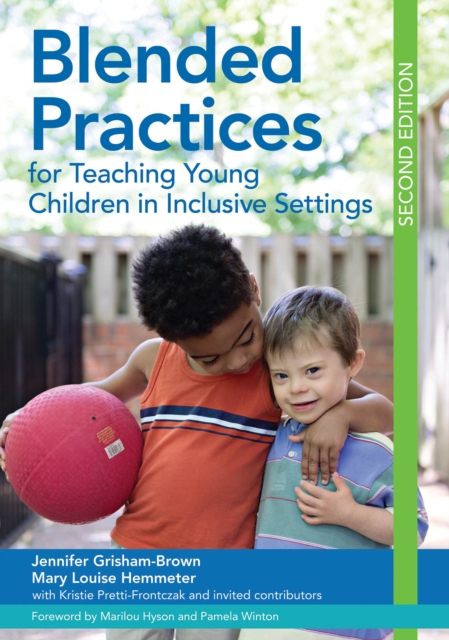
Blended Practices for Teaching Young Children in Inclusive Settings
As more and more early childhood settings implement inclusive practices, teachers need to blend special and general education techniques to help all children learn. They'll find out how with the new edition of this bestselling text, which combines today's best practices for teaching young children with and without disabilities into one comprehensive approach. Ideal for current and future early childhood educators working with children from ages 2 to 5, this comprehensive text provides explicit guidance on developing a successful curriculum framework, working effectively with families and other team members, tailoring instruction to each child's individual needs, and embedding learning opportunities that address all children's goals. Teachers will learn from the field's most current research, and they'll get a full continuum of strategies for teaching young children with diverse abilities. Practical information on authentic assessment and data-driven decision-making is also woven throughout the book. An essential reference to keep and use for years to come, this book is every early childhood educator's guide to blending the best of special and general education, developing effective curricula, and improving outcomes for all children. WHAT'S NEW
* Increased focus on how to implement multi-tiered systems of support (MTSS)
* New chapters on applying blended practices in specific content areas: language, literacy, social-emotional skills, and math
* The latest on state and federal funding initiatives for early childhood—and how to maintain quality practices that align with these initiatives
* More guidance on determining the scope and sequence of what to teach children
* Current recommendations from key professional organizations like NAEYC and DEC, and their implications for teachers
USER-FRIENDLY FEATURES: Includes visual aids and sample forms, vignettes and practical examples that illustrate key concepts and guiding principles, helpful summaries for each chapter, case studies, and learning activities that challenge students to test and expand their knowledge. See how this product helps strengthen Head Start program quality and school readiness.
eBook