
Catalogue Search | MBRL


Are you sure you want to remove the book from the shelf?

{{itemTitle}}
189
result(s) for
"Harris, Trudier"
Sort by:

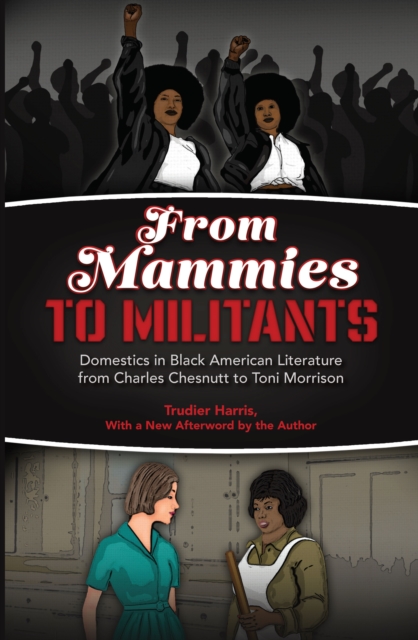
From Mammies to Militants
Welfare queen, hot momma, unwed mother: these stereotypes of Black women share their historical conception in the image of the Black woman as domestic. Focusing on the issue of stereotypes, the new edition of Trudier Harris's classic 1982 study From Mammies to Militants examines the position of the domestic in Black American literature with a new afterword bringing her analysis into the present. From Charles Chesnutt's The Marrow of Tradition to Toni Morrison's The Bluest Eye, Black writers, some of whom worked as maids themselves, have manipulated the stereotype in a strategic way as a figure to comment on Black-white relations or to dramatize the conflicts of the Black protagonists. In fact, the characters themselves, like real-life maids, often use the stereotype to their advantage or to trick their oppressors. Harris combines folkloristic, sociological, historical, and psychological analyses with literary ones, drawing on her own interviews with Black women who worked as domestics. She explores the differences between Northern and Southern maids and between \"mammy\" and \"militant.\" Her invaluable book provides a sweeping exploration of Black American writers of the twentieth century, with extended discussion of works by Charles Chesnutt, Kristin Hunter, Toni Morrison, Richard Wright, Ann Petry, William Melvin Kelley, Alice Childress, John A. Williams, Douglas Turner Ward, Barbara Woods, Ted Shine, and Ed Bullins. Often privileging political statements over realistic characterization in the design of their texts, the authors in Harris's study urged Black Americans to take action to change their powerless conditions, politely if possible, violently if necessary. Through their commitment to improving the conditions of Black people in America, these writers demonstrate the connectedness of art and politics. In her new afterword, \"From Militants to Movie Stars,\" Harris looks at domestic workers in African American literature after the original publication of her book in 1982. Exploring five subsequent literary treatments of Black domestic workers from Ernest J. Gaines's A Lesson Before Dying to Lynn Nottage's By the Way, Meet Vera Stark, Harris tracks how the landscape of representation of domestic workers has broken with tradition and continues to transform into something entirely new.
eBook

Christianity’s Last Stand: Visions of Spirituality in Post-1970 African American Women’s Literature
Christianity appealed to writers of African descent from the moment they set foot on New World soil. That attraction, perhaps as a result of the professed mission of slaveholders to “Christianize the heathen African,” held sway in African American letters well into the twentieth century. While African American male writers joined their female counterparts in expressing an attraction to Christianity, black women writers, beginning in the mid-twentieth century, consistently began to express doubts about the assumed altruistic nature of a religion that had been used as justification for enslaving their ancestors. Lorraine Hansberry’s Beneatha Younger in A Raisin in the Sun (1959) initiated a questioning mode in relation to Christianity that continues into the present day. It was especially after 1970 that black women writers turned their attention to other ways of knowing, other kinds of spirituality, other ways of being in the world. Consequently, they enable their characters to find divinity within themselves or within communities of extra-natural individuals of which they are a part, such as vampires. As this questioning and re-conceptualization of spirituality and divinity continue into the twenty-first century, African American women writers make it clear that their characters, in pushing against traditional renderings of religion and spirituality, envision worlds that their contemporary historical counterparts cannot begin to imagine.
Journal Article

Martin Luther King Jr., Heroism, and African American Literature
Examines how representations of Martin Luther King Jr.'s character and persona in works of African American literature have evolved and reflect the changing values and mores of African American culture African American writers have incorporated Martin Luther King Jr.into their work since he rose to prominence in the mid-1950s.
eBook

South of tradition : essays on African American literature
With characteristic originality and insight, Trudier Harris-Lopez offers a new and challenging approach to the work of African American writers in these twelve previously unpublished essays. Collectively, the essays show the vibrancy of African American literary creation across several decades of the twentieth century. But Harris-Lopez's readings of the various texts deliberately diverge from traditional ways of viewing traditional topics.
South of Tradition focuses not only on well-known writers such as Zora Neale Hurston, Ralph Ellison, James Baldwin, and Richard Wright, but also on up-and-coming writers such as Randall Kenan and less-known writers such as Brent Wade and Henry Dumas. Harris-Lopez addresses themes of sexual and racial identity, reconceptualizations of and transcendence of Christianity, analyses of African American folk and cultural traditions, and issues of racial justice. Many of her subjects argue that geography shapes identity, whether that geography is the European territory many blacks escaped to from the oppressive South, or the South itself, where generations of African Americans have had to come to grips with their relationship to the land and its history. For Harris-Lopez, south of tradition refers both to geography and to readings of texts that are not in keeping with expected responses to the works. She explains her point of departure for the essays as a slant, an angle, or a jolt below the line of what would be considered the norm for usual responses to African American literature.
The scope of Harris-Lopez's work is tremendous. From her coverage of noncanonical writers to her analysis of humor in the best-selling The Color Purple , she provides essential material that should inform all future readings of African American literature.
eBook
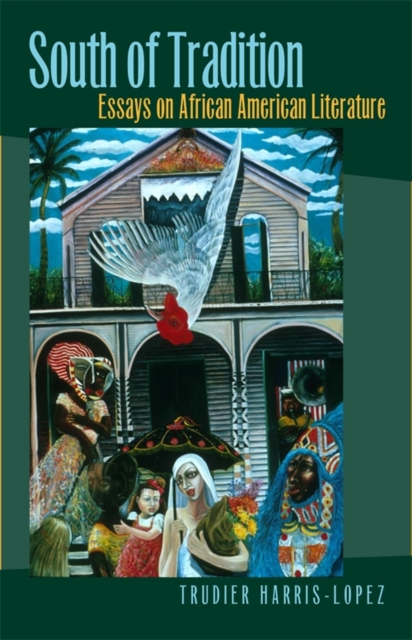
South of Tradition
With characteristic originality and insight, Trudier Harris-Lopez offers a new and challenging approach to the work of African American writers in these twelve previously unpublished essays. Collectively, the essays show the vibrancy of African American literary creation across several decades of the twentieth century. But Harris-Lopez's readings of the various texts deliberately diverge from traditional ways of viewing traditional topics. South of Tradition focuses not only on well-known writers such as Zora Neale Hurston, Ralph Ellison, James Baldwin, and Richard Wright, but also on up-and-coming writers such as Randall Kenan and less-known writers such as Brent Wade and Henry Dumas. Harris-Lopez addresses themes of sexual and racial identity, reconceptualizations of and transcendence of Christianity, analyses of African American folk and cultural traditions, and issues of racial justice. Many of her subjects argue that geography shapes identity, whether that geography is the European territory many blacks escaped to from the oppressive South, or the South itself, where generations of African Americans have had to come to grips with their relationship to the land and its history. For Harris-Lopez, \"south of tradition\" refers both to geography and to readings of texts that are not in keeping with expected responses to the works. She explains her point of departure for the essays as \"a slant, an angle, or a jolt below the line of what would be considered the norm for usual responses to African American literature.\" The scope of Harris-Lopez's work is tremendous. From her coverage of noncanonical writers to her analysis of humor in the best-selling The Color Purple, she provides essential material that should inform all future readings of African American literature.
eBook

When Art Devolves into Horniness and Pimping: Reflections upon Questionable Creativity in Ntozake Shange's “a photograph: lovers in motion”
Harris reflects upon questionable creativity in Ntozake Shange's \"a photograph: lovers in motion.\" The play becomes an interesting mixture of declarations in contrast to actions, professions of art instead of the achievement of art, sex in the place of love/art, class distinctions in education/lifestyle, and disturbing stereotypes that invariably raise questions about Shange's overall objective in creating such characters. From the beginning of \"a photograph\" and Sean's declaration of the status he hopes to achieve as a photographer, it is clear that, though he may take numerous photographs, he is missing some key ingredient in terms of what it takes to make a true commitment to artistic achievement.
Journal Article


AUN' PEGGY: CHARLES CHESNUTT'S VAMPIRE SLAYER?
[...]their actions echo those of traditional vampires: any concern for physical well-being was directly tied to the individual's ability to provide the labor (sustaining blood) which the system of slavery rested. [...]many of the punishments and other physical violations that occurred were designed specifically to cause dis-ease and to induce acquiescence in those enslaved. The buying and selling of human beings obviously reinforce the idea of slavery as a vampire that sucks the life blood out of persons of African descent, for it unconscionably separates parents and children, wives and husbands, and those with any other relationship bonds. [...]of selling and buying Henry, Mars Dugal' earns enough money to buy another plantation. \" \" THE BUYING AND SELLING OF HUMAN BEINGS OBVIOUSLY REINFORCE THE IDEA OF SLAVERY AS A VAMPIRE THAT SUCKS THE LIFE BLOOD OUT OF PERSONS OF AFRICAN DESCENT, FOR IT UNCONSCIONABLY SEPARATES PARENTS AND CHILDREN, WIVES AND HUSBANDS, AND THOSE WITH ANY OTHER RELATIONSHIP BONDS.
Journal Article

Alice Walker's 'Roselily': Meditations on Culture, Politics, and Chains
First of all, Roselily appears an almost forced, involuntary participant in her own wedding ceremony, while persons historically who found themselves in a call and response situation were usually receptive to that occurrence. The man who stands beside her is against this standing on the front porch of her house, being married to the sound of cars whizzing by on highway 61. While it might be an option for Roselily, it is one that she is not liable to take, for her desire to escape Panther Burn, Mississippi and her limited possibilities there leads her to ignore warning signs and acquiesce to self-erasure in exchange for economic security and rest from the sewing plant. Since epigraphs usually overlay, explain, connote, or connect thematically to whatever follows them, it is reasonable to conclude that Ahurole's situation is intended to shed light on the situations of the women in In Love and Trouble, including Roselily's.
Journal Article