
Catalogue Search | MBRL


Are you sure you want to remove the book from the shelf?

{{itemTitle}}
87
result(s) for
"Harrow, Susan"
Sort by:


In it together, in Zola? Empathic Encounters in Naturalist Fiction
At a time when the \"empathy turn\" is bringing disciplines from psychology to philosophy, and from ethics to literary studies, into ever-closer dialogue, Zola's fiction offers intriguing, complex examples of empathy. Framing my reading of three major novels of Zola relative to contemporary narrative empathy studies and broader societal concerns around empathy, I demonstrate how the Naturalist empathic narrative mobilizes the reader in the act of reimagining the experience and the values of fictional characters. In the process, Zola's fiction reveals the paradoxes and tensions of the empathy encounter, drawing the reader into a more problematized exploration of \"feeling with\" that anticipates debates in empathy studies today.
Journal Article

Modernist Monstrosity in Rimbaud’s Verse and Prose Poetry
Rimbaud's poetry and poetics contribute to the prodigious genealogy of monstrosity in Western literature and visual culture. This article argues that monster figures - whether the \"familiar\" terrors of iconographic tradition, horrible hybrids, or everyday bogeymen - are central to the transformative momentum of modernism in Rimbaud's verse and prose poetry. Monstrosity - multifariously embodied and endlessly morphing - generates social, cultural, and political fantasy, challenging orthodoxies, displacing structures, and empowering readers. Through the lacerating light it projects on forms of cultural constraint and aesthetic (self-) limitation, monstrosity is revealed as the force capable of re-visioning poetry and of deepening our equivocal sense of what it is to be human.
Journal Article

‘Je suis de race inférieure de toute éternité’: Towards a Postcolonial Reading of Rimbaud
This reading goes in search of a postcolonial consciousness in the structures and rhetoric of poetry. The dual aim is to consider how key values in contemporary postcolonial thought may shed fuller light on the poetry that Rimbaud wrote between 1870 and 1873, and, reciprocally, to explore how Rimbaud's modernist poetic writing may illuminate postcolonial concerns prospectively. In a wider disciplinary context, this article illustrates the critical scope of postcolonial readings in a genre area—poetry (both verse and prose)—that is traditionally marginalized by the privileging of literary fiction in postcolonial studies.
Journal Article

The Material, the Real, and the Fractured Self
InThe Material, the Real, and the Fractured Self, Susan Harrow explores the fascinating interrelation of subjectivity, materiality, and representation in the poetry and related texts of four modern French writers: Arthur Rimbaud, Guillaume Apollinaire, Francis Ponge, and Jacques Réda. She demonstrates the richness and the relevance of modern French poetry for today's readers, putting contemporary thought to work on the fractured self emerging in the post-Baudelairian lyric.
Harrow addresses the widely perceived marginalization of poetry in the writing/theory debate, demonstrating that the emergence of a self at once shaped by and straining against material, historical, subjective, and cultural impediments reveals fertile relations between theory and poetry. Where purer forms of postmodernist thinking have stressed the dissolution and dispersal of the human subject, new approaches informed by cultural studies, autobiography theory, and gender studies work to recover fictions of experience and retrieve submerged narratives of the self. Probing the activity of textual self-recovery among the debris of history and fantasy, visuality and desire, and culture and corporeality,The Material, the Real, and the Fractured Selfimparts something of the startling beauty and the raw urgency of poetry writing across the broad modern period.
eBook

Thinking Madame Raquin: Consciousness and Cognition in Émile Zola's Thérèse Raquin (1867)
An immersive reading of the elderly matriarch figure in Émile Zola's Thérèse Raquin (1867) demonstrates how representations of old age in nineteenth-century French fiction can benefit from cognitive literary-critical approaches. Putting to work key concepts from this fast-developing field (affordances, propinquity, cognitive adaptability, and embedded thinking) allows us to reveal the complex trajectory of consciousness and the inverse correlation of Madame Raquin's physical incapacity and her mental and imaginative adaptation. Literary cognitive approaches can thus enable a fuller problematization of Naturalism, while Zola's fiction offers a situational understanding of consciousness in old age that challenges clichés of cognitive rigidity and depreciation.
Journal Article
Living Alone Together
Assessing Barthes’s relevance in an applied context, this article explores Comment vivre ensemble (1976–77) in relation to a corpus that is rarely exploited for its discursive and fantasmatic values – a writer’s correspondence. How does Barthes’s model help us gain a fuller understanding of Émile Zola’s representation of his desire to balance the quality of privacy conducive to creativity and the pleasures of sociability? How, in turn, might reading Zola’s correspondence through the figures of Comment vivre ensemble enable us to extend and inflect Barthes’s model? These questions inform my study of the tensions between living individually and living socially through two writers fascinated by micro-history and fantasmatically immersed in the everyday worlds of collectivities and individuals.
Journal Article
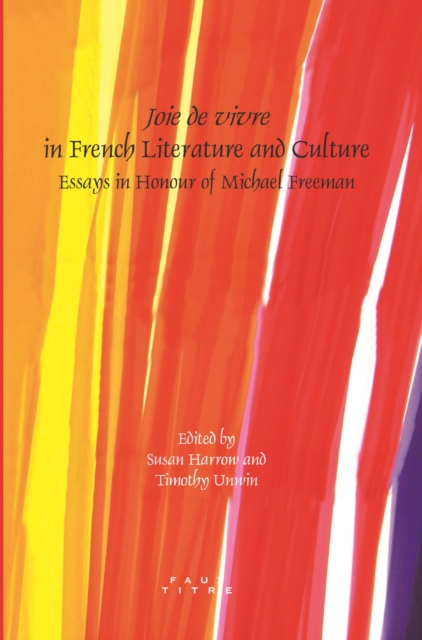
Joie de Vivre in French Literature and Culture
The apparent self-sufficiency of joie de vivre means that, despite the widespread use of the phrase since the late nineteenth century, the concept has rarely been explored critically. Joie de vivre does not readily surrender itself to examination, for it is in a sense too busy being what it is. However, as the essays in this collection reveal, joie de vivre can be as complex and variable a state as the more negative emotions or experiences that art and literature habitually evoke. This volume provides an urgently needed study of an intriguing and under-explored area of French literature and culture from the Middle Ages to the contemporary era. While the range and content of contributions embraces linguistics, literature, art, sport and politics, the starting point is, like that of the term joie de vivre itself, in French language and culture. This volume will be of special interest to researchers across the full range of French studies, from literature and language to cultural studies. It will be of direct appeal to specialist readers, university libraries, graduate and undergraduate students, and general readers with a lively interest in French literature and culture of the medieval, early modern and broad modern periods. This book's fresh perspectives on the theme of joie de vivre and its relation to questions of privacy, contemplation, voyeurism, feasting and nationhood will also be of relevance to researchers in comparative and cognate disciplines.
eBook

Colorsteps in Modern and Contemporary French Poetry
Unlike our co-workers in film, history of art, textile studies or musicology, literary researchers are remote from those perceptual and pleasurable pressure points that may be acoustic, tactile or visual, and which, in this instance, are prismatic.2 Color practice is a blind spot in contemporary critical readings of French poetry and poetic writing, a paradoxical situation given critics' attentiveness to the interact and intermedial significance - manifest and latent - of French modern poetic practice.3 The obscuring of color is anomalous, too, given our concern to bring into dialogue concepts and tropes drawn from cognate research disciplines as part of a wider arts and humanities project.4 Our \"color blindness\" as critics is ironic when counterpoised with the sustained reflection of modern and contemporary poets on the color-practice of painters, and the alertness of poets to their own verbal engagement with color.5 Yves Bonnefoy 's Le Nuage rouge: Dessin, couleur et lumière (1977) and Francis Ponge's U Atelier contemporain (1977) are signal contributions to the reading of Renaissance and modern painting, while René Char's work with Miró on Flux de l'aimant (1964) exemplifies the livre d'artiste, and Bonnefoy's collaboration with Geneviève Asse for Début et fin de la neige (1991) illuminates the interart impetus of twentieth-century poetic innovation.6 And then there are the myriad instances where poetry, with or without a direct pictorial referent, moves beyond the evocation of the enduring tropes of art, such as landscape, and begins to reflect on the visual quality of poetry and its potential to stir acts of chromatic imagining in its narrators and its readers.
Journal Article