
Catalogue Search | MBRL


Are you sure you want to remove the book from the shelf?

{{itemTitle}}
5
result(s) for
"Hart, Kevin, 1954- author"
Sort by:

Barefoot
\"Barefoot is Kevin Hart's eighth collection of poems; it is rich in elegies, meditations on lost love, and celebrations of new love. The title speaks of mourning, pilgrimage, and the direct sensuous contact of flesh with earth. Harold Bloom has long extolled Hart as a \"visionary of desire,\" and in this collection we find that vision deepened and that desire extended. Never before has Hart stretched his range of inspiration quite so far; while continuing to draw from Christianity, he also responds to the rich heritage of American Blues, and reveals a wit as sharp as a razor's edge. The poetry is at once religious poetry and love poetry; indeed, the \"religious poetry\" is itself love poetry. Always, Hart speaks to us in words that seem inevitable in their simplicity. As he himself has written, \"The best conductor of mystery is clarity. The true bearer of complexity is simplicity.\" Barefoot will delight poetry lovers everywhere\"--Provided by publisher.
Book
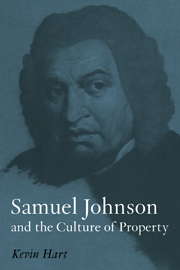
Samuel Johnson and the Culture of Property
Kevin Hart traces the vast literary legacy and reputation of Samuel Johnson. Through detailed analyses of the biographers, critics and epigones who carefully crafted and preserved Johnson's life for posterity, Hart explores the emergence of what came to be called 'The Age of Johnson'. Hart shows how late seventeenth- and early eighteenth-century Britain experienced the emergence and consolidation of a rich and diverse culture of property. In dedicating himself to Johnson's death, Hart argues, James Boswell turned his friend into a monument, a piece of public property. Through subtle analyses of copyright, forgery and heritage in eighteenth-century life, this study traces the emergence of competing forms of cultural property: a Hanoverian politics of property engages a Jacobite politics of land. Kevin Hart places Samuel Johnson within this rich cultural context, demonstrating how Johnson came to occupy a place at the heart of the English literary canon.
eBook

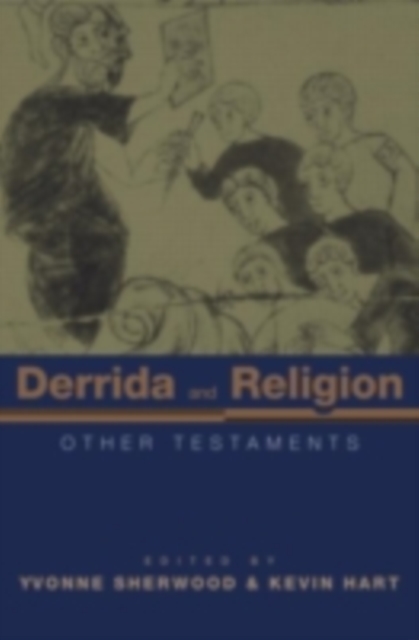
Derrida and Religion
Derrida and Religion: Other Testaments represents the most comprehensive attempt to date to explore, adapt, and test Derrida's contributions and influence on the study of theology, biblical studies, and the philosophy of religion. With over twenty original essays from highly-respected scholars such as John Caputo, Daniel Boyarin, Edith Wyschogrod, Tim Beal, and Gil Anidjar, Derrida and Religion will quickly become the locus classicus for those interested in the increasingly vibrant work on religion and deconstruction and postmodernism.
Yvonne Sherwood is Lecturer in the Department of Theology and Religious Studies at the University of Glasgow. Kevin Hart is Professor of English at Notre Dame.
eBook

Political Writings, 1953-1993
Maurice Blanchot is a towering yet enigmatic figure in twentieth-century French thought. A lifelong friend of Levinas, he had a major influence on Foucault, Derrida, Nancy, and many others. Both his fiction and his criticism played a determining role in how postwar French philosophy was written, especially in its intense concern with the question of writing as such. Never an academic, he published most of his critical work in periodicals and led a highly private life. Yet his writing included an often underestimated public and political dimension.This posthumously published volume collects his political writings from 1953 to 1993, from the French-Algerian War and the mass movements of May 1968 to postwar debates about the Shoah and beyond. A large number of the essays, letters, and fragments it contains were written anonymously and signed collectively, often in response to current events. The extensive editorial work done for the original French edition makes a major contribution to our understanding of Blanchot's work.The political stances Blanchot adopts are always complicated by the possibility that political thought remains forever to be discovered. He reminds us throughout his writings both how facile and how hard it is to refuse established forms of authority.The topics he addresses range from the right to insubordination in the French-Algerian War to the construction of the Berlin Wall and repression in Eastern Europe; from the mass movements of 1968 to personal responses to revelations about Heidegger, Levinas, and Robert Antelme, among others.When read together, these pieces form a testament to what political writing could be: not merely writing about the political or politicizing the written word, but unalterably transforming the singular authority of the writer and his signature.
eBook