
Catalogue Search | MBRL


Are you sure you want to remove the book from the shelf?

{{itemTitle}}
3
result(s) for
"Harvey, Frank P. (Frank Paul), 1962-, author"
Sort by:

Fighting for credibility : US reputation and international politics
\"When Bashar al-Assad used chemical weapons against his own people in Syria, he clearly crossed President Barack Obama's \"red line.\" At the time, many argued that the president had to bomb in order to protect America's reputation for toughness, and therefore its credibility, abroad; others countered that concerns regarding reputation were overblown, and that reputations are irrelevant for coercive diplomacy. Whether international reputations matter is the question at the heart of Fighting for Credibility. For skeptics, past actions and reputations have no bearing on an adversary's assessment of credibility; power and interests alone determine whether a threat is believed. Using a nuanced and sophisticated theory of rational deterrence, Frank P. Harvey and John Mitton argue the opposite: ignoring reputations sidesteps important factors about how adversaries perceive threats. Focusing on cases of asymmetric US encounters with smaller powers since the end of the Cold War including Bosnia, Kosovo, Iraq, and Syria, Harvey and Mitton reveal that reputations matter for credibility in international politics. This dynamic and deeply documented study successfully brings reputation back to the table of foreign diplomacy.\"-- Provided by publisher.
Book
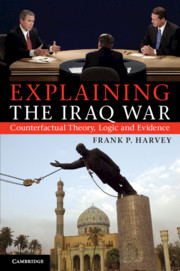
Explaining the Iraq War
The almost universally accepted explanation for the Iraq War is very clear and consistent - the US decision to attack Saddam Hussein's regime on March 19, 2003 was a product of the ideological agenda, misguided priorities, intentional deceptions and grand strategies of President George W. Bush and prominent 'neoconservatives' and 'unilateralists' on his national security team. Despite the widespread appeal of this version of history, Frank P. Harvey argues that it remains an unsubstantiated assertion and an underdeveloped argument without a logical foundation. His book aims to provide a historically grounded account of the events and strategies which pushed the US-UK coalition towards war. The analysis is based on both factual and counterfactual evidence, combines causal mechanisms derived from multiple levels of analysis and ultimately confirms the role of path dependence and momentum as a much stronger explanation for the sequence of decisions that led to war.
eBook
Future's Back
Arguing that previous critiques of rational choice and deterrence theory are not convincing, Frank Harvey constructs a new set of empirical tests of rational deterrence theory to illuminate patterns of interaction between rival nuclear powers. He analyses the crisis management techniques used by the United States and the Soviet Union in twenty-eight post-war crises and isolates factors that promote or inhibit escalation of these crises. This \"crises\"-based data set serves as the basis for identifying patterns of response when one nuclear state is threatened by another.
eBook